
What is the probability that, starting from around 50 newspaper clippings, it is possible to isolate 7 elements, each taken from a different page, such that they form a semantically coherent word (in this case related to the Jubilee and the theme of the liberation of slaves), and that this same word, through a fixed-key shift, transforms into a meaningful term like “SLAVES”, accompanied by a numerical value consistent with the number of victims attributed to the Monster of Florence?
It is precisely from this question that this thread originates: I would like to present an analysis and get your opinion; to be honest, I really need some feedback to understand whether this could be the result of chance or a deliberate construction by the author. I will try to keep this as concise as possible.
As suggested by the title, I believe I may have identified, in the envelope of a letter officially attributed to the Monster of Florence, a possible coded message that recalls the “victim count”, or more precisely a count of his “slaves”, in a style reminiscent of the Zodiac Killer.
The analysis is relatively brief and I will try not to take too much of your time, but for clarity I have divided it into three parts in order to provide the necessary context:
- Brief overview of the Monster of Florence case;
- The envelope sent to prosecutor Silvia Della Monica;
- The possible encrypted message.
If you are already familiar with both the Monster of Florence case and the envelope, feel free to skip directly to part 3.
1. Brief overview of the Monster of Florence
The Monster of Florence is the name given to an unidentified killer believed to be responsible for a series of murders committed between 1968 and 1985 in the countryside around Florence. In total, eight double homicides are attributed to him, for a total of sixteen victims.
It should be noted, however, that not all researchers agree on attributing the first double murder (1968) to the same perpetrator, as it shows some differences compared to the later modus operandi. There is, instead, much broader agreement in linking the crimes committed between 1974 and 1985 to the same individual, due to the clear similarities between them.
The attacks followed a fairly consistent pattern: the victims were mostly couples parked in secluded areas. The killer used a .22 caliber pistol to carry out the murders and, in several cases, subsequently used a knife to mutilate the bodies, particularly those of the female victims, in post-mortem acts that contributed to the particularly disturbing nature of the case.
Despite lengthy and complex investigations, numerous suspects, and multiple trials over the years, no definitive and widely accepted identification of the perpetrator has ever been reached, making the case one of the most debated and controversial in Italian criminal history.
2. The envelope sent to prosecutor Silvia Della Monica
The envelope sent to prosecutor Silvia Della Monica represents one of the most intriguing and disturbing elements connected to the case.
Delivered in 1985 to the Prosecutor’s Office in Florence, the envelope bore the recipient’s name and address composed from newspaper clippings, following a method typical of anonymous communications. Inside, there was also an anatomical fragment belonging to one of the victims of the last double murder, an element that directly linked the envelope to the perpetrator.
Over the years, other anonymous letters potentially connected to the Monster of Florence have surfaced, but this is the only one generally considered authentic, precisely because of its concrete connection to the crimes.
3. The possible encrypted message
In 2020, 35 years after the events, an independent researcher, V. Vecchione, managed to identify the magazine from which the clippings used to compose the envelope had been taken.
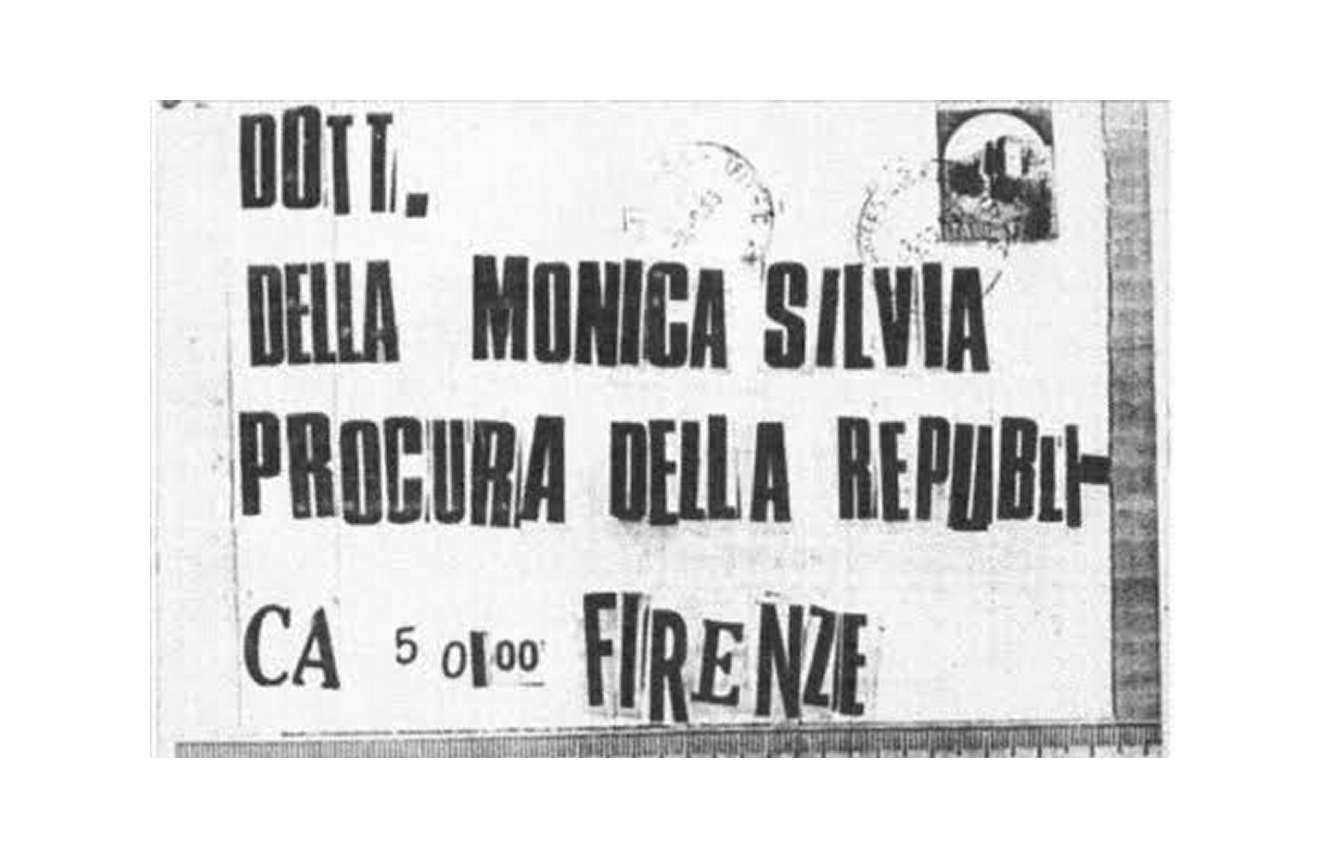
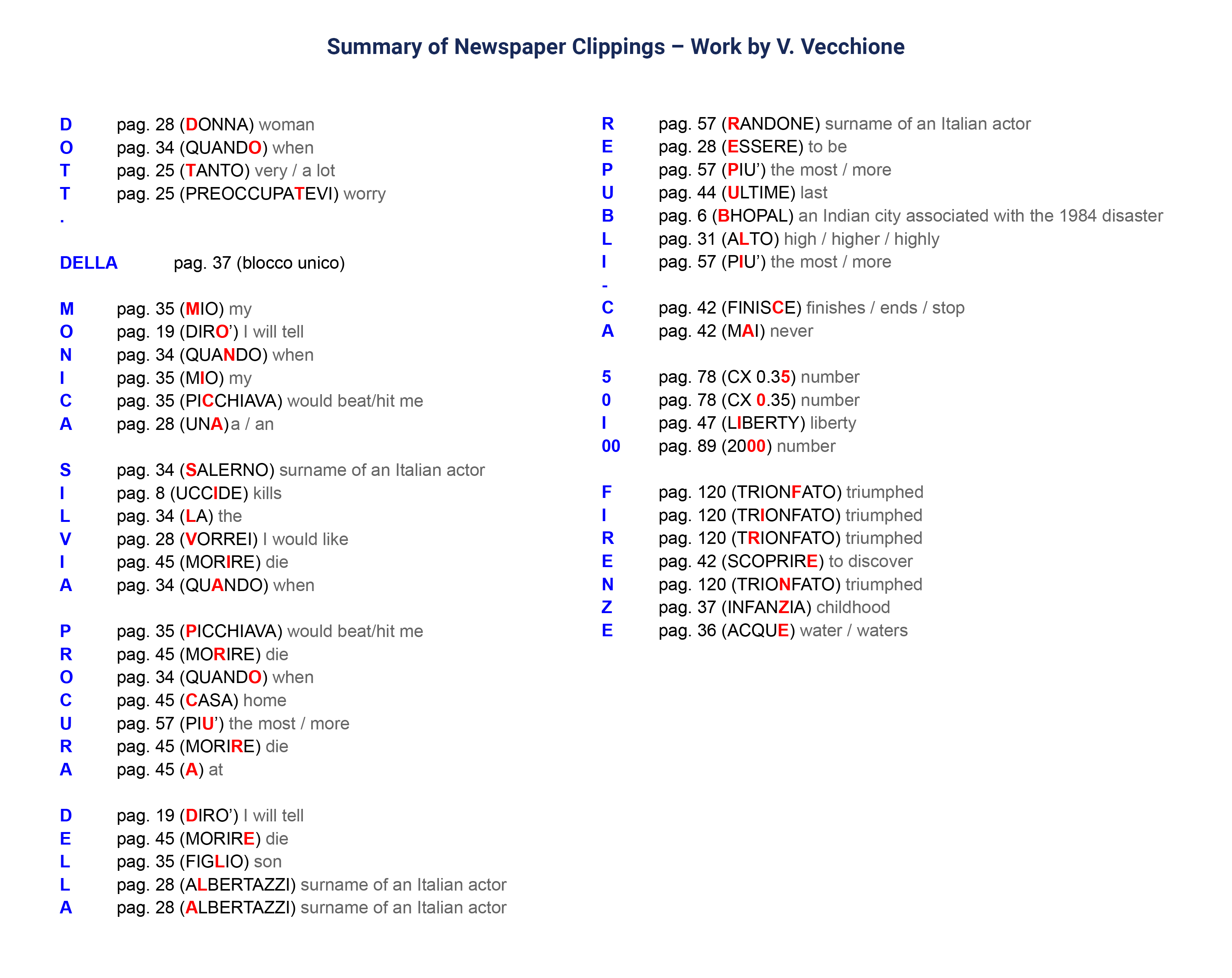
Through a very detailed reconstruction process, she identified, for each clipping, the exact page and the original word from which it had been extracted. It emerged that many letters came from words related to violence and death, such as “uccide” (kills), “morire” (to die), and “picchiava” (was beating).
At the same time, by analyzing the reverse side of the clippings, she observed the presence of content referring to themes such as the afterlife, paradise, and water. In particular, the last two letters of the word “firenZE” derive from:
- the letter Z, on the back of which there is an advertisement for “Zenith” watches
- the letter E, taken from the word “acquE” (water)
Overall, this combination of elements has led to the hypothesis of possible symbolic references to the world of the Zodiac Killer, such as the concept of “Paradice”, references to watches, and the so-called “water theory”.
I would like to emphasize that the work described above was entirely carried out by V. Vecchione, who, through considerable dedication and a significant investment of time, was able to reconstruct the origin of the clippings used in the envelope.
She is responsible both for identifying the source magazine and for mapping each individual clipping, including the page number and the original word from which it was taken. The summary table shown below is therefore entirely based on her research.
In the table, the letters used in the envelope are highlighted in blue; for each one, the page of origin is indicated, along with the original Italian word (with the extracted letter highlighted in red), and, in light gray, I have added an English translation.
Starting from this reconstruction work, I noticed an element that I find particularly interesting: while in some pages multiple letters were cut out, there are also cases where only a single letter was selected from a single page. These are precisely the “isolated” clippings that I highlight in yellow:
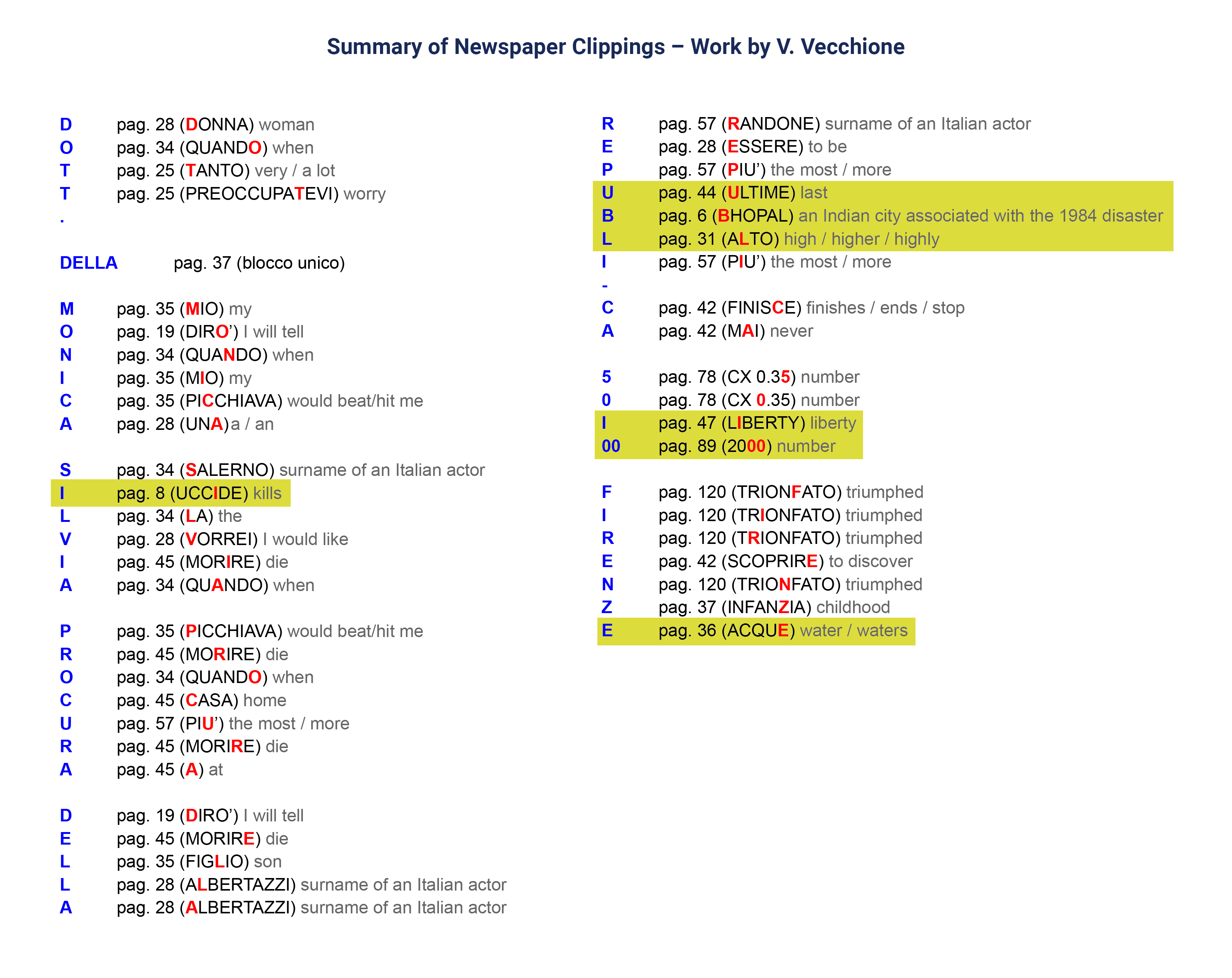
I will now list only the characters taken individually:
I (p. 8 – “SILVIA”)
U (p. 44 – “REPUBLICA”)
B (p. 6 – “REPUBLICA”)
L (p. 31 – “REPUBLICA”)
I (p. 47 – “50I00”)
00 (p. 89 – “50I00”)
E (p. 36 – “FIRENZE”)
Sequence: I U B L I 00 E
Assuming A=0 encoding, “00” can be read as A:
I U B L I A E
A simple anagram gives:
I U B I L A E
“IUBILAE” is not a correct Latin form, but it clearly recalls iubilaeum, the term from which “Jubilee” derives.
In the biblical context, the Jubilee was a special year celebrated every 50 years, during which, among other prescriptions, the liberation of slaves was proclaimed. This makes the semantic reference of the word consistent with the theme that emerges in the possible interpretation of the message.
The form “IUBILAE”, instead of iubilaeum, can be interpreted in different ways. A first hypothesis is structural: it could be an adaptation needed to obtain a seven-letter word, useful for the subsequent transformation step (shift), while still preserving a semantic link to the concept of Jubilee.
A second possibility involves linguistic simplification or contamination. In English, “giubileo” is translated as “jubilee”, and it is plausible that the author constructed a hybrid form like “IUBILAE”, closer in structure and sound to English than to correct Latin.
From this perspective, “IUBILAE” may not be an error, but rather an adapted form that preserves the underlying meaning while serving the overall structure of the message.
It should also be noted that “00” could be read not only as A (A=0), but also as AA. In this sense, the presence of the double digit may serve a redundant or reinforcing function, considering that the letter A appears both in “IUBILAE” and, as we will see, in the subsequent result.
Starting from IUBILAE, I tested several constant shifts, assuming the A (derived from “00”, the only numerical element in the sequence) as a possible character not subject to transformation and therefore kept fixed relative to the others. Applying a +10 shift to the remaining letters gives:
I → S
U → E
B → L
I → S
L → V
A → A (fixed)
E → O
Result: S E L S V A O
Rearranging the letters gives:
SLAVES + O
The word “SLAVES” emerges quite clearly, while the O remains as a residual element.
If the O is reinterpreted using A=0 → 14:
14 SLAVES
The number 14 appears particularly significant, as it corresponds to the number of victims generally attributed with certainty to the Monster of Florence, namely those from the crimes committed between 1974 and 1985.
There are additional considerations that could support this interpretation, but my aim at this stage is mainly to understand whether this result could be coincidental or the outcome of a deliberate construction by the author of the letter.
One final observation: among the many clippings used in the envelope, the author relies almost exclusively on Italian words, with a single exception in English. This is the word “LIBERTY”, from which the second I in the sequence IUBILAE is taken. This detail is interesting because it introduces a possible semantic contrast with the result of the transformation, namely “SLAVES”.
In other words, what is the probability that, starting from around 50 newspaper clippings, it is possible to isolate 7 elements, each taken from a different page, such that they form a semantically coherent word (in this case related to the Jubilee and the theme of the liberation of slaves), and that this same word, through a fixed-key shift, transforms into a meaningful term like “SLAVES”, accompanied by a numerical value consistent with the number of victims attributed to the Monster of Florence?
This is the point on which I would be most interested in hearing your opinion.

Another very interesting presentation, born of an absolutely fascinating case—Il Mostro di Firenze.
In terms of your specific question, I would think we would be needing the input of a statistician and/or cryptoanalyst, of which I am neither, unfortunately. To my limited knowledge, however, it would appear that the analysis, although certainly achievable by someone skilled appropriately, would require some clarification first as to what would and would not stand as a satisfactory candidate fitting your criteria. For this, I would imagine we would have to be asking, initially, questions like:
- does the “semantically coherent word” (SCW) have to have 7 elements, or could it have a different number, as long as it meets the remainder of the criteria?
- the SCW that you have produced is, as you acknowledge, an incomplete or partial word. In effect, it is the root of the forms in Latin corresponding to iubilaeus, iubilaei. What degree of ‘incompleteness’, then, would be acceptible to qualify as a viable candidate SCW?
- similarly, your SCW appears in the text on the envelope in near-direct form, but does present with one single-step order change. What degree of anagramming would you be willing to accept in candidate SCWs?
- your SCW and your “meaningful term” MT are both presented in different languages, both of which use a variant of the Roman alphabet, whilst neither (I suppose) are what we would we assume to be the first language of Il Mostro. What range of similar languages, then, are we to permit in this sense to be able to propose a candidate viable?
If we were to have these limits clarified, then I could imagine it would not be too difficult to automate (programme) a method to generate a suitable alternative candidate set to assist in answering your question.
“This isn’t right! It’s not even wrong!”—Wolfgang Pauli (1900–1958)
I’ll try to respond to your points gradually over the course of the day. Let me start with this aspect.
If one attempts to reconstruct a more complete form such as iubilaeus (9 letters) using the letters available in the envelope, and maintaining, as much as possible, a linear order, the result is a more “noisy” sequence, for example SIUUBLIAE. A sequence of this kind requires a higher degree of anagramming and presents a structure that is less immediately recognizable.
By contrast, a shorter sequence such as IUBLIAE, from which IUBILAE can be obtained, requires fewer transformations and maintains a greater structural compactness. Moreover, increasing the number of letters (from 7 to 9) significantly expands the combinatorial space, thereby increasing the likelihood of obtaining apparently meaningful results a posteriori. In this sense, the length of the sequence is not a secondary detail, but directly affects the degree of arbitrariness in the proposed interpretation.
Buon pomeriggio @shaqmeister!
I agree with this point: without a clear linguistic boundary, the risk of arbitrary interpretations increases significantly.
In my case, however, I am not introducing languages arbitrarily, but limiting myself to those already present in the material attributed to the Mostro di Firenze. The primary language is obviously Italian, but there are also other documented elements: at least one anonymous letter, attributed by some researchers to the perpetrator, contains a phrase in Latin; in another case, English terms appear (in addition to the specific example of “LIBERTY,” the only English word from the magazine used in the envelope under analysis).
These elements were identified well before my analysis and are therefore not the result of a post hoc selection to make the hypothesis work. For this reason, I consider a restricted and contextually justified linguistic set: Italian as the base, with a limited and documented presence of Latin and English where they are actually attested.
It is also worth noting that the emergence of a Latin-related form was not a starting assumption, but a result of the analysis: the anagram leading to “IUBILAE” is relatively simple and does not require complex transformations. In general, I would expect that any intentional structure would emerge through relatively “economical” steps (such as simple anagrams), whereas more invasive transformations, such as shifts, can introduce greater disorder while still operating under a fixed key.
For this reason, a possible next step would be to systematically apply all shifts (from 1 to 25) and evaluate the resulting outputs, assessing whether any of them produce terms that are meaningful or contextually coherent.
Finally, the broader context should also be taken into account. The content found on the reverse side of the clippings, with references to recurring themes (such as the afterlife or water), as well as the unusual presence of the letter “I” in the word “LIBERTY” used in place of a “1” in the postal code (50100), suggest that some choices may not be entirely random.
Having the languages, as well as the initial word length, fixed like this would certainly simplify the analysis. Yes, the letter ‘I’ used instead of ‘1’, where ‘1’s were otherwise available, is somewhat suggestive—of what, though, I wouldn’t know.
“This isn’t right! It’s not even wrong!”—Wolfgang Pauli (1900–1958)
According to the researcher V. Vecchione, the use of the letter “I” in place of the digit “1” could be linked to an Anglo-Saxon writing habit, where the number 1 is sometimes written as a simple vertical stroke, making it visually similar to the letter “I”.
Alongside this interpretation, a structural reading can also be considered. The insertion of the “I” may not be purely stylistic, but functional to the construction of the final line. Looking at its composition, “CA” corresponds to 2 characters, “FIRENZE” to 7 characters, and the full sequence “CA I FIRENZE” results in a total of 10 characters.
From this perspective, the presence of the “I” may help maintain a specific internal structure within the line, which would otherwise appear more irregular.