
alidating the Z13 Solution: How a Palindromic Key Reinforces Dr. Ryan Garlick’s Hypothesis
Hey everyone,
I wanted to share a structural analysis I’ve been working on that provides mechanical backing for Dr. Ryan Garlick’s proposed solution to the Z13 cipher ( on Dave Oranchak’s channel).
While Dr. Garlick derived the historical context from 1960s newspaper publications and assigned the letters P-R-T to fill the short cipher’s missing slots, my goal here is to demonstrate the geometric shift mechanism that validates this exact substitution.
1. Historical Context: Taunting the 1960s Academic
Around the time the Z13 was mailed (prefaced by “My name is…”), a 1960s academic and cryptography expert publicly challenged the Zodiac in local newspapers to provide a cipher containing his actual name.
As analyzed by Dr. Garlick, the Zodiac’s response wasn’t his real identity, but a dark taunt directed at that scholar:
-
The Railway “Torpedo”: In 1960s railroad parlance, a “torpedo” was a small explosive cap strapped to train tracks that detonated with a loud bang when rolled over by a train wheel to warn the engineer.
-
The Response: By combining characters solved via the Z340 and assigning P-R-T to the unmapped symbols of the short Z13 code, the plaintext resolves into DREATATORPEDO (“Dr Eat a torpedo”) — a sarcastic “eat an explosive” response to the scholar who dared him.
2. Structural Validation: The Palindromic Rotation Matrix
To show that the assignment of P-R-T holds mechanical backing and isn’t arbitrary, I applied the mirrored shift vector ZYXWVUTSRQPONMNOPQRSTUVWXYZ across two parallel tracks anchored around the central pivot M:
| Layer / Track | Sequence & Structure | Function in Code |
| 1. Z13 Ciphertext (Symbols) | A E N ⊕ ⊗ K ⊗ M ⊗ ⅋ N A M |
Ciphertext anchored at central pivot M |
| 2. Revealed Plaintext | D R E A T A T O R P E D O |
Decoded plaintext (“Eat a torpedo”) |
| 3. Upper Key Track | Y X W V U T S R Q P O N M |
Regressive shift sweep towards center M |
| 4. Lower Key Track | Z Y X W V U T S R Q P O N |
Phase offset validating missing P-R-T values |
Sliding the key leftward creates a symmetrical rotational shift that naturally maps the Z13’s unknown symbols directly into P, R, and T.

Marcelo
https://zodiacode1933.blogspot.com/

Hi @Marclean!
I wanted to share a few of my thoughts about the Z13, starting from what you showed in your latest post, namely the geometric shifting mechanism that led you to formulate your intuition regarding the solution “DR EAT A TORPEDO.”
In my own solution to the Z13, I also use a very similar principle of geometric shifting, which I like to compare to the functioning of the Jefferson cylinder: I imagine an alphabet that can slide to the right or to the left, while a sort of selector identifies the correct character each time.
I have never published my full solution because the result leads to a first and last name which, quite rightly, I cannot disclose. However, I can share some observations about the method, which I believe may also be useful in strengthening and further developing your idea.
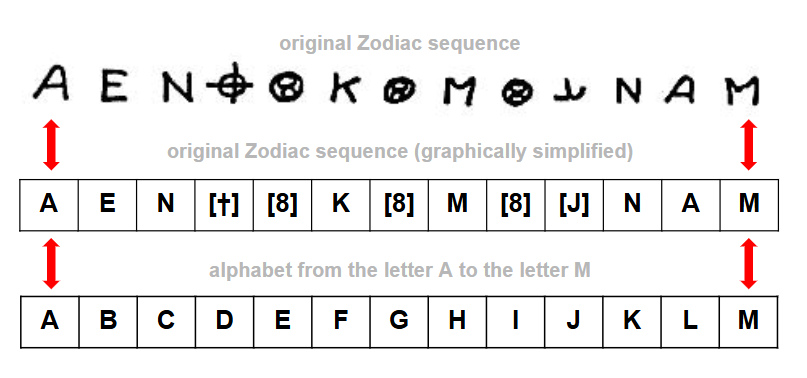
1. ALPHABET
First of all, we can observe that the sequence consists of 13 symbols and letters, exactly half of the 26 letters of the alphabet.
The sequence begins with the letter A and ends with the letter M. Between the first and last positions there are 11 intermediate elements, exactly the same number of letters that lie alphabetically between A and M.
In this way, the distance between the two ends of the sequence and their position within the alphabet correspond perfectly: A occupies the first position and M the thirteenth, just as they do in alphabetical order.
2. THE J AND D CHARACTERS
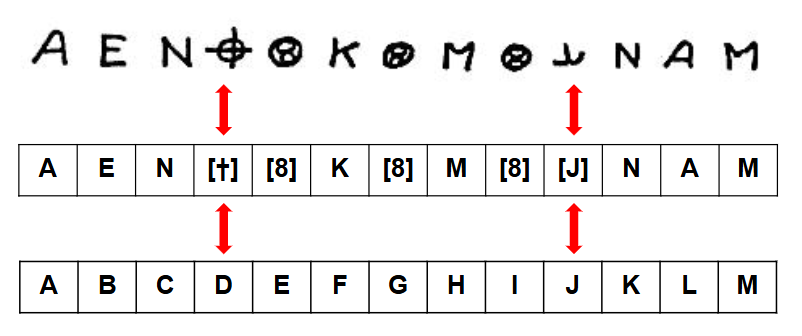
As a second step, we can observe in the diagram that the position of the letter J corresponds to that of the symbol that can be described as a “mirrored J”. This correspondence suggests that the symbol could be interpreted as a graphic variation of the letter J itself, preserving its alphabetical value while introducing a transformation based on symmetry.
Applying the same principle to the Zodiac symbol, we can see that in the diagram it falls in correspondence with the letter D. In this case as well, the symbol could therefore be read as a sort of “mirrored D”, that is, as a graphic representation of the letter D produced through a similar mechanism of reflection or visual transformation.
The presence of these two correspondences strengthens the hypothesis that these symbols are not arbitrary elements, but may instead refer to specific letters through a shared principle of graphic symmetry, as shown in the diagram.
3. THE EIGHT-BALL SYMBOL
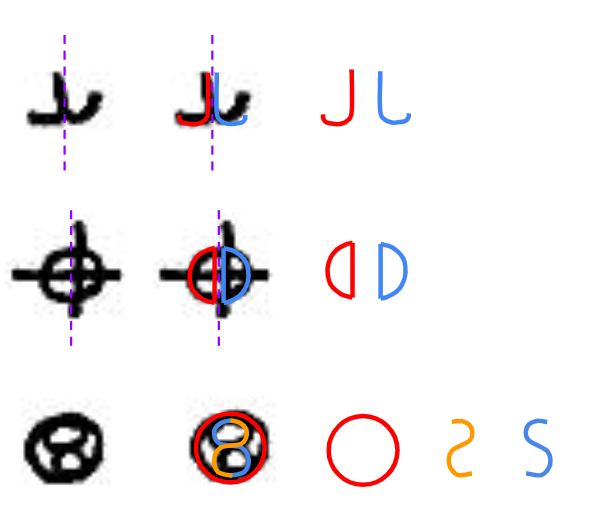
Finally, let us consider the so-called “eight-ball” symbol. Graphically, it can be broken down into several elements: the outer circle, which may be interpreted as the letter O, and the 8 contained within it.
The 8 itself can in turn be interpreted as the combination of two overlapping letter S’s, giving an overall reading that can be reduced to the sequence O + S + S.
According to this interpretation, the “eight-ball” would therefore not represent a single character, but rather a compound symbol containing multiple alphabetic elements.
4. POSSIBLE SOLUTION: T and R
The observations developed in points 1 and 2 suggest that the alphabet may play a fundamental role in determining the meaning of the “eight-ball” symbols.
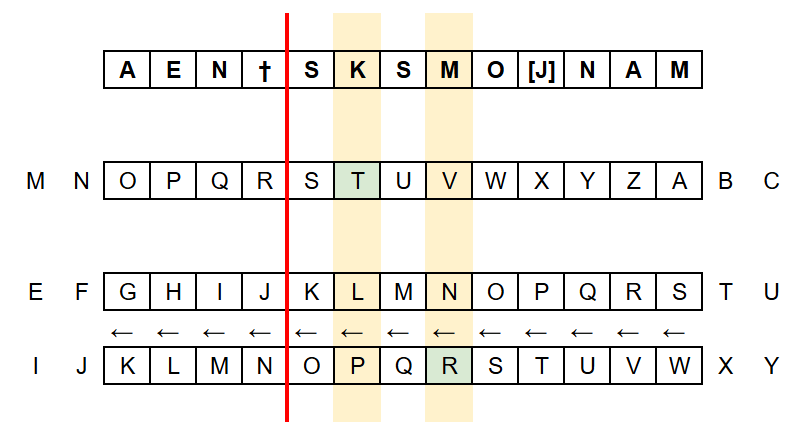
If we use the first eight-ball symbol as a sort of block toward which the characters are made to converge, and treat the two central letters K and M as selectors, the alphabetical shifting mechanism makes it possible to identify the letters T and R.
What we observed in point 3 may provide an additional clue in this direction. If the eight-ball symbol is broken down into its graphic components, we obtain two identical and symmetrical letters (the two S’s) together with one different letter, O.
This structure (two identical letters and one different letter) may suggest looking for the same pattern within the proposed solution: two T’s and one R.
These would be precisely the three characters needed to complete the reading “DR EAT A TORPEDO.”
I hope you can understand what I have written. I’m Italian, and for convenience I use ChatGPT to translate my texts from Italian into English.
Personally, I don’t think “DR EAT A TORPEDO” is the correct solution, because I believe that Z13 really does conceal Zodiac’s name. That said, I still find this solution very interesting, perhaps one of the best I have seen.
Also, the idea that the message might contain some kind of provocation or mockery directed at the investigators seems perfectly consistent with Zodiac’s style.
Buona giornata!!!!! 😀
Suas observações são interessantes.
Não se preocupe, o inglês também não é minha língua nativa; sou brasileiro.
Bem, observar símbolos e encontrar significados neles, extrair letras do desenho — isso é legal, mas veja bem, se fosse só isso, nunca seríamos capazes de provar.
Se houver uma solução, creio que ela necessariamente virá do que temos (as teclas 340 e 408), e é por isso que gosto particularmente da solução do Dr. Ryan.
Não sei se você teve a oportunidade de assistir ao vídeo!
Neste link, você encontrará diversas observações, compiladas ao longo de anos de pesquisa por muitas pessoas diferentes.
De qualquer forma, é bom ver trabalhos independentes como o seu; fiquei curioso sobre o nome que você extraiu do código.
Atenciosamente, e você será sempre bem-vindo(a) aqui.
PS
Estou anexando uma imagem da simetria Z13 que criei anos atrás e o palíndromo visual.

https://zodiacode1933.blogspot.com/
Your observations are interesting.
Don’t worry, English isn’t my native language either; I’m Brazilian.
Well, observing symbols and finding meanings in them, extracting letters from the drawing—that’s cool, but look, if that were all there was to it, we’d never be able to prove it.
If there’s a solution, I believe it will necessarily come from what we have (keys 340 and 408), and that’s why I particularly like Dr. Ryan’s solution.
I don’t know if you’ve had a chance to watch the video!
At this link, you’ll find several observations, compiled over years of research by many different people.
In any case, it’s great to see independent work like yours; I was curious about the name you extracted from the code.
Best regards, and you’re always welcome here.
P.S.
I’m attaching an image of the Z13 symmetry I created years ago and the visual palindrome.
https://zodiacode1933.blogspot.com/
Well, what I have in mind is an alphabet from M to Z, like an alphabetical chain around the code.
Z-YXWVUTSRQPON— M—-NOPQRSTUVWXY-Z

https://zodiacode1933.blogspot.com/

One problem I have with Dr. Garlick’s solution is that if he’s going to encipher such a benign message using the 340 cipher key, then why not just use all symbols from the 340 cipher? Why add any new symbols at all? What’s the point? And why is that mistake there? This cipher is 13 symbols long. He made mistakes, but not that many. Given the length of the cipher, a mistake like that shouldn’t really be there imo.
I’m personally not buying that Garlick’s solution is valid, but I always enjoy checking out the work you post on here Marcelo. Keep it up.
Cheers.