
Sorry, I’m having trouble following you, could you rephrase that?

Le mia scuse, lendor.
Yes. In your solution you have the letters that make up ‘HERCULES’ as well as ‘X’ and ‘Y’. These correspond to numbers using the A=0 system. The numbers are therefore tied to the letters and cannot be changed without changing the letters.
This means that The Zodiac has no way, at this point, of intentionally adding any further information about the distance and direction of Hercules from Diablo into the numbers.
If you happen to find ’20’ and ’23 – 18 = 5′ among these numbers, then that can only be a coincidence.
I hope that is clearer for you, lendor. If not, let me know and I’ll try again.
“This isn’t right! It’s not even wrong!”—Wolfgang Pauli (1900–1958)
Alright, let me see if I’ve understood this correctly.
When I reversed the “omega” sequence, I initially thought it was also meant to determine the position of the city of “Hercules.” At this point, however, I think it may simply be a coincidence that the combination of the two sequences associated with the Greek letters yields exactly the angle in radians (5), and that the number 20 from the half-filled rectangular sequence corresponds to 20—interpreted here as the distance in miles from Mt. Diablo.
I now believe that the “omega” sequence should only be reversed to derive the author’s name.
This sound good, lendor and, as you said before, seems to be much more robust as a proposal.
If I understand you correctly, you now have a homophonic plaintext that gives the direction and distance, but only approximately. However, with this you also have a numeric solution giving the actual name of the place pointed to.
As well as both these things, you also include something to give the name of The Zodiac, but I haven’t looked at that in detail so I cannot give any comment.
“This isn’t right! It’s not even wrong!”—Wolfgang Pauli (1900–1958)
You’re welcome!
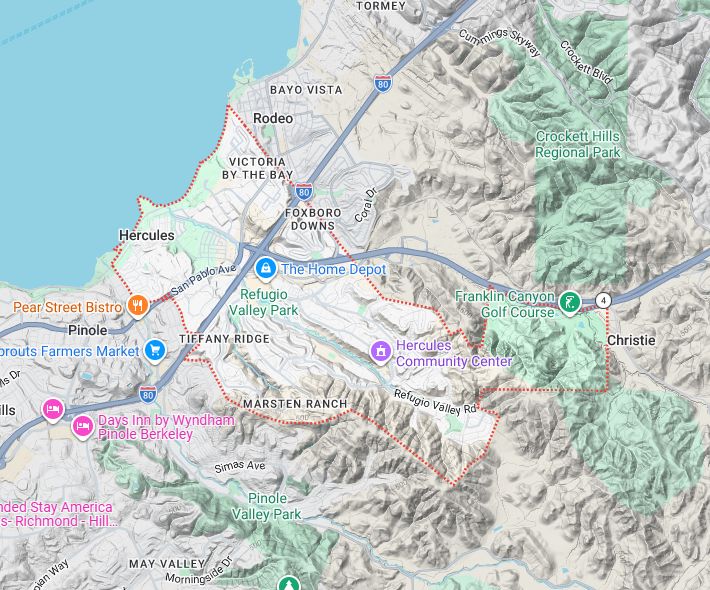
As for where 3 inches at 5 radians plots on the map, this does indeed fall into the limits of the city of Hercules.
Here are those limits (orange dashed line):
…
“This isn’t right! It’s not even wrong!”—Wolfgang Pauli (1900–1958)
… and here is where the coordinates plot to, on the North side, somewhere around the border with Rodeo:
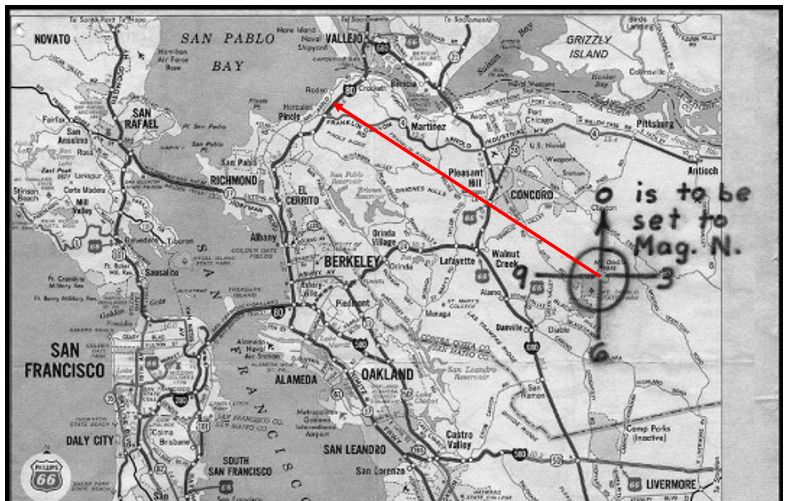
(Apologies about the low resolution image, but I don’t want to be uploading massive files just to make quick points.)
“This isn’t right! It’s not even wrong!”—Wolfgang Pauli (1900–1958)
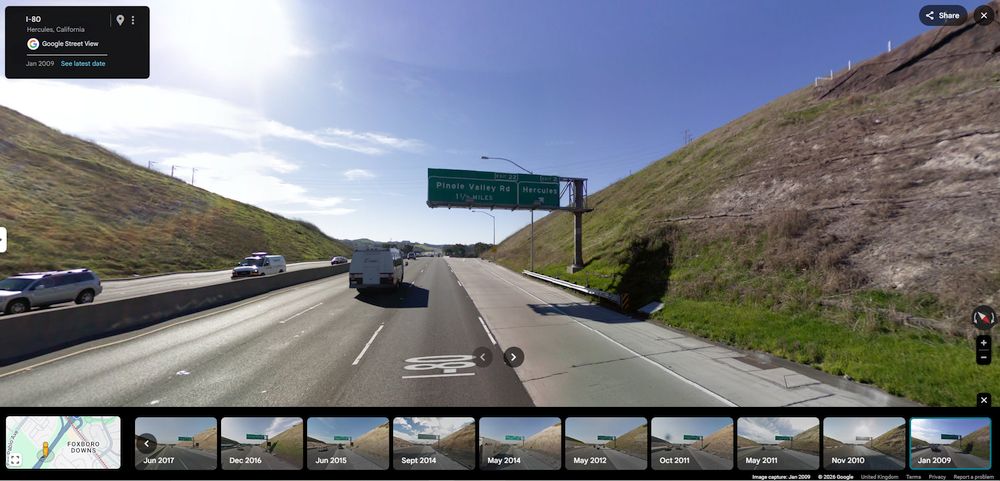
Plenty of nice roadside embankments along the I80 coming into Hercules from Rodeo 🤔
“This isn’t right! It’s not even wrong!”—Wolfgang Pauli (1900–1958)
Here I am! @shaqmeister, I’ll briefly explain why I believe the inverted T in the Z13 represents a mirrored J; this also helps justify some of the choices I made regarding the Z32, as outlined in my analysis.
As mentioned in my previous messages, I can’t show everything, so I’ll focus only on the preliminary steps used to define the special characters of the Z13 cipher—specifically the Zodiac crosshair symbol and the inverted T.
First of all, we can observe that the sequence of symbols and letters consists of 13 elements, exactly half of the characters in the alphabet, which are 26. The sequence begins with the letter A and ends with the letter M. Between the first and the last position there are 11 intermediate elements, a number that matches the alphabetical distance between A and M. In other words, the distance within the sequence and the distance in the alphabet are perfectly aligned.
Next, it is necessary to assign values to the symbols. As a first step, we can observe from the scheme that the position of the letter J and that of the “mirrored J” symbol correspond. This correspondence suggests that the symbol can be interpreted as a graphical variant of the letter J, preserving its alphabetical value while introducing a visual symmetry consistent with the structure of the puzzle.
Applying the same reasoning to the Zodiac symbol, we can observe that it falls within the scheme under the character D. In this case as well, the symbol can be interpreted as a “mirrored D,” that is, a symbolic representation of the letter D obtained through a graphical transformation based on symmetry.
This reinforces the idea that the symbols are not arbitrary, but correspond to specific letters through operations of visual reflection, as shown in the diagram.
Ciao, @lendor-77.
I am following. I will not interrupt you.
“This isn’t right! It’s not even wrong!”—Wolfgang Pauli (1900–1958)
Nothing, I’ve already finished 🤣 Basically, the Zodiac crosshair and the inverted T correspond to the letters D and J, since they are mirror images of these symbols and match the exact positions of the first 13 letters of the alphabet, as you can see from the diagrams.
Thank you. I did think, after I posted, that maybe you had already said what you wanted to say.
So, that is an interesting observation.
I don’t know why, but while I was waiting I was just reading about Il Mostro di Firenze having, I think, noted that the Zodiac symbol could, in one sense, be interpreted as a double ‘B’, as well as ‘D’. I guess this then turned my thoughts to JB and Joseph Bevilacqua, for some reason.
“This isn’t right! It’s not even wrong!”—Wolfgang Pauli (1900–1958)