
What was I trying to achieve?
Two possible outcomes:
-
Objective A – Z + 51: Four letters matching DX HAND, with the remaining letters, excluding Z, adding up to 51.
-
Objective B – LUNEDZ: Obtaining exactly the letters L, U, N, E, D, Z among the remaining letters, regardless of their order.
I also considered three levels of difficulty, based on the positions of the letters J, B, and G in the sequence:
-
Level 1: J, B, and G anywhere in the sequence.
-
Level 2: J at the beginning and BG at the end, as in the original letter.
-
Level 3: BG at the beginning and J at the end.
The positional requirements were checked before removing repeated letters.
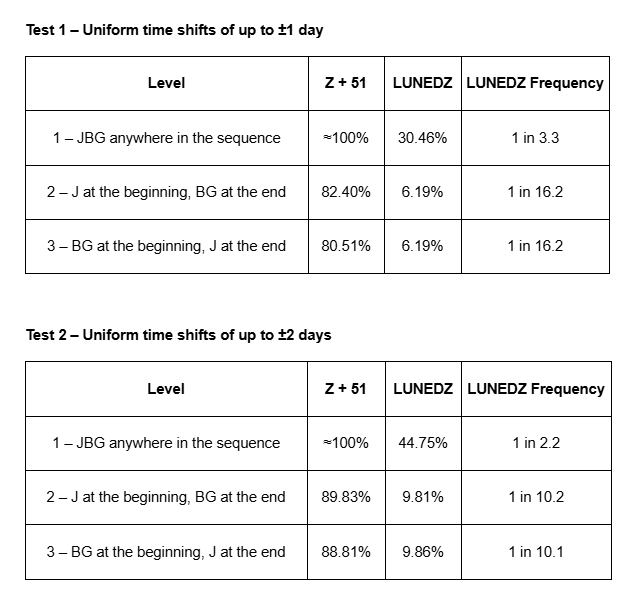
The results I’m most interested in are those from Level 2, since they reproduce the arrangement found in the original letter, with J at the beginning and BG at the end.
Looking specifically for the residual letters LUNEDZ, the results were:
-
Time shifts of up to ±1 day: 6.19%, approximately 1 in 16 cases.
-
Time shifts of up to ±2 days: 9.81%, approximately 1 in 10 cases.
To be clear, these percentages indicate how often, out of 30,000 groups of random dates, it was possible to find at least one valid combination using all the degrees of freedom allowed by the test. Each group was counted only once, even if multiple valid solutions were possible.
This does not mean that my proposed decipherment has a 1 in 16 or 1 in 10 chance of being correct. It simply means that, under the rules adopted in the simulations, a sequence compatible with the desired result could be deliberately constructed with that frequency.
My thoughts
I developed this approach by drawing on your reconstruction of the numerical triplets and the corrections you identified to explain the possible errors made by the author.
However, I tried to look at the issue from a different perspective, considering the possibility that some of those anomalies, rather than being simple mistakes, might have been intentional modifications introduced by the author to obtain specific letters.
Of course, none of this proves that the author actually followed such a procedure. After all, the rules of the tests were developed by examining the letter itself and its anomalies, so they do not constitute an independent statistical validation of my proposed decipherment.
What I mainly wanted to understand was whether a hypothetical author, already knowing the result he wanted to achieve and having these degrees of freedom available, could have deliberately constructed a sequence like the one I identified, without completely departing from a consistent astronomical method.
And, at least according to these simulations, it seems that such a construction would have been feasible.
I don’t know whether this will change your opinion of my interpretation, but I found it an interesting exercise, especially since it grew out of the observations you shared during our discussion.
Good night!