
@shaqmeister Yes, besides the targeting scope interpretation, the Zodiac watch correspondence is worth mentioning as well. The symbol can be interpreted in a variety of ways.
Regarding the celestial Zodiac mention, in my paper I do mention that the LHR attack was on the eve of the Winter Solstice, and BRS was on the Earth’s aphelion, the day where it is furthest from the sun in it’s orbit. Lake Berryessa has a 4 days offset from the Autumnal Equinox.
The operational triangle region has a spatial resemblance to the constellation Orion, known as the Hunter. Specifically the stars for the head and feet, with the inner equilateral being placed similarly to Orion’s belt, which is a perfect line with 3 stars, where each line segment is approximately the same length.
I did not include the Orion resemblance with his geometry in my paper because it is too speculative, I am just sharing the potentially incorrect observation since you mentioned the celestial Zodiac.
“Sometimes it is the people no one can imagine anything of who do the things no one can imagine.”
― Alan Turing
Best regards,
-David Stampher, the solver of Mount Diablo code aka Z32.
Cracked using the Python programming language in December 2025 using modern computational techniques.
Code: https://github.com/dstampher/zodiac-z32-cipher
Paper: https://zenodo.org/records/18645227
The side lengths of Zodiacs inner equilateral geometry region based on his crime scenes and Mt. Diablo are all 3.3 miles. The proposed solution lands within this triangle, where there is a triangle landmark on the ground. This was discovered after decryption.
If you bury something and give someone a map, you would need a landmark on the ground to know where to look when they check the decoded coordinates, due to manual plotting imprecision.
“Sometimes it is the people no one can imagine anything of who do the things no one can imagine.”
― Alan Turing
Best regards,
-David Stampher, the solver of Mount Diablo code aka Z32.
Cracked using the Python programming language in December 2025 using modern computational techniques.
Code: https://github.com/dstampher/zodiac-z32-cipher
Paper: https://zenodo.org/records/18645227

@shaqmeister Close but still missing an important detail. We did not only have the cipher and the map. We also had the post script hint regarding “The Mount Diablo Code”.
Yes, what I intended by just the cipher and map included the postscript. What I was excluding is the modern day preoccupation with the erroneous belief that bearings and distances on the map can ever be meaningfully translated into the same on the ground in order to pin point anything whatsoever. Try a semi transparent overlay for yourself. Even the Bay itself fails to line up, let alone the towns and highways.
The problem was put to us in 1970. We need to go back to 1970 to solve it. Just the cipher and postscript, just the Phillips 66.
“This isn’t right! It’s not even wrong!”—Wolfgang Pauli (1900–1958)
@shaqmeister “We need to go back to 1970 to solve it. “
When my code uses the 1970’s magnetic declination of the Mt. Diablo region, this is akin to going mathematically back in time to 1970 in my plotting. This also goes back to his map hint regarding magnetic north.
Had I not used the correct 1970’s magnetic declination, the decoded coordinates would be incorrectly plotted, and would not land by the triangle.
“Sometimes it is the people no one can imagine anything of who do the things no one can imagine.”
― Alan Turing
Best regards,
-David Stampher, the solver of Mount Diablo code aka Z32.
Cracked using the Python programming language in December 2025 using modern computational techniques.
Code: https://github.com/dstampher/zodiac-z32-cipher
Paper: https://zenodo.org/records/18645227
In 1970 you couldn’t convert a Phillips 66 into GPS mapping to pin point a cow’s watering hole in the middle of a field. You could though, as you say, flip a protractor round 17 degrees, granted.
“This isn’t right! It’s not even wrong!”—Wolfgang Pauli (1900–1958)
In 1970 you couldn’t convert a Phillips 66 into GPS mapping to pin point a cow’s watering hole in the middle of a field. You could though, as you say, flip a protractor round 17 degrees, granted.
You don’t have to. You can use a ruler. Because there is a 100 foot equilateral triangle on the ground, it makes it pretty easy to know, if you check the general area. The triangle is large and obvious to anyone checking the area out, it has a high contrast with the surrounding environment.
If you are writing a computer program, precisely converting the manual plotting instructions into GPS coordinates is the right move. It is also what Oliv92 did. You must use the Haversine formula, which accounts for the curvature of the earth. A simple distance calculation will not suffice, as that assumes a flat plane, resulting in accumulating error. Precision matters, and it requires the proper formula.
Also, out of curiosity, are you implying this 100 foot equilateral triangle was constructed for the purpose of watering the cows? What purpose does the shape, size, and orientation serve for a cow’s watering hole? While cows drink from it, that does not mean it was the intended purpose of it’s construction.
“Sometimes it is the people no one can imagine anything of who do the things no one can imagine.”
― Alan Turing
Best regards,
-David Stampher, the solver of Mount Diablo code aka Z32.
Cracked using the Python programming language in December 2025 using modern computational techniques.
Code: https://github.com/dstampher/zodiac-z32-cipher
Paper: https://zenodo.org/records/18645227
Perhaps we need to try some control examples. Pick a number of features on the map that are marked. Use the correct scale and measure their bearing and distance from Mount Diablo, factoring in the appropriate magnetic north correction. Use these values, along with your haversine algorithm or whatever. Then take the results to a modern mapping application and we can evaluate through blind testing whether we’re now able to pull out the original features.
Sorry, as for the nature of the morphing crop circle, I have no interest in whatever that might be. From what I recollect, you haven’t even been able to place it there before sometime in the 1980s.
“This isn’t right! It’s not even wrong!”—Wolfgang Pauli (1900–1958)
@shaqmeister Yeah if you can prove any of the proper falsifications mentioned previously, that would be a notable accomplishment and the first to do so. You are certainly not the only person that has read the paper or checked the code, and I am still awaiting someone to let me know they found a critical error. One Computer Science professor that reviewed it told me to let him know if I end up digging there. That part isn’t my job, and I don’t have the authority to do so.
If it were on public land, I would pay out of pocket for a quick GPR scan. It isn’t expensive, since the search area is known and relatively small. If there is a hit, just give a call to the authorities and let them know to come check it out. A couple hundred bucks isn’t much money to pay, to potentially find evidence in this case. It is a small effort, for a potentially massive reward. The cost-benefit analysis checks out.
It isn’t on public land, so that is beyond the scope of my capabilities.
“Sometimes it is the people no one can imagine anything of who do the things no one can imagine.”
― Alan Turing
Best regards,
-David Stampher, the solver of Mount Diablo code aka Z32.
Cracked using the Python programming language in December 2025 using modern computational techniques.
Code: https://github.com/dstampher/zodiac-z32-cipher
Paper: https://zenodo.org/records/18645227
Your code, @coder1987, models your assumptions and I am more than confident it does so admirably.
“This isn’t right! It’s not even wrong!”—Wolfgang Pauli (1900–1958)
@shaqmeister Thanks, it also models all of the Zodiacs hints as well. Not one of them was overlooked.
I appreciate your engagement, and expect healthy skepticism. I know the reputation of this cipher, some claim it is impossible to solve. I can tell by talking to you about it, that you at least believe that it is solvable. I think that puts us in the minority.
“Sometimes it is the people no one can imagine anything of who do the things no one can imagine.”
― Alan Turing
Best regards,
-David Stampher, the solver of Mount Diablo code aka Z32.
Cracked using the Python programming language in December 2025 using modern computational techniques.
Code: https://github.com/dstampher/zodiac-z32-cipher
Paper: https://zenodo.org/records/18645227
Yeah, thanks for the ride @coder1987. It’s been fun (was gonna say “a blast”). I should probably turn off my notifications now and leave you alone.
“This isn’t right! It’s not even wrong!”—Wolfgang Pauli (1900–1958)
@shaqmeister Haha, good one.
Always happy to chat if you come back around. After reviewing these forums, I see that you were quite involved in this cipher, and so I realize you are someone that has been analyzing it for a long time, and deeply. Not a casual Z32 commentor.
“Sometimes it is the people no one can imagine anything of who do the things no one can imagine.”
― Alan Turing
Best regards,
-David Stampher, the solver of Mount Diablo code aka Z32.
Cracked using the Python programming language in December 2025 using modern computational techniques.
Code: https://github.com/dstampher/zodiac-z32-cipher
Paper: https://zenodo.org/records/18645227
I know the reputation of this cipher, some claim it is impossible to solve. I can tell by talking to you about it, that you at least believe that it is solvable. I think that puts us in the minority.
Hi @coder1987.
Just wanted to return one more time because today has left me thinking about, and re-evaluating, my beliefs around the solvability of the Z32.
Today I had some time and set about hacking around with your code to adapt it to the assumptions that I am happy in making in regard to the basic form and structure of what I feel the solution must contain. In doing so, I didn’t think finally taking a programmatical approach would lead me in any new directions different from the paths I have trodden many times before. That said, I guess I had wondered whether this last step would throw in just that one detail that would be enough to make that one solution not just stand out above the rest, but to appear incontrovertible. Sadly, however, at the end of it all I merely found myself trudging the same old familiar scenery without any further insight.
I did get my candidate list down to, I think, fourteen ultimately. Amongst them was the one that I would, and have for some years, favoured on more generalised, not-easy-to-quantify grounds. But, try as hard as I have done, it does finally appear to me that incontrovertibilty is not something that can be reached. This is especially so as I have never held the view that anything was ever “dug in,” to use The Zodiac’s own words.
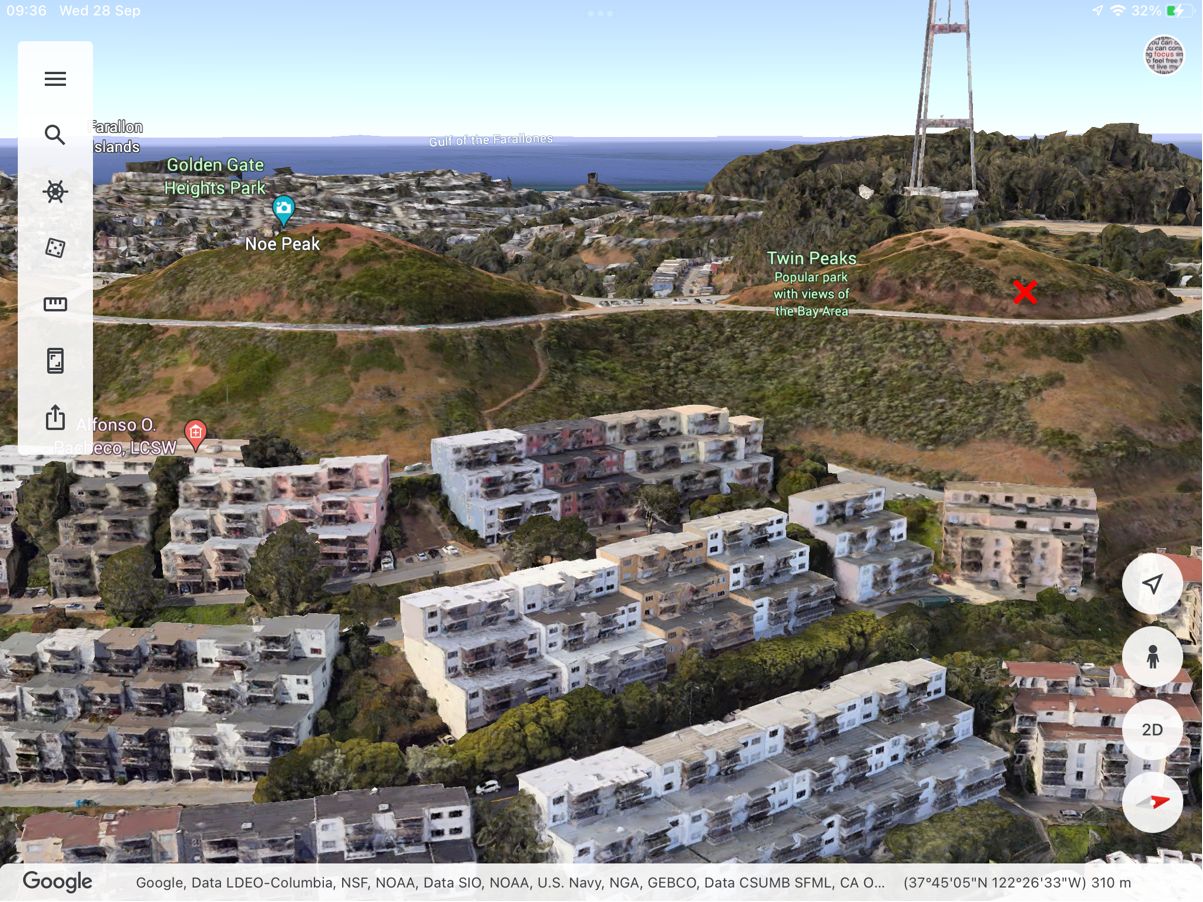
All the same, I’m not leaving it in a despairing mood. For all the lack of ultimate success I do still feel that I know exactly where The Zodiac was wanting us to be looking. Even setting aside the cipher and map completely, I think its most detailed presentation was given in the Halloween card, most obviously down in the right-hand corner, towards where all the eyes are ‘peeking’. There we see a sketch of a two-peaked hilltop, aligned to the ‘N’ (not ‘Z’) at its right-hand side and quarted by four dots in faux perspective into four faces. The extra line then picks out the North East face which is just the face where you would need to set the mechanism to catch the morning sun in the June of 1970. In phonetic style we also find “peak kaboom” wrapped around the single eye in the tree trunk. To this I could add how the corresponding solve makes clever use of a zodiacal reference to identify the particular double-peak specifically and how comparison of the Z13 and Z32 using this specific solve of the latter gives strong support to the former having been intended to communicate, albeit more briefly, exactly the same location specification.
But none of this can be proved through elimination of all alternatives. Nor do I make any significance of the fact that, of all the possible candidate locations that survived through my re-programming, this one would come right to the top according to the ranking criteria you employed in your code.
Although I am saddened at the thought of having exhausted all the avenues I had felt it viable to pursue, I am happy to still hold on to the strong sense that, had The Zodiac planted his bomb after all, we would have found it here:
“This isn’t right! It’s not even wrong!”—Wolfgang Pauli (1900–1958)
Hi again shaqmeister,
Was glad to see you engaging with the code and trying your own experiments. I am currently working on version 3 of the paper, as I have expanded the search space from 2 million to 6.6 million. I figured adding some more plausible templates would be a good idea.
Even after tripling the search space, my original proposed solution remains the top ranked candidate. Survivors went from 54 to 103.
For version 3 I will be porting the code to Javascript and coupling it with an interactive map, that will make it easier for you to quickly visualize your experiments and where they plot. And will let others create their own templates. No ads or anything like that, just something for people to play around with. It will essentially be the same application as the python code, but with a UI that can run in any browser. That will be appealing to more people.
I did purchase the domain inthreeandthreeeighthsradiansten.com, in case it turns out to be verified. Long domain name, but that is probably where I will be hosting the browser based version of the solver for educational purposes.
Thanks for chatting about the cipher. It is pretty difficult to find people to talk about it with.
“Sometimes it is the people no one can imagine anything of who do the things no one can imagine.”
― Alan Turing
Best regards,
-David Stampher, the solver of Mount Diablo code aka Z32.
Cracked using the Python programming language in December 2025 using modern computational techniques.
Code: https://github.com/dstampher/zodiac-z32-cipher
Paper: https://zenodo.org/records/18645227
Visualisation through plotting is a good next step. I shied away from it only because I was reaching minimal candidate sets and so plotting by hand remained viable. Obviously you will be plotting from lat/long conversions, according to your current model. It would be useful, however, to permit switching between this approach and the more direct application of ruler and compass plotting onto the map. I would imagine that significant variations between the two approaches would be made apparent in some instances. It would also permit the broadest scope of experimentation if there was a feature allowing for the generation of candidate coordinate pairings that, of themselves, fall short of completing the available 32. Owing to the necessary vagueness of almost all coordinate specifications on a Phillips 66, I wouldn’t want to be factoring out at the outset the possible inclusion of a final specific identifying prompt. Of course we don’t have enough constraints to be able to complete such candidates using cypher solving methods, but a subsequent search on the ground may suggest plausible completions.
But that’s enough feature requests. 🤔
“This isn’t right! It’s not even wrong!”—Wolfgang Pauli (1900–1958)