
Hi everyone! Unfortunately, probability calculations are not really my field, so for this check I relied on ChatGPT. I’d therefore really appreciate confirmation from someone with more expertise.
The question I asked was the following: given a fixed sequence A made up of 9 different characters,
A = CREHSXUYL
and then randomly selecting a second sequence of 9 letters, also all different, what is the probability that, after trying all 26 possible alphabetical shifts, at least one of them produces a sequence in which at least 7 out of the 9 letters belong to A and at least 3 of those letters are also in exactly the same position?
In our case, applying a +16 shift to EBORITMHP gives UREHYJCXF: 7 of the letters belong to A, and the three letters R, E, H also appear in exactly the same positions.
The calculation gives a probability of about 0.179%, or roughly 1 chance in 560.
Does that calculation look correct to you? And would you consider this a fairly rare coincidence?
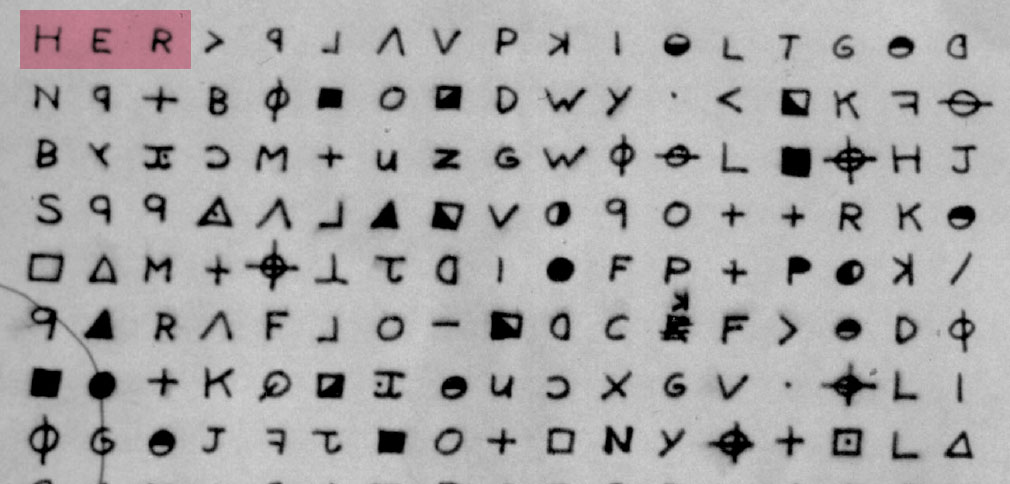
Then I remembered another detail about Zodiac’s Z340 cipher: the first three characters are HER, which are also the first three letters of the word HERCULES.
What caught my attention is that these are also the same three letters involved in the positional matches between my Z32 sequence and the +16 shift of Z18: R, E, H.
So the exact same three letters appear again, although in a different order: HER in the Z340 and REH in the correspondence between Z32 and Z18.

Hello to everyone reading this message! I could use your help, but let me start from the beginning.
A few days ago, I read an interesting post by @Marclean in the thread “Symbols and Letters 340 Key.” One of his observations particularly caught my attention, so I would like to thank him for giving me this insight.
Marclean pointed out that the Z18 sequence:
EBEORIETEMETHHPITI
has a rather unusual structure: it consists of 9 vowels and 9 consonants. Furthermore, if repeated letters are removed while preserving the order of their first occurrence, exactly 9 distinct letters remain:
EBORITMHP
This observation led me to two considerations.
The first may be somewhat marginal to the main subject of this thread, but it is still intriguing: the number 9 also recurs in some analyses of the dates associated with the Monster of Florence murders. I therefore brought this feature of Z18 to the attention of a researcher who is investigating the possible recurrence of this number.
The second consideration, which is more relevant to this thread, concerns the sequence EBORITMHP. Out of curiosity, I applied every possible Caesar shift to these nine letters and obtained the following results:
Shift 0: EBORITMHP
Shift 1: FCPSJUNIQ
Shift 2: GDQTKVOJR
Shift 3: HERULWPKS
Shift 4: IFSVMXQLT
Shift 5: JGTWNYRMU
Shift 6: KHUXOZSNV
Shift 7: LIVYPATOW
Shift 8: MJWZQBUPX
Shift 9: NKXARCVQY
Shift 10: OLYBSDWRZ
Shift 11: PMZCTEXSA
Shift 12: QNADUFYTB
Shift 13: ROBEVGZUC
Shift 14: SPCFWHAVD
Shift 15: TQDGXIBWE
Shift 16: UREHYJCXF
Shift 17: VSFIZKDYG
Shift 18: WTGJALEZH
Shift 19: XUHKBMFAI
Shift 20: YVILCNGBJ
Shift 21: ZWJMDOHCK
Shift 22: AXKNEPIDL
Shift 23: BYLOFQJEM
Shift 24: CZMPGRKFN
Shift 25: DANQHSLGO
It was precisely at this point that I noticed a curious feature connected to the solution I proposed for Z32.
If you read through this thread and follow how my analysis developed, you will see that I divided Z32 into 9 sequences. For each sequence, I added together the alphabetical values of its symbols using an A=0 system, obtaining the following nine-character sequence:
CREHƧXUYL
Let us now compare it with shift 16 derived from EBORITMHP:
Z32: CREHƧXUYL
Z18: UREHYJCXFThe two sequences share no fewer than 7 out of 9 characters:
C – R – E – H – X – U – Y
But this peculiarity is not limited to the number of characters they share. When the two sequences are divided as follows, a very interesting structure emerges:
Z32: C | REH | ƧX | U | YL
Z18: U | REH | YJ | C | XFThe sequence REH appears in exactly the same position in both cases, from the second to the fourth character. Furthermore, the letters C and U occupy the same two positions in reverse order: in Z32, C appears at the beginning and U in the seventh position, whereas in Z18 the opposite occurs, with U at the beginning and C in the seventh position.
These two letters therefore seem to “mark out” both sequences according to the same structure:
Z32: C | REH | __ | U | __
Z18: U | REH | __ | C | __Finally, two pairs of characters remain in each sequence:
Z32: ƧX | YL
Z18: YJ | XFHere, too, another curious feature emerges: the letters X and Y appear in both sequences, but they are distributed across the two pairs in a crossed arrangement. In Z32, X belongs to the first pair and Y to the second; in Z18, the opposite occurs, with Y in the first pair and X in the second.
This creates a pattern somewhat similar to the interchange observed between C and U, although in this case the correspondence is not as immediate: to align X and Y in the same column within their respective pairs, the ƧX pair would need to be rearranged.
Z32: ƧX | YL
Z18: YJ | XF
At this point, however, I will stop because I would like to ask you two questions.
My first question is: how can I determine whether the similarities between the sequence produced by my proposed Z32 solution and shift 16 of Z18 are genuinely significant or simply due to chance?
The two sequences share seven out of nine characters, contain REH in exactly the same position, and display the C–U interchange as well as, less directly, the X–Y interchange. What kind of test could I perform to determine how likely it would be to obtain a similar result by chance when comparing the Z32 sequence with all possible Caesar shifts of a nine-letter sequence?
My second question is more general and concerns the procedure I followed.
At the end of this reasoning, I arrived at a possible interpretation based on comparing two sequences. Through two separate processes, I obtain two very similar results. I then superimpose the sequences, identify the matching elements, and use the differences between them in an attempt to derive the final message.
I have applied a similar procedure to some anonymous letters associated with the Monster of Florence case. I would therefore like to know whether this method has a specific name and whether it can be related to an established cryptological technique, such as comparison with known plaintext, subtraction between sequences, or some form of differential analysis.
Or is it simply my own interpretive method, without a formally recognized equivalent in cryptology?
I would especially like to understand this so that I can describe my procedure accurately, without incorrectly assigning a technical name to it.
I hope you find this interesting; I’m posting it here—it’s a more detailed version, basically the text from my blog.
Great work—I follow it with interest.
Look
The Hidden Mathematical Symmetry of the Z408 Cipher’s Final Segment
Cryptograms often conceal more than just hidden text; sometimes, their structural anatomy reveals striking mathematical properties. A fascinating geometric and structural balance emerges when analyzing the final 18-character segment of the famously difficult Z408 cipher attributed to the Zodiac Killer: EBEORIETEMETHHPITI.
https://zodiacode1933.blogspot.com/
Hi @marcelo-leandro ! I’m not sure if you noticed my message above, but in any case I wanted to thank you again for your thoughts on Z18, which I wasn’t familiar with.
Z18 is a cipher I’ve never really looked into in depth, but you gave me a huge “assist” — more than you can probably imagine! Thanks again.
When I have a bit more time, I’ll also go back and carefully reread your thoughts about the ciphers connected to typewriters. I mention this because the person I suspect may have been Zodiac seems, over time, to have been very skilled with a typewriter.
Although, come to think of it… who wasn’t in the ’70s and ’80s? 😄
Thanks again!