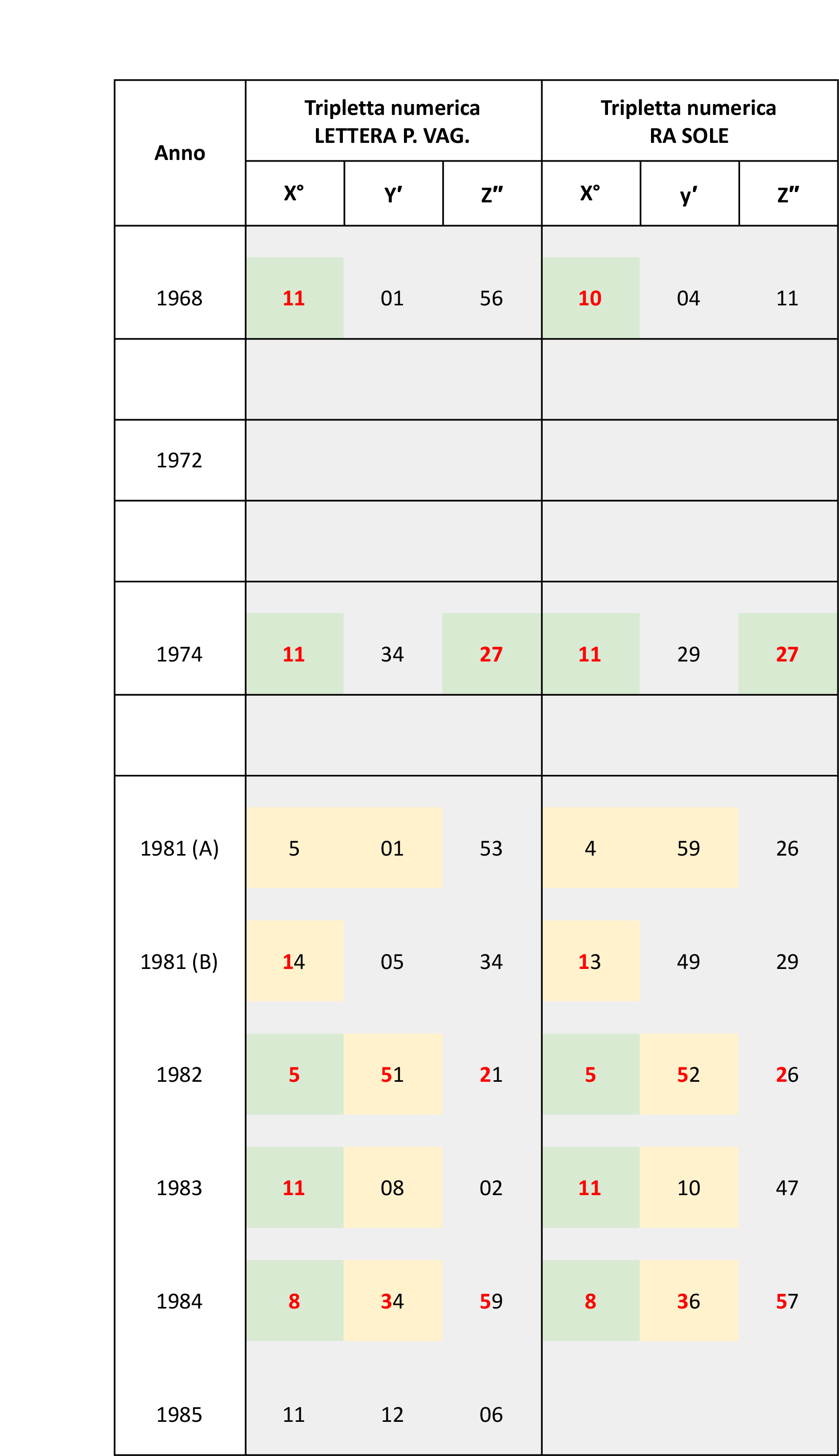
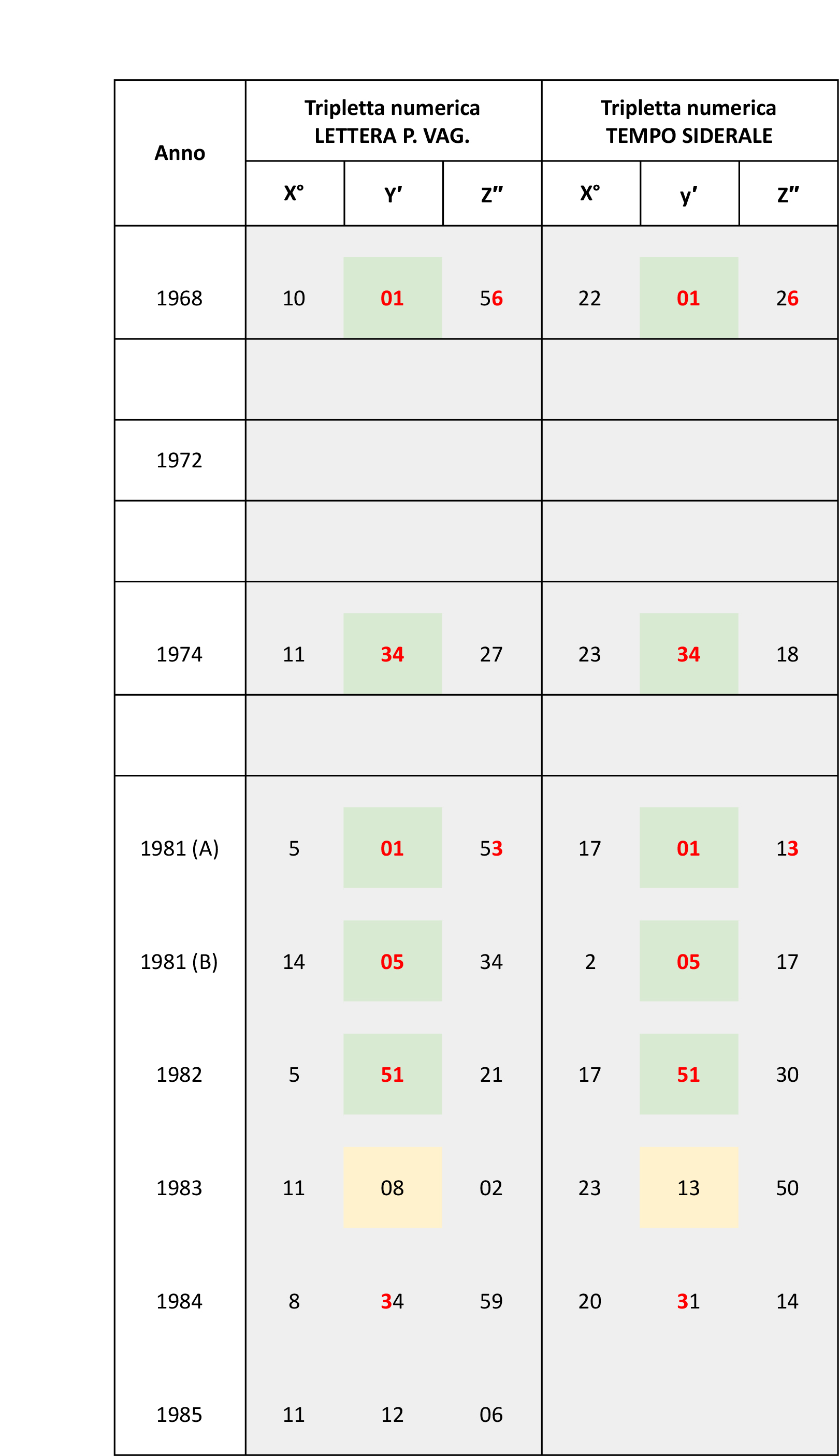

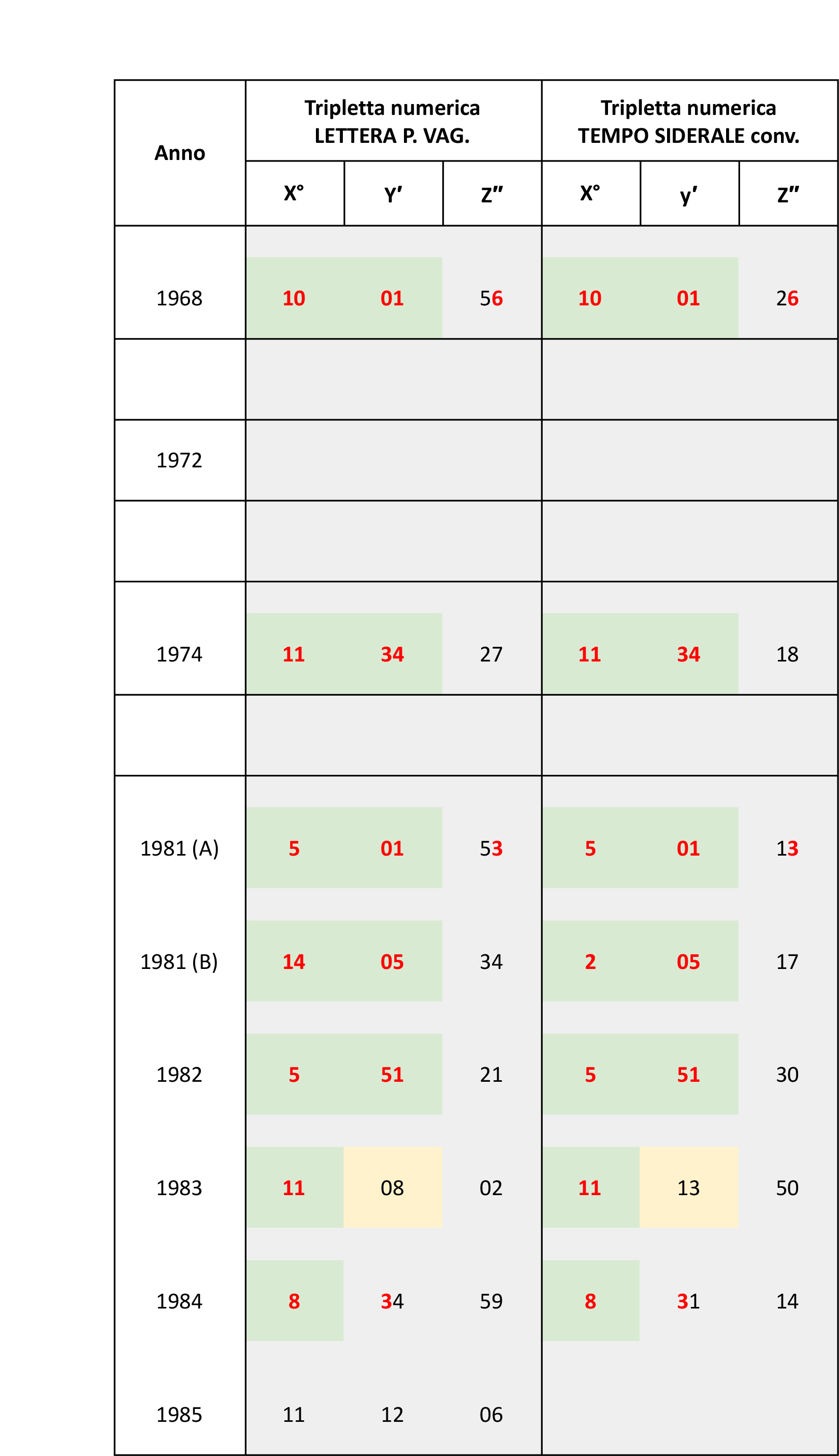
Although I still think that any actual decryption of the letter may operate on a different level of language or interpretation, I am posting these four tables simply as a numerical comparison between the triplets found in the letter to Paolo Vagheggi and some of the values that have been considered so far: the Sun’s Right Ascension, sidereal time, sidereal time converted to a 12-hour format, and the geographic longitude of the murder locations.
The colour coding is intended only to make the numerical relationships easier to see. Green indicates values that match exactly in the same position. Yellow indicates values differing by no more than ±2, and which can therefore be regarded as numerically very close. Red indicates partial correspondences within a two-digit value: the complete number does not match, but either the tens digit or the units digit remains the same in the two values being compared.
At this stage, I am not suggesting that these correspondences necessarily carry any specific meaning, nor am I trying to favour one interpretation over another. The purpose is simply to apply the same comparison criteria consistently across all rows and see what numerical patterns emerge under the different hypotheses.

I find the reconstruction based on the Sun’s Right Ascension very interesting, especially because the proposed model reproduces several of the table values remarkably well and leaves 1983 as the only major anomaly, precisely the row that the compiler himself highlighted.
That said, I have one logical and practical objection. If the compiler knew what Right Ascension was, knew how to consult an ephemeris, and was able to derive the 1984 value from a table, why would he then choose not to do the same for the other years? In other words, why read a precise tabulated value for 1984 and then reconstruct 1968, 1974, 1981, 1982 and 1983 through an approximate model which is, moreover, astronomically incorrect?
These are important questions and, in order to address them, it is relevant to think about where a young novice (such as I propose the author to have been) would first encounter the concept of Right Ascension. Although somewhat abstract to those without a background interest in astronomy, the system of ‘equatorial coordinates’—Right Ascension and Declination—is the system that a budding astronomer is first likely to encounter. It is through equatorial coordinates that a telescope, mounted on an equatorial mount and driven in step with the stars according to the rate of sidereal time, is positioned directly on an object of interest without having to search for it. The practice of locating celestial objects using their Right Ascensions is thus likely to have been ingrained in the novice astronomer long before he/she has progressed to understanding the theory of equatorial coordinates and how these relate to the more logical, but impractical for the astronomer, system of ecliptic coordinates, the ecliptic forming the actual path of the Sun in the sky. Likewise, an astronomer would consult a published ephemeris produced in a series of editions annually, year by year. I do not think that we have to look much further than to suppose that the author of the table had access to (that is, possessed) only the one ephemeris for 1984.
Despite being published each year, every ephemeris would repeat the same instructions year after year as to how the tables within it are to be read. Don’t forget that, even here, the author made a basic error in not realising that the epoch for the daily positions of the Sun in 1984 was 12h UT (noon, GMT), not 0h UT, as was the epoch used for the baseline RA. Thus, even the idea that the author “knew how to consult an ephemeris” is strongly negated by this basic error, arising likely from not being familiar with their use and having not followed the published directions correctly.
On your last point here, the author’s naïve method of extrapolation from this first baseline RA is not such as I would call “approximate,” in that it doesn’t produce values bearing any formal relation to actual Right Ascensions. It is erroneous, simply.
This seems even more relevant because, in order to construct the matrix of zodiac signs, the compiler must in any case have consulted ephemerides covering the other years and dates. If he already had the relevant tables in front of him, it is not immediately intuitive why he would ignore values that could simply be read directly and instead calculate thousands of days backwards from 1984.
A wholly different set of tables are used to read off the signs, and these are so basic and non-technical that they are published in single volumes covering an entire century at a time. Yet even here it can be identified that, aside from the 1983 lunar entry, the author also made an error in consulting such tables for one of the earlier lunar entries. These tables do not generally give Right Ascensions for the various celestial bodies, including the sun, putting the body in the given sign and then counting off degrees and parts thereof from the start of the respective sign. RAs could be deduced easily from these entries, but only with a degree of knowledge that is not otherwise evidenced by our author.
You refer to counting back “thousands of days,” but the whole span of time only covers 17 years and whole years are accumulated as merely additions of 365 or 366 days, depending upon whether the traversed year is a leap year or not.
Of course, this does not make the proposed reconstruction impossible. It may be that the compiler was using two different sources, for example, a multi-decade astrological ephemeris for the zodiac signs, and a separate astronomical table, perhaps limited to 1984, from which he obtained the Right Ascension for that year. In that case, extrapolating the remaining RAs by calculation would make considerably more sense.
That would certainly be my reconstruction.
For this reason, I think the decisive check is to identify exactly which ephemeris or publication is supposed to yield the value 08h 34m 59s for 1984. If that same publication also contains the corresponding data for 1968 to 1983, then the objection becomes much stronger: it would be difficult to explain why the compiler chose to calculate approximate values when he could simply have read them directly. If, on the other hand, the identified source really is limited to 1984, or otherwise does not provide the earlier years, then the extrapolation hypothesis becomes substantially more plausible.
No single ephemeris or publication will yield 08h 34m 59s without interpolation, as the RA corresponds to the event time of the corresponding murder whilst the tabulated entries are deduced for a given daily epoch such as 12 UT. Because of the precision of astronomical calculation, there should be no difference occurring between any specific ephemerides, although the way the base data is presented to the astronomer may show limited variation, such as precise choice of epoch.
That said, not one of any edition of any ephemeris will show the corresponding data values from the artefact for 1968 to 1983 because, as shown, these have been deduced using a wholly erroneous model of the Sun’s motion. This is the entire point. We could use yearly ephemerides to look up what these values should have been, but we will not find the artefact values in any table.
I would add one further point. The reconstruction seems to require a compiler who was knowledgeable enough to understand what Right Ascension is, work in hours, minutes and seconds, use a tropical year, perform sexagesimal calculations and reduce values modulo 24 hours, yet at the same time inexperienced enough to assume that the Sun’s RA increases uniformly. That is certainly possible, but I think the profile should perhaps be described more carefully: rather than someone with virtually no understanding of astronomy, it would seem more like someone with partial knowledge and a conceptually incorrect, but by no means trivial, model of solar motion.
As noted, the ability to work with concepts you list would become quickly understandable to the practical astronomer, someone who perhaps had joined a local or school astronomy club or had a decent telescope of their own. Theoretical astronomy, in contrast—a detailed understanding of which would be required to be able to model the motion of the Sun with any mathematical accuracy—would require a much more concerted programme of study; and since the author’s primary area of interest appears to be astrology and mysticism, there is no reason to require that they would have taken their studies this far.
The author has started out from a clumsy table lookup for the Sun for 1984; he has then projected both forward and back using a naïve model of the Sun’s motion; and he has committed countless identifiable and accountable slips and errors along the way.
He has also use a stencil, applied stickers, and calculated in base 60 using (very likely) some model of the Casio school calculators that I can remember using for the same purpose around the same time.
“This isn’t right! It’s not even wrong!”—Wolfgang Pauli (1900–1958)
Numerical Comparison — Sidereal Time
So, let’s take a look at the right-hand column of triplets and ask what it is that we actually have here.
From my reconstruction, I can identify these triplets as giving the sidereal time such as would be read from an appropriate ephemeris corresponding to 0h UT, this being the nearest midnight (UT) to each of the eight murder events. But again, I have to ask “what is this?”
Well, each sidereal time corresponds, by definition, to the Right Ascension culminating at the Greenwich Meridian at 0h UT on the given (post) date. But what does any of this have to do with events in Florence, which is some 11¼° off the meridian at Greenwich? And what has 0h UT got to do with events that are not occurring at this hour?
As noted, although contextually distinct there are relationships between solar RAs and certain, specific sidereal times. In particular, if we concern ourselves with just these very sidereal times corresponding to 0h UT on the Greenwich Meridian, then these sidereal times will be, by construction, very close to being equal to the RA of the Sun at this hour ±12h mod 24. But then, as right ascension changes only by about 3m 56s per day, we can expect the Greenwich Sidereal Time (GST) at 0h UT to be always close to what we would determine to be the Sun’s RA at any reasonable time around the actual event times.
It is thus for this reason, wherever you attribute some otherwise absent relevance to the GST equivalent of 0h UT, you will get values that will tend to fall somewhere near the Sun’s RAs at the precise event times.
And this is the central problem with the sidereal time model. Either by lookup or by calculation the follower of this explanation derives a ‘sidereal time’ but then forgets to ask “sidereal time of what?” Sidereal time is just like civil time and proceeds at almost exactly the same rate (just a little quicker, in fact). So, just like civil time we can’t just pick a random time, say at the start of the day, and suppose it has meaning for events happening later in the day. To do that, we have to allow sidereal time to tick on until we get to the event in question. Only then, we won’t find anything even remotely corresponding to the artefact values.
The RA model, on the other hand, constructs the Sun’s Right Ascension precisely at the time of the murder event, as far as this has been pinned down.
So, again. The fact that you need to deduct 12 from some of the sidereal times merely reflects the fact that you are choosing 0h UT which is 12 hours away from 12h UT, at which time the mean Sun is culminating at the Greenwich meridian and its Right Ascension is equal, at this culmination, to the corresponding Greenwich Sidereal Time.
“This isn’t right! It’s not even wrong!”—Wolfgang Pauli (1900–1958)
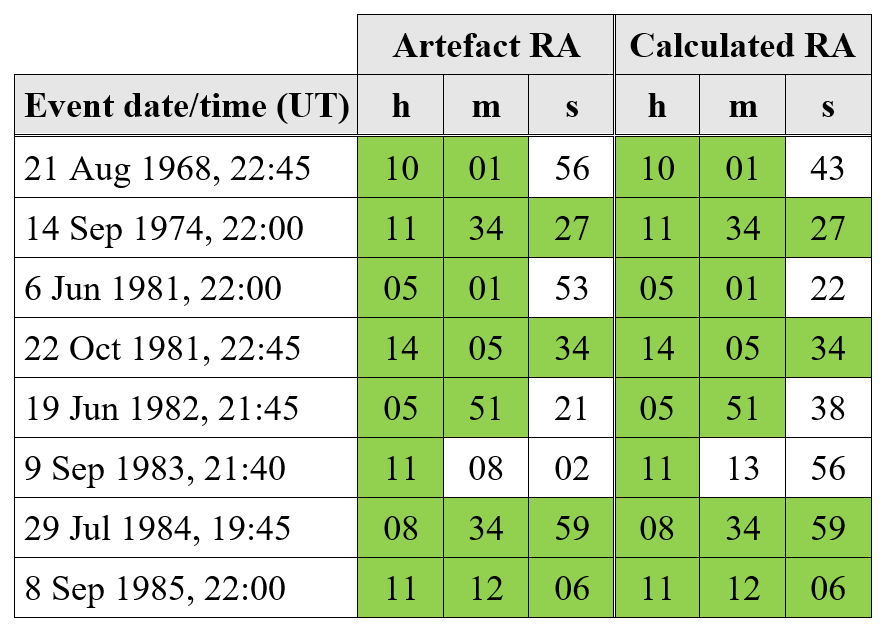
Numerical Comparison — Sun’s Right Ascension
Comparing the tabulated values with the RAs deduced using the 1984 baseline, applying the erroneous model of uniformly changing RA and factoring in, for all entries, a 1 day error in calculating the year-day of the 1984 event, we find:
“This isn’t right! It’s not even wrong!”—Wolfgang Pauli (1900–1958)
Correction: 09 September 1983 time should be 21:30.
“This isn’t right! It’s not even wrong!”—Wolfgang Pauli (1900–1958)
It is thus for this reason, wherever you attribute some otherwise absent relevance to the GST equivalent of 0h UT, you will get values that will tend to fall somewhere near the Sun’s RAs at the precise event times.
Modulo 12, that is.
I don’t know whether the following will help, but you might get a better understanding if I explain to you why, although the correspondences you highlight in the minute columns of your artefact/sidereal time comparison table appear to convey relevance, this relevance is, in fact, wholly vacuous and arises merely from the fact of your having considered precisely the sidereal time corresponding to 0h UT on the Greenwich meridian.
If we do the calculation, we find that it takes approximately 6 hours of civil time for the RA of the Sun to change by 1 minute of RA. That is a long time. Now, if we consider each of the actual event times of the 8 murders, we find that they all occur within approximately 1 to 4 hours of 0h UT. Thus, even taking the maximum of 4 hours, this is still only two-thirds of the time required for a 1 minute solar RA change. And, since the erroneous constant rate of RA increase model is effectively taking the rate of increase to be the same as that at which sidereal time increases, and since the right ascension of the Sun at 0h UT is equal to the sidereal time plus 12 hours, then the overwhelming likelihood is that the RA at the event time and the sidereal time at midnight UT will correspond precisely in the minute value. Yet, as noted, this correspondence, where it does occur, is wholly illusory and arises precisely from the fact of being faced with the RA of an event within 4 hours max of 0h UT and mistakenly taking it to be the sidereal time of the 0h UT epoch.
I know that must sound complicated, but it really isn’t once you give it some time to sink in. Promise. 🤓
“This isn’t right! It’s not even wrong!”—Wolfgang Pauli (1900–1958)
I am not saying that your reasoning is wrong. On the contrary, I find the reconstruction very interesting, because starting from the 1984 value it manages to reproduce almost all of the values in the table with only very small discrepancies, while leaving 1983 as the one clear anomaly. So I certainly think the linear model you have identified deserves serious consideration.
My main reservation concerns the role of the 1984 value itself. If the compiler had a precise RA value available for that year and knew how to obtain it from an ephemeris, I wonder why he would have used only that one value as a baseline and then reconstructed all the other years through an approximate model.
This seems even more relevant because the compiler must in any case have consulted ephemerides in order to construct the zodiac-sign matrix for the other murders. So, if the same source that provided 08h 34m 59s for 1984 also contained the corresponding data for the earlier years, it would be difficult to understand why he did not simply read the other RAs directly instead of calculating them retrospectively over intervals of thousands of days.
For this reason, I think the key test is to identify as precisely as possible which publication or table would have provided the value 08h 34m 59s for 1984. If that same source also contains the relevant data for 1968, 1974, 1981, 1982 and 1983, then this logical difficulty becomes quite significant. If, on the other hand, the source was genuinely limited to 1984, or did not make the earlier values readily available, then the extrapolation hypothesis becomes much more plausible.
I would then add a second consideration, this one more strictly mathematical. Once 08h 34m 59s is fixed as the starting point, together with a uniform rate of increase and the same one-day counting error, the procedure becomes essentially deterministic. One would therefore expect it to generate precise and consistent results according to a single rule.
Instead, some rows match exactly or almost exactly to the second, while others remain out by 10, 20 or 30 seconds. We also tried several possible rounding schemes, but no single rounding rule seems able to transform all of the calculated values systematically into the triplets actually found in the letter.
So, as I see it, your model does a very good job of showing that there is a strong linear structure in the data. What still needs to be established is whether that structure really corresponds to the method used by the compiler, or whether it is instead an excellent retrospective fit to the numbers.
This seems even more relevant because the compiler must in any case have consulted ephemerides in order to construct the zodiac-sign matrix for the other murders. So, if the same source that provided 08h 34m 59s for 1984 also contained the corresponding data for the earlier years, it would be difficult to understand why he did not simply read the other RAs directly instead of calculating them retrospectively over intervals of thousands of days.
We should perhaps return to this point first in isolation, as something I had attempted to address in a previous post but evidently not clearly enough.
The tables used for RA lookup (and, indeed, the sidereal times for 0h UT at Greenwich) are yearly ephemerides. These have an astronomical purpose and are intended for use by amateur astronomers actually observing the sky. They do not include tables of which signs the various planets are in, as this would be something only of value to those pursuing astrological interests, not to the astronomer. They would not be generally available in libraries and thus, had the compiler merely joined an amateur (perhaps school) observatory in 1984 (I propose at age 12) only to lose interest in observational astronomy over the first year, it would be precisely the case that he would have obtained, through the observatory, an ephemeris for 1984 only which we can assume he kept.
The tables used for the lookup of the lunar and planetary signs are more general, cover multiple decades, are of no interest or value whatsoever to astronomers and can be consulted directly in libraries by anyone interested in astrology.
No single source containing the solar Right Ascensions for 1984 also contains the corresponding data for any other year than 1984.
This is the context that we have to first keep in mind through any analysis of actual tables.
“This isn’t right! It’s not even wrong!”—Wolfgang Pauli (1900–1958)
Despite the residual non-correspondences in the seconds column for three rows other than the highlighted 1983 row, we have clear and incontrovertible evidence that the method proposed was the method used. Let me explain further.
The 1984 entry is the only one that can be obtained directly from an ephemeris for the corresponding year by table lookup. However, even in performing this base task, the author committed an identifiable and understandable error in applying the wrong epoch for the solar Right Ascension. He took this epoch to have been 12h UT on the day when, in fact, the table used was undeniably constructed using an epoch of 0h UT. This would shift his interpolation for the murder time by precisely 12 hours civil time, giving an erroneous but reconstructable RA for 1984. It is precisely this erroneous RA that we see in the 1984 column, to the second, and which we can show was used as baseline for all the other rows. As the model I have demonstrated uses extrapolation, the very fact that this initial error is seen to propagate through all the remaining calculations demonstrates that this must, indeed, have been the method used.
Again, when it came to the extrapolation itself, the author made yet another error. In determining how many days interval there were between the beginning of 1984 and the event date he made an identifiable counting error of +1 day. This is again crucial, and allows us to confirm the method, since the result of having done so introduces a clear asymmetry in the RAs deduced by extrapolation. For all the dates prior to 1984, this would cause the RAs to be out by plus 1 day whilst for dates post 1984, the shift would be minus 1 day. And this is precisely what we see in the reconstruction, thus again showing that this second error is seen to propagate through in the remaining calculations in the precisely expected manner under extrapolation, and such as cannot be accounted for though any alternative means.
Couple this with the fact that the fit (where we have such) requires that the model used takes the increase in RA to be linear (constant rate), and we have all that we need to be able to confidently conclude that this must have been the broad method of construction. We cannot account for the observed near perfect correspondence of the rows in any other manner, and the propagation of the errors found for the 1984 baseline confirms this.
Undoubtedly, given the evidence we have to this point, the compiler was clearly capable of making further errors and slips along the way, and thus we need not be surprised to find the three remaining ‘seconds’ values not precisely matching.
“This isn’t right! It’s not even wrong!”—Wolfgang Pauli (1900–1958)
So, as I see it, your model does a very good job of showing that there is a strong linear structure in the data. What still needs to be established is whether that structure really corresponds to the method used by the compiler, or whether it is instead an excellent retrospective fit to the numbers.
Though wanting to remain cautious in not being overconfident, I would regard the specifics detailed in my previous post as incontrovertibly demonstrating the first of these possibilities.
“This isn’t right! It’s not even wrong!”—Wolfgang Pauli (1900–1958)
For this reason, I think the key test is to identify as precisely as possible which publication or table would have provided the value 08h 34m 59s for 1984. If that same source also contains the relevant data for 1968, 1974, 1981, 1982 and 1983, then this logical difficulty becomes quite significant. If, on the other hand, the source was genuinely limited to 1984, or did not make the earlier values readily available, then the extrapolation hypothesis becomes much more plausible.
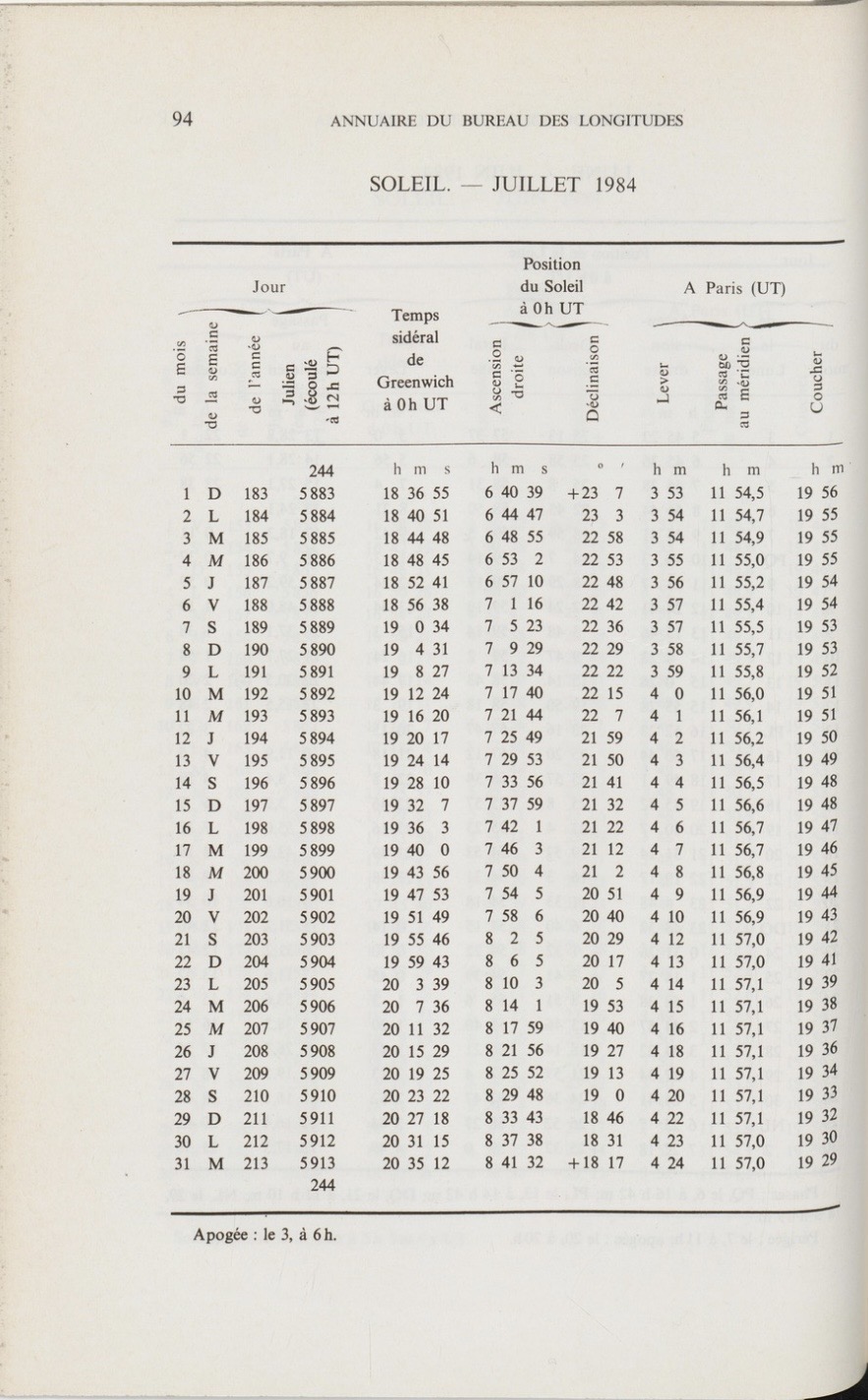
Although unlikely to have been the precise ephemeris consulted, this one would be sufficient to have attained 08h 34m 59s for the event on 29 July 1984 at 21:45 CEST, or 19:45 UT, allowing for the fact that the compiler applied a 12h UT epoch for the calculation (as is often required) rather than the stated 0h UT.
We read off the Right Ascensions for the Sun on 29 and 30 of July, as 8h 33m 43s and 8h 37m 38s, and take their difference as the daily motion of RA. We obtain 3m 55s, or 235s advance per day. Taking (in error) the difference of the the time of the event, 19:45h UT, from 12h UT (should use 0h UT), and we get 7h 45m or 7.75h. Thus, the (erroneously) deduced increase in RA to the event time will be given by:
235s × 7.75h / 24h = 75.89s
So, we need next to add 1m 15.89s to the RA for the incorrectly interpreted epoch RA, and we get:
8h 34m 59s
The same result would have been achieved whatever specific ephemeris was consulted.
“This isn’t right! It’s not even wrong!”—Wolfgang Pauli (1900–1958)
The same result would have been achieved whatever specific ephemeris was consulted.
That is, provided the ephemeris published the solar Right Ascensions according to a 0h UT epoch for 1984. We can immediately rule out any such ephemeris using 12h UT.
“This isn’t right! It’s not even wrong!”—Wolfgang Pauli (1900–1958)