
5. Zodiac Signature Hypothesis: At this stage of the analysis, the focus shifts to identifying the author of the letter, namely Zodiac.
Based on the considerations developed earlier—particularly in point 2—two possible interpretations remain. These can be simplified as follows: the omega sequence can be resolved either through a direct swap between the omega symbol and the letter S, or through a swap combined with mirroring.
In the latter case, the omega symbol remains unchanged due to its symmetry, while the letter S, once mirrored, assumes a negative value.
From these two approaches, four possible author signatures emerge: JS, JB, TS, and TL.
These outcomes stem from two distinct resolution methods:
- an incremental approach, based on the progressive summation of letter values until reaching the unknown variables, yielding the signatures JB and TL;
- a structural approach, which divides the cipher into two macro-sequences defined by the special symbols (theta and the Zodiac crosshair), producing the signatures JS and TS.
Compared to the initial analysis, it is now appropriate to discard the residual letter from the final sequence—namely L—as Zodiac explicitly indicates that the unknown letters to be determined are only two: X and Y.

2. What to do with the omega sequence?
2.1 – First hypothesis: adjust it by moving the omega directly to the final position. However, this opens up several possibilities, since the sequence as divided — “omega ORTG” — needs to be modified. But how?I could simply move the omega to the end by shifting all the letters, obtaining “ORTG omega,” or I could swap the G with the omega, resulting in “GORT omega.”
Ciao, @lendor-77.
So, here there is one small but important point that we must remember. The ‘O’ in the omega sequence is not one of the letters that we can actually move. It has to stay where it is, or else we would break the decryption of the homophonic text, for which the ‘O’ pairs with the sixth symbol and gives us one of our constraints here.
Beyond this one case, however, we are free to move the remaining letters.
“This isn’t right! It’s not even wrong!”—Wolfgang Pauli (1900–1958)
or that the omega sequence itself, given how it is constructed, carries a dual value, representing both “E” and “S.”
Now this, as an assumption, I could really like. Particularly as you have included in your thinking that The Zodiac had deliberately limited himself to 32 symbols, just as the IAU boundary for the constellation Hercules has 32 line segments.
With this limitation in mind, it would be feasible to assume that The Zodiac might have to double up two letters somewhere. And, had he done so, he would likely have wanted to do something different for this block by having the omega start the sequence.
In this way, then, you could both explain why the omega sequences is different from all the others and, at the same time, end up with a clean decoding that produces all the letters of ‘HERCULES’, repeats included.
“This isn’t right! It’s not even wrong!”—Wolfgang Pauli (1900–1958)
Oh, and @lendor-77. I’m sure you won’t mind if I ignore all the noise our discussion seems to be generating and just carry on? Thanks. 👍
“This isn’t right! It’s not even wrong!”—Wolfgang Pauli (1900–1958)
Also, it would be important to think about whether the Zodiac could reach ‘S’ in the same manner as in all the other blocks, merely through assigning the free letters ‘R’, ‘T’, ‘G’ differently, keeping ‘O’ where it is and pushing ‘Ω’ to the end.
I will come back to this idea next, although your recent idea about having the omega sequence produce both ‘E’ and ‘S’ actually answers this particular point very nicely.
“This isn’t right! It’s not even wrong!”—Wolfgang Pauli (1900–1958)
We start, of course, with:
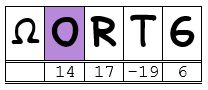
which, according to your preferred scheme (with ‘T’ considered reversed), scores as:
14 + 17 – 19 + 6 = 18 → ‘S’
However, for this we have had to interpret the omega at the start of the sequence as requiring us to accept the ‘T’ as mirrored, otherwise we would have got:
(14 + 17 + 19 + 6) % 26 = 4 → ‘E’
as you know.
“This isn’t right! It’s not even wrong!”—Wolfgang Pauli (1900–1958)
But if the only purpose here was for The Zodiac to give us an ‘S’, then he could have kept to the basic pattern and used:
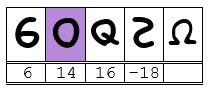
which, likewise, scores as:
6 + 14 + 16 – 18 = 18 → ‘S’.
So, the omega sequence as it is actually given surely must be constructed to give us something else as well as just the ‘S’.
“This isn’t right! It’s not even wrong!”—Wolfgang Pauli (1900–1958)
I’ve had a quick look at this and am sure that it will interest me. I will, however, need to spend some time with it so that I can work on a translation of what is being said. Thanks for posting it, though.
“This isn’t right! It’s not even wrong!”—Wolfgang Pauli (1900–1958)
Ciao @shaqmeister! I’m quite busy today, but this evening try to create a visual summary of what we discussed. That way we can check together whether I understood your questions and your thoughts on the solution correctly 👍
Ciao, @lendor-77.
I am busy as well, up until about midnight (BST) here in the UK.
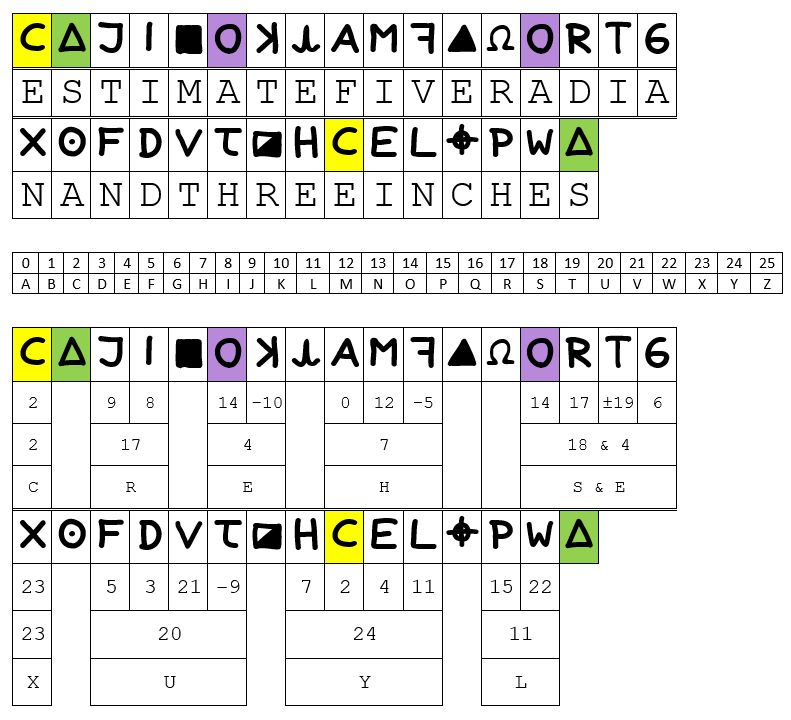
Just to help our thinking along, I will post the following as a “visual summary” of my own.
Hope this helps.
“This isn’t right! It’s not even wrong!”—Wolfgang Pauli (1900–1958)
Basically, this is just your original proposal up until you come to consider the initials (X, Y), with the one addition showing how it might be possible to argue that the omega sequence gives both the final ‘E’ and ‘S’.
“This isn’t right! It’s not even wrong!”—Wolfgang Pauli (1900–1958)
“This isn’t right! It’s not even wrong!”—Wolfgang Pauli (1900–1958)
Look at how the letters are arranged—this is way more than just an anagram! They go counterclockwise, starting from the two nearby special symbols. I don’t think it’s a coincidence! Sorry for the drawing, I’m on my phone.