
And this, finally, would be the situation that we are left with were we to think of adding a further numerical layer to the overall solution.
Let’s assume the author’s initials are ‘MK’, and that he wants to use the same system he used for the second layer to encode these initials in one and the same cipher. Only, at this point, he essentially cannot.
With the second layer added, we have practically nothing left that we could change that would allow random initials to be included in this way. We have already fixed (constrained) the positions of the symbols, as well as the sizes of each of the blocks and what letters they must evaluate to. Likewise, this practically fixes what cipher letters each block must contain and, further, we have no ‘freedom’ left to reorder any of the blocks.
Thus we are almost fully constrained at this point, as the second layer of interpretation pretty much defines the cipher text to be precisely as we have it without any meaningful scope to make further changes.
As noted, then, it is left for the author only to be able to find his initials there already, or else to give up on any third layer of meaning, as having no way left to put them there.
‘UL’ then becomes, easily, the simplest and most obvious example that supposes the former.
“This isn’t right! It’s not even wrong!”—Wolfgang Pauli (1900–1958)
I’m not entirely convinced that the order of the initials is that important. If, in the end, we had to choose between UL or LU, I don’t think it would make a significant difference from an interpretative standpoint.
It would certainly make a “significant difference” to Lucio Umbri, if we had just arrested him when Umberto Leoni was the one who actually did it. 😉
“This isn’t right! It’s not even wrong!”—Wolfgang Pauli (1900–1958)

I understand your point, and I think I see what you mean when you say that the constraints become tighter once the “HERCULES” layer is fixed. The idea that the second layer effectively locks the structure, leaving very little room for adjustment, is understandable.
That said, I’m not entirely convinced that the system is as fully constrained as you suggest. But even if we momentarily accept that UL are indeed Zodiac’s initials, a question naturally arises: why arrange the sequences in this way?
Wouldn’t it have been simpler to structure everything so that the final result was directly readable, for example:
first row: H E R C
second row: U L E S
Possibly introducing a variation (such as inverted sequences) specifically for U and L, in order to highlight that they represent his initials.
A solution like this would have been, on the one hand, more straightforward, while still maintaining a level of complexity comparable to the original Z32.
These are good questions, @lendor-77.
As to “why” the author might have arranged things in this way, I would be taking the following into consideration:
Firstly, what is more simple to highlight that the intended initials are UL than to simply introduce the ‘X’ and ‘Y’ blocks as markers in the order ‘XUYL’? If he has originally produced only ‘HERCULE/S’, he would then have had the freedom to introduce these two blocks without disturbing anything.
Secondly, what could be more of an additional hint than to purposely set the sequence ‘XUYL’ on its own line, strongly signalling that this line is doing something else that the other isn’t?
In thinking about the second point, you could ask yourself, also:
Why is a 32-character cipher split over 2 lines of lengths 17 and 15 and not 16 characters each?
And, why has the author chosen to start and end the counterclockwise path on what is otherwise a completely random position in the cipher, if it is not precisely to get ‘XUYL’ alone on the last row?
These would be my thoughts.
“This isn’t right! It’s not even wrong!”—Wolfgang Pauli (1900–1958)
Perché un cifrario di 32 caratteri è suddiviso su 2 righe di lunghezza 17 e 15, anziché su 16 caratteri ciascuna?
I think there’s actually a pretty simple explanation for that. It could just be that the author stuck to the same format used in the previous ciphers, where the maximum line length is 17 characters.
So the first row of the Z32 hits that limit (17), and the second row just contains whatever is left (15). It might not be a cryptographic choice at all, but more of a formatting habit for consistency.
The Z13 is different simply because it’s too short to reach that length, so there’s no need to break it into multiple lines.
You could think about the arrangement of the cipher blocks as being something like a choker necklace.
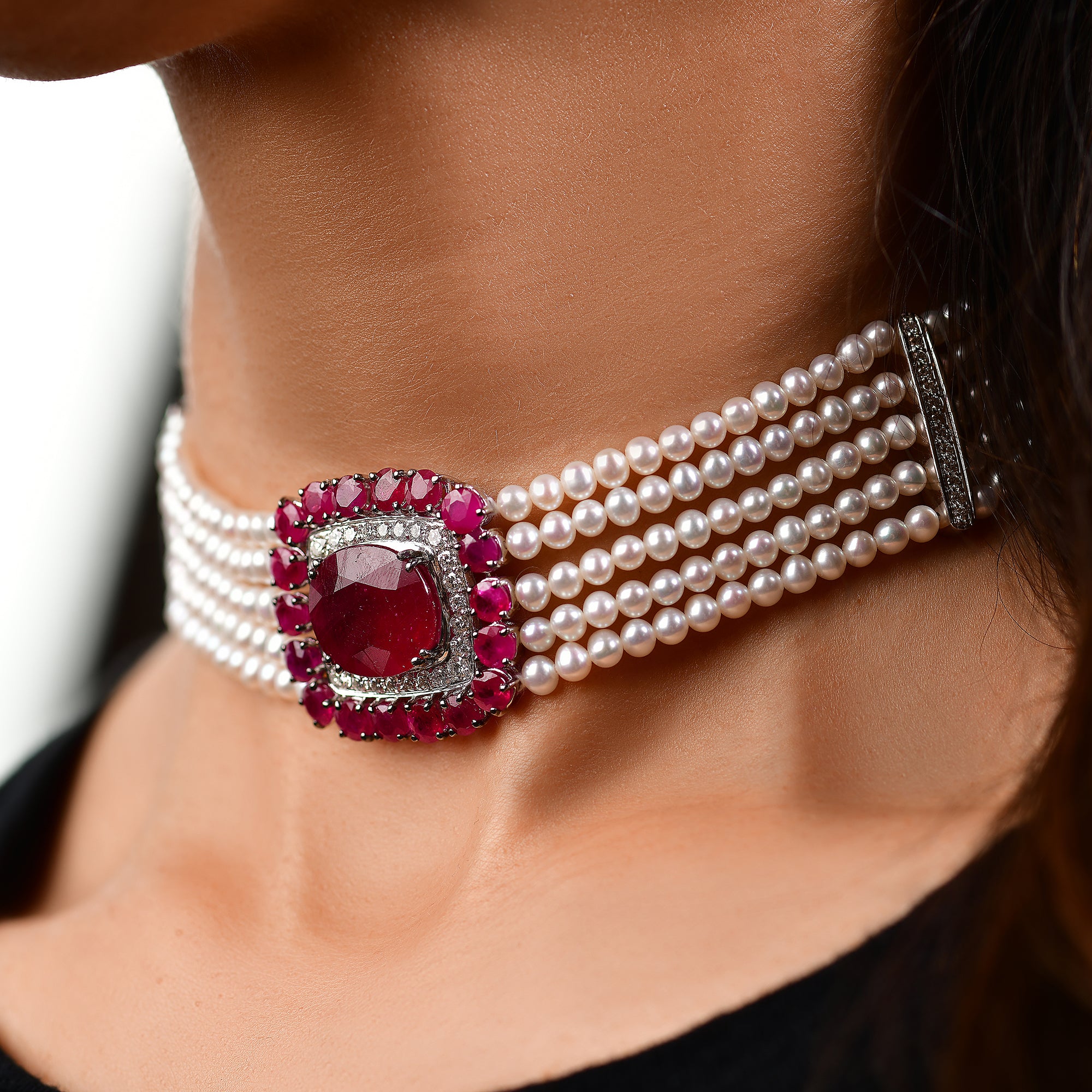
It has been made ‘circular’ so that it can be rotated around on the neck. Then, to position it properly, you select that particular rotation that has the jewel piece nice and centrally at the bottom.
“This isn’t right! It’s not even wrong!”—Wolfgang Pauli (1900–1958)
But coming back to the point: if the initials were really UL, why not simply use XX as markers instead of XY?
Again, because ‘U’ and ‘L’ are different. ‘X…X…’ would be suggestive of the two initials being the same, wouldn’t it? 🤔
“This isn’t right! It’s not even wrong!”—Wolfgang Pauli (1900–1958)
I wonder if the difference in our thinking might be that you are viewing the ‘XY’ as simply markers, in which case they could reasonably be the same, whereas I, on the other hand, see them more as assigned variables, with ‘XUYL’ implying:
X = 'U'; Y = 'L'
“This isn’t right! It’s not even wrong!”—Wolfgang Pauli (1900–1958)
And then, once again (and apologies for the rapid posting of thoughts), to me it is crucially important to use ‘X’ and ‘Y’, so that we are ultimately able to deduce the author to have been one Umberto Leoni, and not his friend Lucio Umbri.
“This isn’t right! It’s not even wrong!”—Wolfgang Pauli (1900–1958)
Ok, now I understand how you’re treating X and Y. I’m not 100% convinced yet, but your reasoning makes sense.
As I mentioned a few posts ago, we could probably debate the initials endlessly. I still consider my original idea for identifying Zodiac’s signature to be solid and defensible; however, when I compare it to the one you’ve found, yours is definitely more interesting in terms of simplicity and how directly it leads to the initials.
In any case, I’m not relying only on this solution for the Z32. I’ve also developed an interpretation of the Z13 which, in my opinion, further strengthens the overall picture. I’d like to show it to you, but I have a practical limitation right now: I don’t have the time to translate it into English, and for obvious reasons I’d prefer not to share it publicly here. I would have to send it to you by email.
That said, I think it would still be hard to convince you with that as well. I consider my Z13 solution to be a good one, but claiming to have definitively solved that cipher would be quite an exaggeration 🤣 Probably we’d need Zodiac himself to confirm the solution… and even if he were still alive, I doubt he would remember how to solve it.
On top of that, I also have some cryptographic and steganographic analyses related to the Monster of Florence case which, in my opinion, show interesting connections with Zodiac and help reinforce this hypothesis. Some parts are difficult to translate because they are strongly tied to the Italian language, while others I might be able to share here, maybe starting as soon as this evening.
I have found it very interesting to have followed your thinking as you have presented it in this thread. I only hope I have not been a distraction with my own thoughts from time to time.
Before now, I had not given any attention to the many non-homophonic substitution solutions that have been put forward, having found most to be far too random and indefensible. But your proposal certainly presents a number of features that make it much more compelling, and I have learnt a lot by seeing how you develop it.
I can understand that you do not want to post your other work publicly at this time. Unfortunately, there doesn’t appear to be any private messaging function on this forum, otherwise I would have been happy to send you my e-mail address.
What I do think there is, however, is a function that allows you to create private threads, if that is an option? I’m guessing such threads would then only be visible to invited members, but I’m not quite sure.
In the meanwhile, keep up the good work @lendor-77!
“This isn’t right! It’s not even wrong!”—Wolfgang Pauli (1900–1958)
Just out of interest, are you able to tell me how the name ‘Ulysse’ (specifically) fits into the MoF case? I’ve seen different accounts, claiming anything from it being a known nickname for various people suspected of having been the MoF, including Bevilacqua, I believe, to a more mysterious monicker for an unidentified ring leader. I only ask because I have seen this name often in this form (as ‘Ulysses’, without the final ‘S’) and it just reminds me that, in your proposal, it can be most simply argued that you have ‘Hercule’ (as ‘Hercules’, without the final ‘S’). Would these both be French forms of the two classical heroes, both of whom were, at different times, sackers of Troy?
“This isn’t right! It’s not even wrong!”—Wolfgang Pauli (1900–1958)
One final question for this afternoon, as I’m needing to get off to work soon…
Have you ever given consideration to the thought that The Zodiac’s “My name is ______” might, in fact, be complete in itself, as in:
“My name is [I’m not going to give you my name].”
and that the cipher below this starts a completely new idea and doesn’t have anything to do with names?
After the cipher, the letter itself just goes on to talk about bombs.
At the very least, I have always wanted to make sure that I never ruled this out as a possibility. (Indeed, it has always been my preference to view it in this way.)
“This isn’t right! It’s not even wrong!”—Wolfgang Pauli (1900–1958)
Per pura curiosità, potresti spiegarmi come il nome “Ulisse” (nello specifico) si inserisce nel caso del Maestro delle Finanze?