
So, this:

variously interpreted by Zodiac researchers to represent a gunsight, to be a symbol merely copied (for no especial reason) from the branding of the Zodiac watch, as well as a number of other less readily accepted conceptualisations. But these start out from how we choose to conceptualise the symbol. What, then, of how The Zodiac himself perceived its ‘meaning’?
I think we can get close to the author’s conceptualisation through careful study of the two key instances where it is clear The Zodiac was using this symbol for a purpose other than as just his signature.
These occur, firstly, on the ‘Death Machine’ letter of 9 November 1969, as:

and, secondly, on the Phillips 66 map sent with the Z32 cipher on 26 June 1970:

“This isn’t right! It’s not even wrong!”—Wolfgang Pauli (1900–1958)
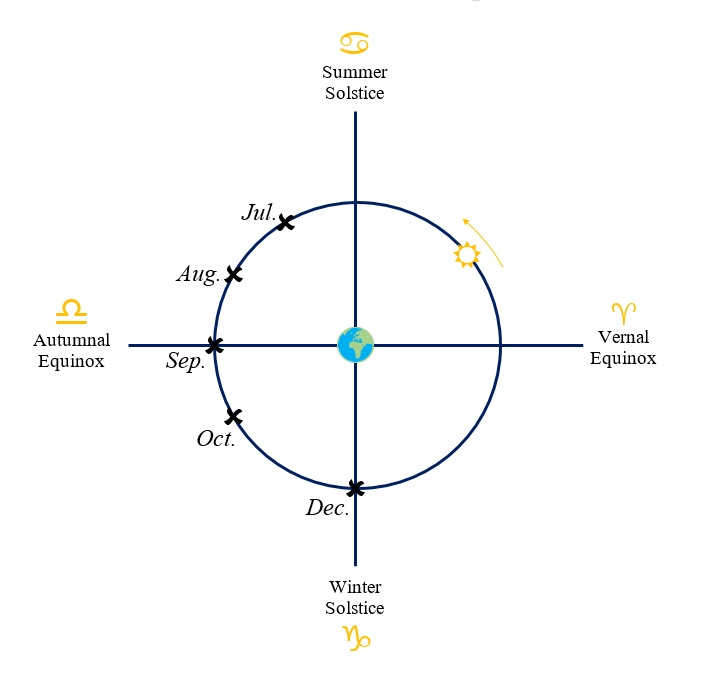
If we look, then, at the first example from 9 November 1969—actually sent, or at least postmarked, on the very day of Stine’s shooting in Presidio Heights—we can see clear indication that The Zodiac conceived a method of communication of some information that required the circle of his symbol to be marked off with 12 equally spaced points, 4 of these formed from the cross itself, and 8 interpolated. What is further evident, however, is that, whatever it is he is marking out here, he does not appear to be interested in conveying any further interpolations. All of the five marked crosses fall on one or other of these 12 points and not in between.
This point alone indicates that we are not to visualise the circle of The Zodiac symbol as presenting any kind of continuous line or scale used for mapping, but rather as merely a medium for plotting against 12 differentiated and discrete points. There is no consideration, and therefore no implied meaning, to any ‘in-between’ points.
This observation alone will help us when we come to the next part, which is to consider what it may actually be that he is plotting for us in this manner.
The general interpretation to be presented next is, to date, a well-discussed one, presented, however, with some additional speculations.
“This isn’t right! It’s not even wrong!”—Wolfgang Pauli (1900–1958)
On the door of Hartnell’s car at Lake Berryessa The Zodiac had written the dates of his first two hits, together with the one he had just committed.

We are going to pull out and be focussing on the specific months in which each of these occurre, to which we add the most recent shooting to give us:
- December;
- July;
- September;
- November,
given which we can conceive of the figure as documenting this sequence of months visually, together with one tantalising, perhaps spurious, addition.
“This isn’t right! It’s not even wrong!”—Wolfgang Pauli (1900–1958)
If we look, then, at the first example from 9 November 1969—actually sent, or at least postmarked, on the very day of Stine’s shooting in Presidio Heights
CORRECTION: Stine was actually shot on 11 October 1969, and the Zodiac did send a letter on this date, but it was not this one.
“This isn’t right! It’s not even wrong!”—Wolfgang Pauli (1900–1958)
We are going to pull out and be focussing on the specific months in which each of these occurred, to which we add the most recent shooting to give us:
- December;
- July;
- September;
- November October.
CORRECTION: as previous.
“This isn’t right! It’s not even wrong!”—Wolfgang Pauli (1900–1958)
This interpretation is, however, only possible if, together with the point made about there being only 12 discrete points to plot against, we accept the following as also inherent in the construction of the figure:
- that the direction of the sequence of months projected in this manner goes counterclockwise; and
- that the origin of the sequence of months, if we take this conventionally to be January, does not sit at one of the cardinal points of the figure, but off to one side.

Both of these appear odd and, perhaps, counterintuitive initially. However, some of this uneasiness can easily be dispelled through asking what the significance, if any, of the four cardinal points could be otherwise. What occurs, consistent with this choice of association, in the months of December, March, June and September?
“This isn’t right! It’s not even wrong!”—Wolfgang Pauli (1900–1958)
To those in the know, of course, in June and December we have the Summer and Winter Solstices, respectively, whilst in September and March we find the Autumnal and Vernal Equinoxes. And these, plotted on a reduced down schematic of the celestial zodiac, would be rendered precisely in this very way, with:
- a cross over a circle where the circle is “the zodiac” and the lines of the cross the solstitial and equinoctial colures; and
- the direction of progression of the Sun through the zodiac going counterclockwise.
These two correspondences, taken together, must surely indicate that, at least for this usage, The Zodiac was conceptualising his chosen symbol in terms of nothing other than the celestial zodiac. Indeed, with the same evidenced clearly here, we must at least be open to the idea that this is precisely how he had conceptualised the use of this symbol all along.
“This isn’t right! It’s not even wrong!”—Wolfgang Pauli (1900–1958)
We get some degree of support for the above claim when we turn to look at how the symbol was again used later as a ‘compass rose’, setting the origin of coordinates for use on the Phillips 66 map.
In this case, then, he again gives us the circle divided by 12 points. Only now, because the usage is one of defining merely a bearing (with no additional astronomical associations) he:
- chooses the clockwise direction for his numbering; and
- has the zero at one of the cardinal points.
As he did not, likewise, take this simplistic approach for the previous figure, we can be confident that the choices he made there were deliberate and for a specific reason, as demonstrated.
“This isn’t right! It’s not even wrong!”—Wolfgang Pauli (1900–1958)
In summary, this:
“This isn’t right! It’s not even wrong!”—Wolfgang Pauli (1900–1958)
And just to be clear, in presenting this I am not wanting to suggest that The Zodiac had any particular interest in dates or zodiac signs as guiding his killing, just that his symbol provided a convenient way of broadly representing the months in which he killed, but that this requires a conceptualisation of his symbol, on his part, as being “the zodiac.”
“This isn’t right! It’s not even wrong!”—Wolfgang Pauli (1900–1958)

Hey Shaq! I had no idea anyone was posting on here. This is an image I found somewhere so long ago I have no idea… anyways this target was put out by the same company JC Higgins that the police believe was used in the Lake Herman Road attacks. I still tend to think that Zodiac came up with his symbol and name after that attack but who knows
Hey, Druzer. Yeah, it’s not the most active forum around these days. I’m old school and remember when this was where you came for the serious discussions. Myself, personally, I post here when I’m working on something and I want to get it down somewhere and out of my head, but not have it get totally lost behind a wall of topic wandering.
Here, I’m putting forward a case which, in essence, poses a challenge to the currently unquestioned view that has the Zodiac symbol has to be viewed as a ‘crosshair’ or gun sight. In this analysis, I’m just wanting to show that there is evidence that, at some point around 09 November 1969 letter at least, The Zodiac himself was able to conceive of, and use, his symbol as a representation of the celestial zodiac. Whether this was the only way in which his symbol was imagined by him is another question, and certainly he later used it as a compass rose on the Phillips 66 map.
The key conclusion for the argument here is that the points marked on his symbol correspond precisely to the months that The Zodiac had listed on the Dripping Pen card, but further that:
- the order of the months, as marked, go counterclockwise (which is the direction of the sun’s apparent travel around the celestial zodiac); and
- the months are aligned such that December corresponds with a point where the cross of the symbol cuts the circle (the Winter Solstice).
These two observations, taken together, leave little room for any other interpretation than that the Zodiac was here visualising his symbol with the circle being the annual path of the sun through the zodiac, the cross marking the solstitial and equinoctial colures.
If any other conception of the symbol had been in the Zodiac’s mind when drawing this figure, we would undoubtedly have expected likely a clockwise direction with January at one of the intersections.
“This isn’t right! It’s not even wrong!”—Wolfgang Pauli (1900–1958)
Here’s the list of five months which The Zodiac added to the Dripping Pen card:
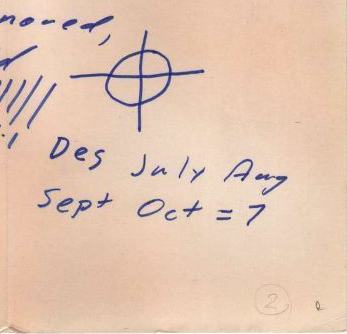
for comparison with how these same months are represented in the letter of 09 November 1969, sent just one day later.
“This isn’t right! It’s not even wrong!”—Wolfgang Pauli (1900–1958)

In summary, this:
Hey Shaq! I found this idea you posted really interesting!
I know I might be trying to make it fit my own theory 😄, but take a look at the dates of the Monster of Florence murders on Wikipedia. 😉
Hopefully I’ll come back here with something interesting to share. In the meantime, I stop by every now and then to read what you write!