
Hi Shaq! First of all, congratulations on the work you’ve done. As an architect, I know very well what it means to spend time on this kind of thing, the hours just fly by without you even noticing!
I also wanted to share an interesting video with you about the famous Zodiac composite sketch. It includes some thoughts on the possibility that the sketch may not fully reflect what the survivors actually saw.
Here’s the link: https://www.youtube.com/watch?v=taL5qoQtlp8
The interesting part starts at around 57:15. Unfortunately, the video is in Italian, but you should be able to use automatically translated subtitles.
Have a great day!

Given that we now have determinable eye-to-subject distances and angles obtainable from our model, we can go on to make some broad deductions about what degree of feature detail we might accept as having been realistically discernible by the Robbins witnesses. Specifically, we might want to ask whether the viewing conditions were such that we can have confidence in the rendering of the composite sketches that were produced and, if only so to a limited degree, then to what limit.
As our research above led us to note, a common standard for the minimal angle of resolution (MAR) for 20-20 vision under ideal viewing conditions is 1 arcminute (1′), or a sixtieth of a degree. As pointed out, however, we cannot assume such ideal viewing conditions as being those experienced by our witnesses, but what we can do is perform a graded analysis to steadily introduce degrees of visual separation degradation, taking this down to, say, 2′ and even 4′.
For our modelling, then, we will introduce something we can call a ‘Resolution Factor’ (RF). For any given feature of our scene, we can calculate an RF using:
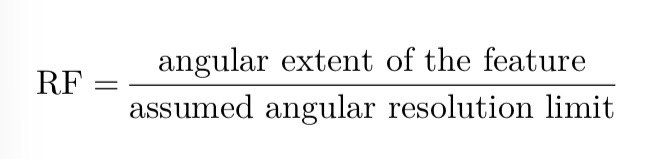
Using this formula, we will be able to extract precise measurements from within our model, deduce a resolution factor for each of our key features of interest under the various minimal angles of resolution and then grade them according to a deterministic set of interpretive bands, which we can define next.
“This isn’t right! It’s not even wrong!”—Wolfgang Pauli (1900–1958)
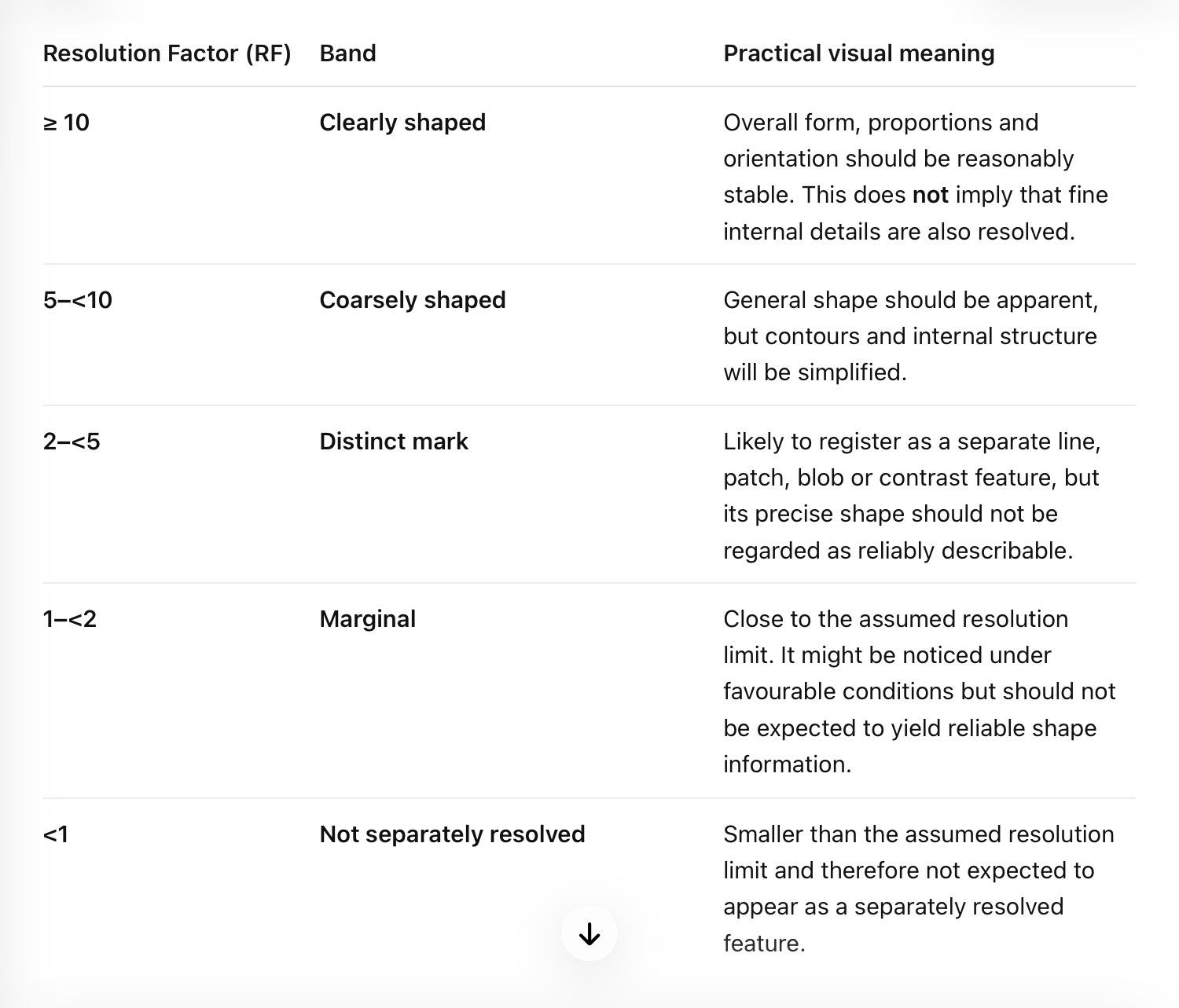
For our interpretive banding of the extent to which specific features may be clearly discernible under our chosen visual conditions, we will make use of the following classification:
“This isn’t right! It’s not even wrong!”—Wolfgang Pauli (1900–1958)
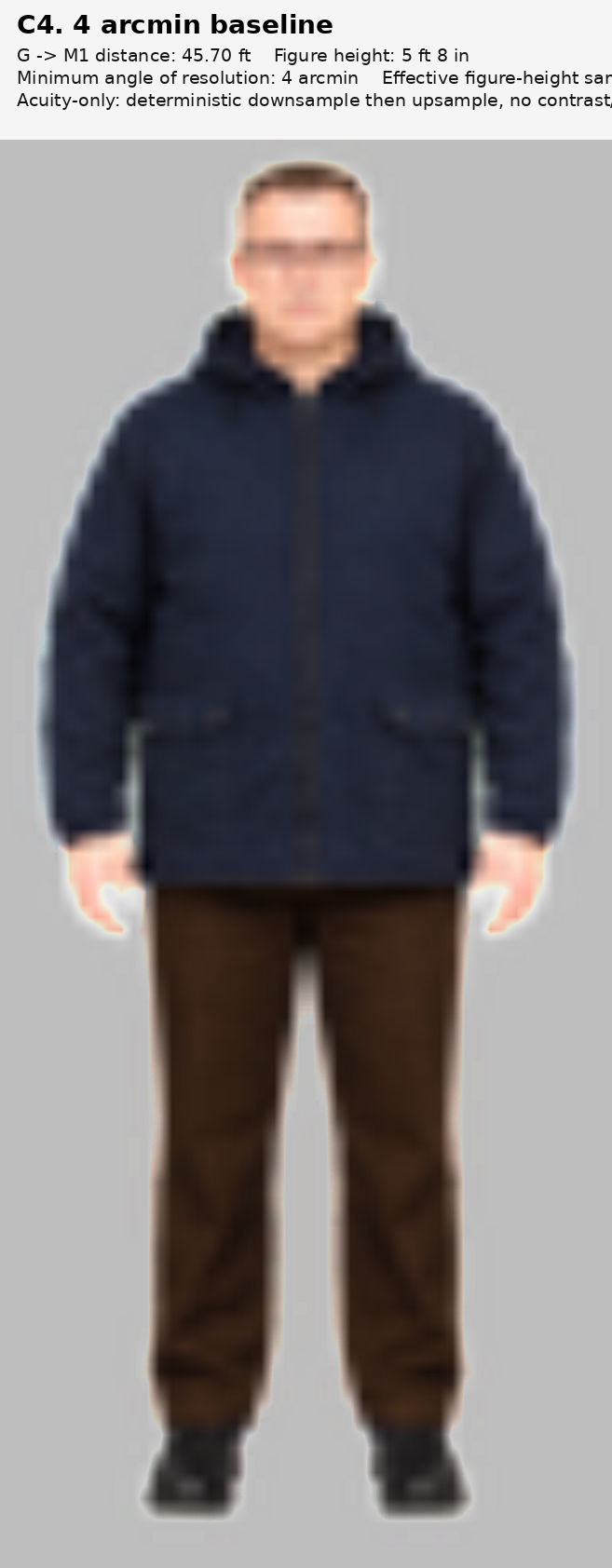
Here, then, are the results we would obtain for our three candidate MARs of 1′, 2′ and 4′ for a figure of height 5′ 8′′ standing 45.70 ft away in an unobstructed face-on view.
Idealised 1′ resolution
| Feature | Angular extent | RF at 1′ | Interpretation |
|---|---|---|---|
| Full figure height | 425.7′ | 425.7 | Clearly shaped |
| Maximum body width / build | 166.8′ | 166.8 | Clearly shaped |
| Shoulder width | 144.4′ | 144.4 | Clearly shaped |
| Head height | 56.0′ | 56.0 | Clearly shaped |
| Head width | 50.1′ | 50.1 | Clearly shaped |
| Glasses — overall width | 43.6′ | 43.6 | Clearly shaped |
| Eye-to-eye centre spacing | 19.8′ | 19.8 | Clearly shaped |
| Mouth width | 18.3′ | 18.3 | Clearly shaped |
| Nose length | 13.0′ | 13.0 | Clearly shaped |
| Nose width | 12.7′ | 12.7 | Clearly shaped |
| Spectacle lens/frame height | 10.0′ | 10.0 | Clearly shaped |
| Single eye aperture width | 7.4′ | 7.4 | Coarsely shaped |
| Lip vertical thickness | 3.2′ | 3.2 | Distinct mark |
| Spectacle-frame/temple thickness | 1.5′ | 1.5 | Marginal |
Baseline 2′ resolution
| Feature | Angular extent | RF at 2′ | Interpretation |
|---|---|---|---|
| Full figure height | 425.7′ | 212.9 | Clearly shaped |
| Maximum body width / build | 166.8′ | 83.4 | Clearly shaped |
| Shoulder width | 144.4′ | 72.2 | Clearly shaped |
| Head height | 56.0′ | 28.0 | Clearly shaped |
| Head width | 50.1′ | 25.1 | Clearly shaped |
| Glasses — overall width | 43.6′ | 21.8 | Clearly shaped |
| Eye-to-eye centre spacing | 19.8′ | 9.9 | Coarsely shaped |
| Mouth width | 18.3′ | 9.1 | Coarsely shaped |
| Nose length | 13.0′ | 6.5 | Coarsely shaped |
| Nose width | 12.7′ | 6.4 | Coarsely shaped |
| Spectacle lens/frame height | 10.0′ | 5.0 | Coarsely shaped |
| Single eye aperture width | 7.4′ | 3.7 | Distinct mark |
| Lip vertical thickness | 3.2′ | 1.6 | Marginal |
| Spectacle-frame/temple thickness | 1.5′ | 0.7 | Not separately resolved |
Degraded 4′ resolution
| Feature | Angular extent | RF at 4′ | Interpretation |
|---|---|---|---|
| Full figure height | 425.7′ | 106.4 | Clearly shaped |
| Maximum body width / build | 166.8′ | 41.7 | Clearly shaped |
| Shoulder width | 144.4′ | 36.1 | Clearly shaped |
| Head height | 56.0′ | 14.0 | Clearly shaped |
| Head width | 50.1′ | 12.5 | Clearly shaped |
| Glasses — overall width | 43.6′ | 10.9 | Clearly shaped |
| Eye-to-eye centre spacing | 19.8′ | 5.0 | Coarsely shaped |
| Mouth width | 18.3′ | 4.6 | Distinct mark |
| Nose length | 13.0′ | 3.2 | Distinct mark |
| Nose width | 12.7′ | 3.2 | Distinct mark |
| Spectacle lens/frame height | 10.0′ | 2.5 | Distinct mark |
| Single eye aperture width | 7.4′ | 1.9 | Marginal |
| Lip vertical thickness | 3.2′ | 0.8 | Not separately resolved |
| Spectacle-frame/temple thickness | 1.5′ | 0.4 | Not separately resolved |
“This isn’t right! It’s not even wrong!”—Wolfgang Pauli (1900–1958)
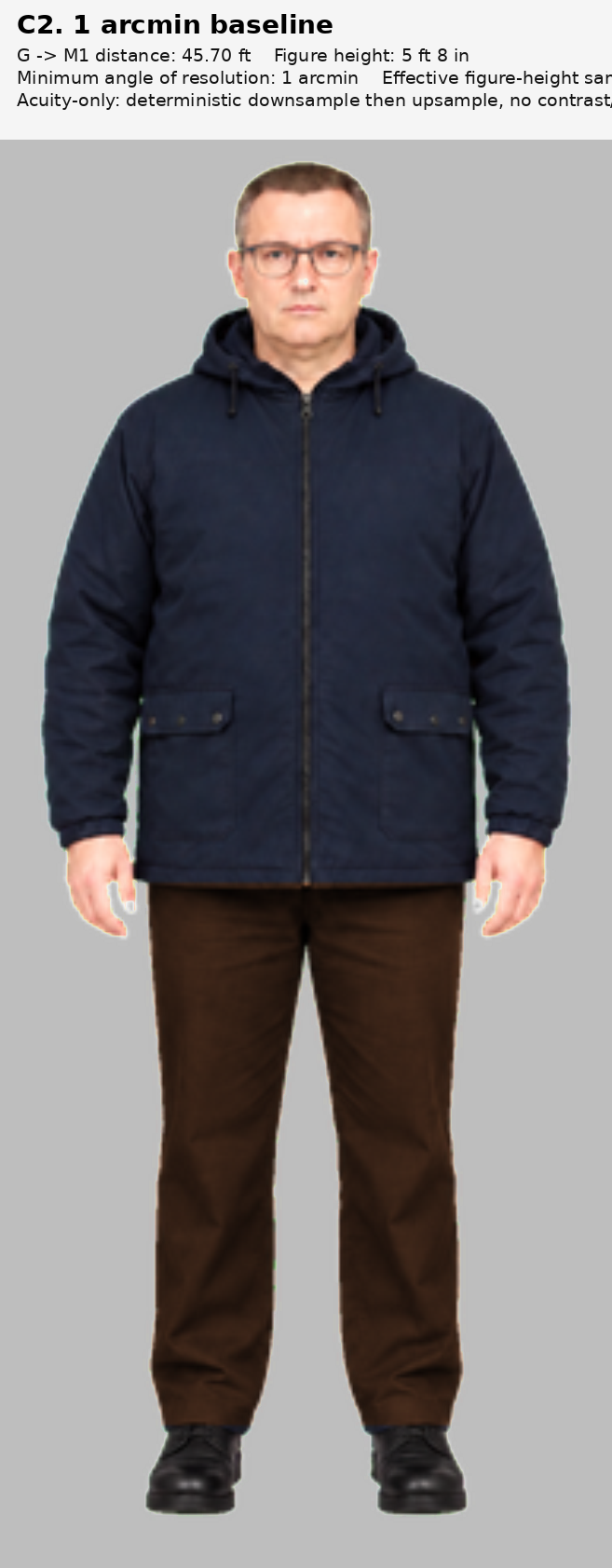
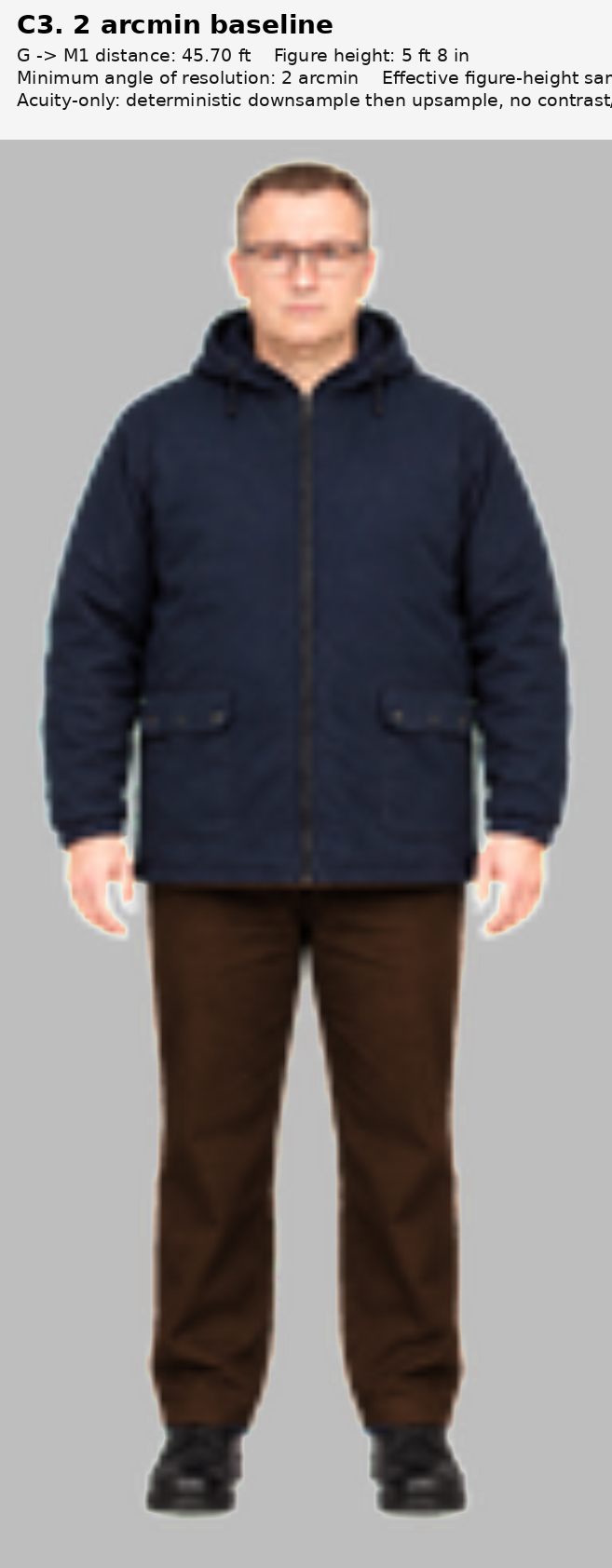
Taking this data, we can go one step further and offer it in visual representation, one rendering for each MAR of 1′, 2′ and 4′, respectively. It needs to be clearly noted, however, that the following images are not in any sense intended to convey how our figure would appear to our witnesses’ vision. Rather, they convey the specific degradations we have identified in visual acuity and the ability to distinguish and describe specific features.
For the three cases considered, we have:
“This isn’t right! It’s not even wrong!”—Wolfgang Pauli (1900–1958)
So, what does all this tell us about what the Robbins witnesses saw or, more correctly, given the appropriate viewing opportunities we have taken into consideration, what would they have been capable of seeing and discerning?
Firstly, the data we have been working with here should give us little concern regarding confirmation that the broad details documented from the scene in Pelissetti and Peda’s report are very comfortably matched to what our visual analysis predicts could reliably be observed.
As to stature, we must of course hold back from claiming that the witnesses could precisely ascertain that the unsub was 5′ 8′′ in height. Nonetheless, the individual’s height provides the grossest feature capable of resolution in the view and we have, also, his position standing close against a vehicle of well-defined dimensions and one which remained at the scene after the killer had fled and whilst the witnesses were giving their description to Pelissetti. It can be proposed, but not stated with certainty, that the question of height as observed by the teens may have been developed from having various of the officers present stand by the car, whilst the witnesses were returned for this purpose to their viewing stations. Build is likewise clearly also readily discernible, with the torso and shoulder dimensions occupying very large angular extents, surviving even down to the 4′ degraded-resolution case comfortably. Clothing can mask build to some extent, of course. However, an oversized jacket on a slender person has a very different hang to one that is well-fitted on a broader figure.
The cut of the unsub’s hair likewise, as to its gross extent in overall hair boundary, sits again far above the fine-detail threshold, although we would have to consider the illumination and spectral/contrast conditions to assess the colour with the same precision. In the view passing around the back of the cab, if this was indeed the primary view, we would have to factor in the possibility that the rear lights of the cab may have been contributing something of the “reddish” to an otherwise “blond.”
The glasses, again, are such that we can be confident in claiming that their overall shape and configuration would have been presented in an ample angular extent to permit the easy identification of spectacles being worn. However, the specific details of the rims, etc., fall into a different category, as we can see, and we must be more cautious in attributing any ability to distinguish the frame type and thickness even under optimal conditions.
We have already discussed the description of clothing to some extent, and the present analysis of spatial resolutions supports our earlier suggestion that the type of jacket, its fall and its cut, would not have presented any difficulty of distinction to our witnesses.
However, the details required to have been clearly seen and distinguished, in order to give credence to the finer features presented in our two subsequent composites, sit much, much closer to, if not over, any reasonable acuity threshold.
“This isn’t right! It’s not even wrong!”—Wolfgang Pauli (1900–1958)
Any broad age estimate has to be treated somewhat differently. In close-up, high visibility situations there are a multitude of fine facial details that are considered when we come to offer a guess at how old someone appears to us. As our analysis has shown, the majority of these finer details are likely to have been unavailable to the witnesses under their viewing conditions on the night of the murder. However, age estimates do not derive solely, nor perhaps even predominantly, from such fine descriptors. We derive our estimates from an accumulation of things such as facial proportions, facial maturity, hair appearance, build, posture, movement, and potentially clothing/social-age cues, all of which attain some degree of definition above our specific thresholds here.
Similar to how we proposed the witnesses might have been assisted to fix on a height estimate at average height, we could readily imagine the witnesses clarifying their perception in some such manner as “older than the officer here [early thirties] but definitely not as old as my dad [52].” “Like the Detective here [Toschi, 38]?” “Maybe a little older.”
“This isn’t right! It’s not even wrong!”—Wolfgang Pauli (1900–1958)
In summary:
1. Set-up & Methodology
Our initial 3-D modelling, constructed using all available data from a multitude of sources to permit the scene to be recreated with sufficient accuracy to determine precise viewing lines and distances, as well as back-drops and scene shadowing, firstly confirms the broad assessment of Pelissetti in his initial report of an unobstructed viewing from around 50ft, with this distance being somewhat increased on taking the initial sightline to have been from the dormer window of 3899. This, then, became the basic test arena for our further analysis.
Having only an anachronistic 2000s NYC cab to place in our model for broader illustrative purposes and to estimate shadowing, we couldn’t on this occasion progress into the detail of what might have been seen specifically regarding what was later reported to have taken place inside the cab. However, the cab footprint alone has permitted us to scale and station our unsub sufficiently that we could use the model to determine precise line-of-sight distances and overall lighting conditions. Specifically, we find our unsub to have been front-lit from the Robbins house views by a single street light on the south-east corner of Washington and Cherry, an arrangement strongly conducive to aiding our reconstructed front-on views through both good subject lighting and an assumed lack of direct lighting, or glare, feeding back into the viewing stations.
For the quality and intensity of lighting itself, it has only been possible to approximate this in the model using contemporary data sheets assuming that the area around Washington and Cherry was subject to the city’s major 1960s street-lighting modernization programme in which existing overhead district lighting was being converted to mercury-vapour, with the city further increasing both the number of streetlights as well as their total lumen output. We have thus modelled the streetlight as a late-1960s municipal mercury-vapour streetlight in an enclosed prismatic cobrahead. Care was taken to try and model the precise spectral output of such a lamp, which would have produced a cool bluish-white/blue-green light from the mercury vapour.
Taking as our primary view that of the unsub walking around the back of the car to the driver’s door, thus facing directly any witnesses stationed at that moment in the ground floor window, we determined the primary features of this one scene to be likewise unobstructed with the unsub strongly front-lit from the streetlamp against a contrasting background of concrete steps and raised garden features unshadowed by either the vehicle or the two trees that feature prominently in the scene. For the direct distance we determined 45.70 ft and, from there, we were able to start analysing what degree of detail we would expect to have been distinguishable in the features of our so-placed unsub.
We considered a minimum angle of resolution (MAR) of 1 arcminute (1′) to have been that which would be achievable by 20-20 vision under optimal viewing conditions. We do not assume that this would have been achieved by our witnesses here, although 1′ is not to be taken as wholly unrealistic. Instead, we introduced a plausible degradation to 2′ as a reasonable working baseline, adding in a deliberately pessimistic sensitivity case at 4′. We then analysed a set of features presented by the unsub to this view using an interpretive classification as to which features would be likely to survive visual separation and distinction at the given MAR and which not.
“This isn’t right! It’s not even wrong!”—Wolfgang Pauli (1900–1958)
2. Conclusions
Our modelling and analysis suggests that the witnesses were likely to have had enough visual information to support a broad, coherent description of the unsub, even taking into consideration the night-time lighting conditions at the scene. At our 2′ MAR baseline, large-scale characteristics such as WMA, approximate stature, heavy build, short closely-cropped hair, the presence of glasses and the general cut, length, bulk and darkness of the clothing were found to lie well within the range of plausible observation. This, then, should give us relatively good confidence in the broad description recorded by Pelissetti at the scene, while allowing greater uncertainty only where the description depends on finer visual information, such as precise hair colour or narrow numerical age estimation.
In contrast, this analysis supports only a more qualified reading of the subsequent composite drawings. In relation to these, we can have reasonable confidence in features that depend on broad facial structure or conspicuous high-contrast elements: overall head and face shape, hair mass and hairline, the presence and general size of the glasses, the broad spacing and relationship of the eyes, nose and mouth and any pronounced silhouette features that may have been present. However, confidence should fall progressively for the finer details such as exact eye shape, lip form, small nasal contours, wrinkles, skin texture and subtle cheek modelling.
It is therefore assessed that the composites are best treated as potentially reliable for overall configuration and gross morphology, but much less securely for fine line-level facial detail.
“This isn’t right! It’s not even wrong!”—Wolfgang Pauli (1900–1958)