
I don’t know how much difference that makes, but thought it worth pointing out.
Hi @letega.
Thank you. Yes, certainly worth pointing out.
As I had noted previously, the code I’ve used here is stripped down and re-parameterized from that linked to elsewhere by user @coder1987, and the error evidently stems from there. As you have seen, record 274147 actually relates to the Three Peaks Mountain in Monterey, CA, and not Diablo. The correct entry for Mount Diablo would be record 222343.
Even then, the coordinates for this entry are given as 37.8816462, -121.9140403 and not the 37.881628, –121.914382 in the original codebase.
I have to think that, as the code was auto-generated initially using AI, the author’s assistant had got muddled up a little with both its figures and its source references.
Of the various values available, I find that the coordinates given by the Wikipedia article pin the actual summit most closely, and so I have changed to these values also in the code, although the difference this makes is minimal.
“This isn’t right! It’s not even wrong!”—Wolfgang Pauli (1900–1958)
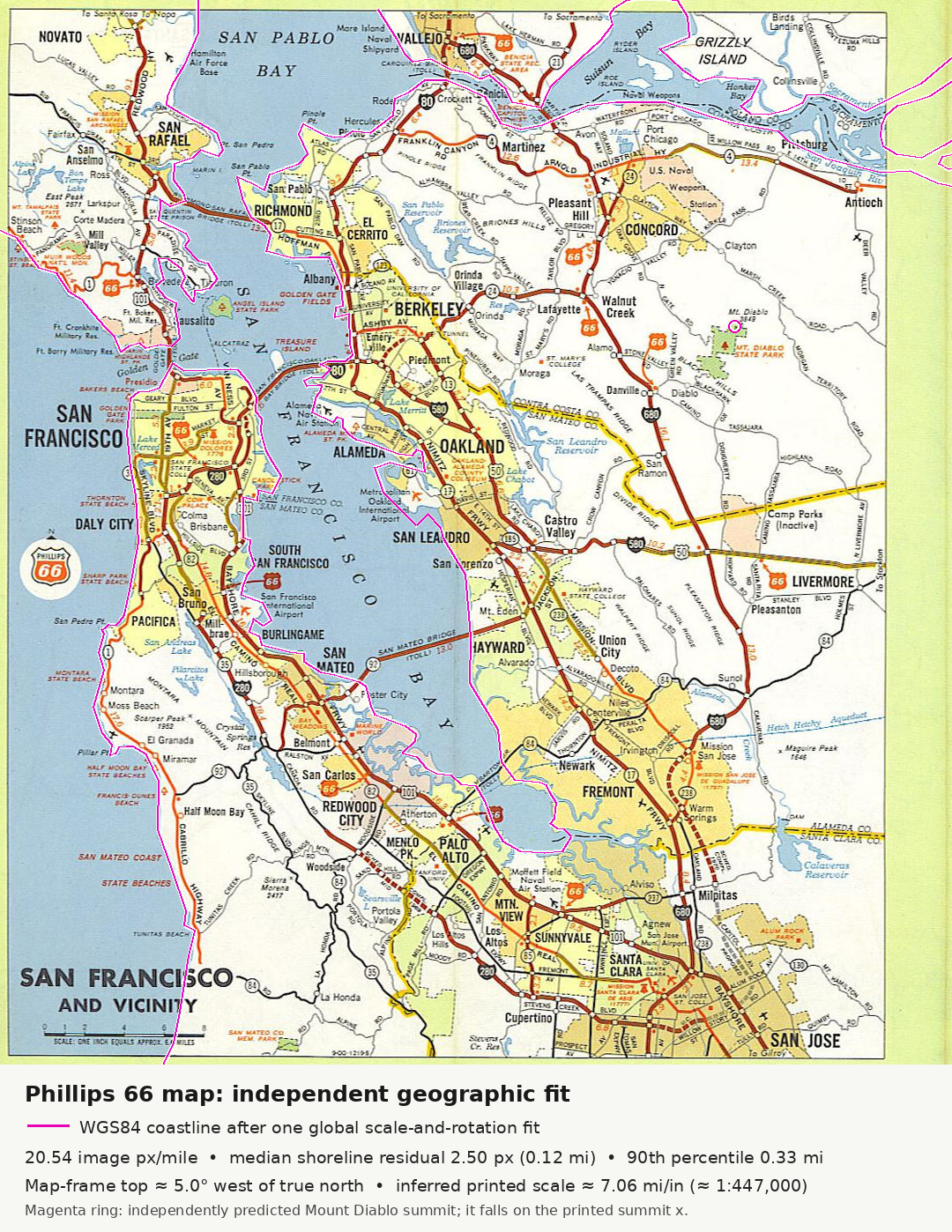
To pursue more precise values for the scaling and northing errors of the Phillips 66, we can substitute for our previous method—one which used a minimum number of identifiable points and deduced the mean best-fit values from only these few—a more systematic and more accurate approach. For this, we can begin with a full coastal mapping and best-fit overlay and then, from this, deduce the mean scale and the north misalignment analytically.
The following is the result of having ChatGPT perform just this very mapping analysis and return its determined values, ones which are clearly very closely in accord with the values found using the more rough-and-ready method.
“This isn’t right! It’s not even wrong!”—Wolfgang Pauli (1900–1958)