
Aside from the fact that the plaintext of the Z32 cipher is, as its name implies, 32 characters in length (assuming a simple homophonic substitution cipher), there are three further constraints that we have to work with in any attempt at deciphering the text:
- the first and the twenty-sixth letter must be the same;
- as, also, the second and the final (thirty-second) letter;
- and, finally, the same for the sixth and the fourteenth letter.
This is all that we have to work with.
Yet, it is perhaps worthwhile considering the question as to why it was these specific three constraints that the author chose to give to us at the outset, and not any of the alternatives that must have been equally possible.

Why, in particular, does he seem especially keen to direct us to the relationship between the very beginning and end of the cipher?
“This isn’t right! It’s not even wrong!”—Wolfgang Pauli (1900–1958)
As compared to the earlier Z408 and Z340 ciphers, we are not working completely in the dark when it comes to attempting to decode the Z32. We are, indeed, given specific details pertaining to both the content and the form of the hidden plaintext.
As to content, once decoded, we will have reached a short text that will give us the location of a supposed bomb which we would then be tasked with trying to pin down with the aid of the Phillips 66 map which we are also given.
“The Map coupled with this code will tell you where the bomb is set.”
This is hardly enough in itself to be of specific help, and so we are later given a further postscript that provides details as to the form of the plaintext.
“PS. The Mt. Diablo Code concerns Radians & [#]inches along the radians.”
with the ‘#’ (“number of”) having been added in as something of an important afterthought. (Note, however, that the author of this postscript does not also add ‘#’ before the first “Radians.”)
“This isn’t right! It’s not even wrong!”—Wolfgang Pauli (1900–1958)
The use of the word “Radians” in this context is clearly problematic, as it leads us initially to think about the relevance of this term to angles in ‘radian measure’. This cannot, however, be claimed, with certainty, to have been the author’s intention, without then being faced with having to explain the semantic oddity of “inches along the radians.” If we are working with radian measure ‘radian’ is, in this context, a unit of angular measure, and the idea of measuring out a distance “along” an angle has no meaning.
Thankfully, at this early point in the analysis we are not required to commit ourselves to any specific interpretation of what is intended by the word ‘radians’ here, still retaining the ability to be able to investigate a little further whilst keeping our options here open.
What we must have, however, under any reading of the instructions as given, is a plaintext that starts by giving a bearing that identifies a specific radial line projected out from Mount Diablo as centre on the map, and a range, or distance therefrom, to be measured out in inches.
As to the former—the bearing, or angle—we are then to heed the numbering around the compass rose drawn for us over the origin on Mount Diablo, indicating some number ranging from 0 to 12, likely non-inclusive.
This, then, gives us quite something to this point alone.
We can propose, then, that the start of the plaintext will be one of the following words, the actual form being dependant upon how the bearing is precisely formatted:
- ONE, FIRST;
- TWO, SECOND;
- THREE, THIRD;
- FOUR[TH];
- FIVE, FIFTH;
- SIX[TH];
- SEVEN[TH];
- EIGHT[H];
- NINE, NINTH;
- TEN[TH];
- ELEVEN[TH].
Likewise, supposing that we are afforded the freedom to do so, we would first want to propose that coordinates alone complete to the end of the cipher and that the last six letters spell ‘INCHES’ preceded by a number that, perhaps, may also contain a fraction.
Only, as will be seen on closer inspection, these two propositions are, in fact, incompatible.
“This isn’t right! It’s not even wrong!”—Wolfgang Pauli (1900–1958)
With the word ‘INCHES’ assumed to be at the very end of the plaintext, we already fix the key association:
Δ → ‘S’
Only, under the second paired constraint regarding the symbols of the ciphertext (2nd = 32nd), this requires that the second letter of the plaintext must also be ‘S’ and this, as we have seen, is not an option as none of the proposed starting numbers have an ‘S’ in the second position. Indeed, from the alternatives that we have proposed the triangle symbol would need to decode to one of the following:
Δ → ‘N’, ‘I’, ‘W’, ‘E’, ‘H’, ‘O’ or ‘L’.
“This isn’t right! It’s not even wrong!”—Wolfgang Pauli (1900–1958)
This very finding, we can argue, ought then to be taken as a clear indication that the specification of the co-ordinates (bearing, range) as they appear in the plaintext does not, of itself, complete the whole cipher.
There is yet something else that comes after ‘INCHES’.
“This isn’t right! It’s not even wrong!”—Wolfgang Pauli (1900–1958)
And, in one sense, this shouldn’t really surprise us, as it matches the straightforward way in which we communicate location information in our everyday language.
Let’s say that I’m arranging our first meeting and I send you a message telling you where I will be. I write:
4th and Hudson
as that is where you will find me. But “4th and Hudson” is a busy, wide intersection and I realise this just before sending the instruction. I then correct this oversight with the addition:
4th and Hudson. NW corner
or:
4th & Hudson. ATM
assuming there to be a bank on one of the corners.
Likewise, with coordinates such as bearing/range specifications.
Suppose we’re arranging some or other covert exchange away from prying eyes. I want you to pull up behind me off the highway and come over to my car and get in. I send you:
I80 W mile marker 242
This conveys the bearing (west along the I80) and a ‘range’ (mile marker 242). But, what if you get there and there are several cars pulled over? Which do you get in? I notice the potential for confusion in time and send you:
I80 W mile marker 242. White Acura
In each of these examples, we are starting with enough information to get you to the immediate location of the meet-up and then, in addition, an item of pertinent information that will pin things down precisely.
I want to propose that this is what we should be looking for with the Z32 also, and that the very specific choice of the constraint between the second and the final letters is included specifically to indicate precisely this.
“This isn’t right! It’s not even wrong!”—Wolfgang Pauli (1900–1958)
Such considerations followed through might then suggest the following as a starting point in attempting to decode the Z32:

“This isn’t right! It’s not even wrong!”—Wolfgang Pauli (1900–1958)
In any event:
- the first word of the plaintext is going to be a spelled-out integer number (or its ordinal equivalent);
- the very last letter of the plaintext is going to match the second letter of this number (or ordinal); and
- this letter is not going to be ‘S’.
“This isn’t right! It’s not even wrong!”—Wolfgang Pauli (1900–1958)
It may, at this point, seem as if we have not gained very much from our attempt to limit down a form for the Z32 plaintext. However we do, at the very least, now possess a plausible part-schema against which we can begin testing potential cases.
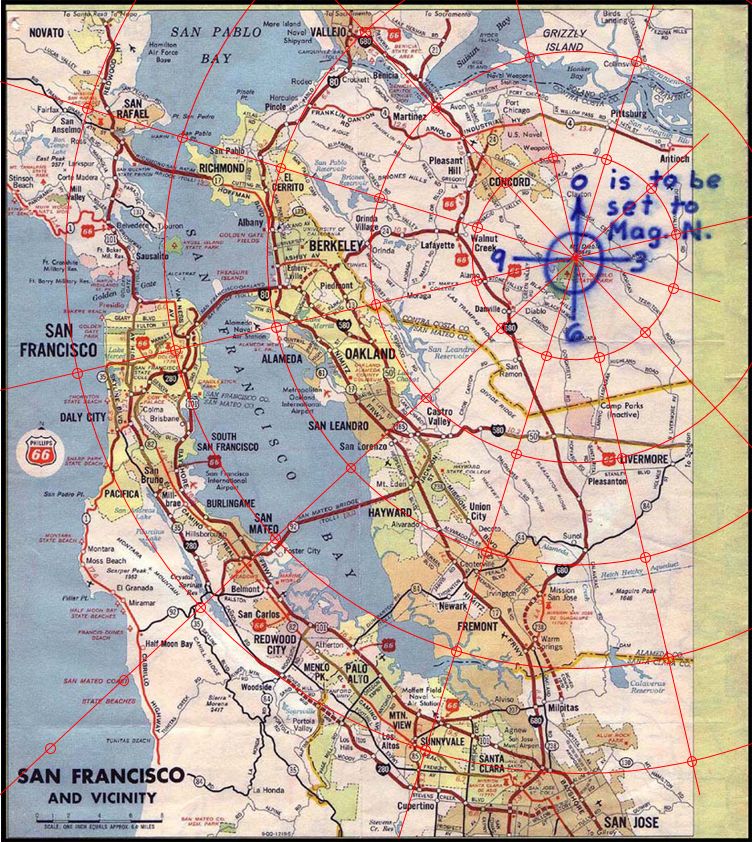
Suppose, as an example, that we consult the following figure and note that a distance of 2 inches along the 11th ‘radian’ brings us to a point on the East side of Ryer Island in Suisun Bay.
Although a merely random selection at first, we might quickly become encouraged when we begin our attempt at matching the given schema with:
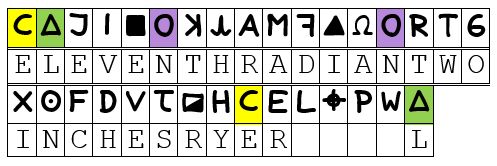
Although we can be sure that this will rarely be the case, we have here managed to hit two of the three paired-letter constraints right off the bat, including having been able to sneak in ‘RADIAN’ specifically, as well as the name of the location pointed to. We are left with (perhaps) a single, five-letter word ending in ‘L’, but we have yet to come to the part where we focus in on the island and get down to details.
“This isn’t right! It’s not even wrong!”—Wolfgang Pauli (1900–1958)
Only, this is the very point at which our enthusiasm must vanish.

Ryer is not, as we might first propose, an ‘ATOLL‘. The numerous waterways which cut across its expanse are, likewise, not such as we would term ‘CANAL‘s. Indeed, the island is, in every possible way, essentially featureless and there is nothing else left for us to reference. There are no conurbations, no roads and, certainly, no school bus routes.
We must, then, simply move on to the next beginning.
“This isn’t right! It’s not even wrong!”—Wolfgang Pauli (1900–1958)
Just before doing so, however, we may stop and think about whether we might not need to consider the inclusion of one further minor layer of misdirection, and consider that the additional ‘locator’ might be only allusive rather than explicit.
Returning to this first example, we can note that there is the option of shifting the word ‘INCHES’ 4 characters to the right to have its ‘E’ fall under the second cyphertext ‘C’ and remove ‘RYER’. Further, we could add justification for doing so as merely aiming to take the postscript’s instruction—”+ # inches”—quite literally, inserting ‘PLUS’ before ‘TWO’. Finding that in statehood times Ryer Island was first known as King’s Island, we might at least consider proposing something such as:
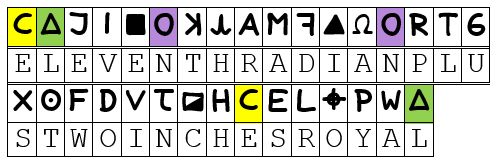
But even if we did, we would still not be able to get beyond the fact that there is simply nothing there and we call for “next” anyway.
“This isn’t right! It’s not even wrong!”—Wolfgang Pauli (1900–1958)
‘ROYAL’, here, also doesn’t add anything; it doesn’t serve to pin anything down, since we are already at the Island with the coordinates alone.
If we are going to permit the addition of such location indicators, we are going to have to require that they at least do some work.
“This isn’t right! It’s not even wrong!”—Wolfgang Pauli (1900–1958)
As we are here already, we may as well finish up the remainder of potential examples of the form ‘[ordinal]RADIAN’, as there are only a few.
‘FOURTHRADIANTHREEINCHES…’ does achieve a match with the ciphertext, as does ‘SEVENTHRADIANTHREEINCHES…’. However, the first takes us off the Phillips 66 to the East, whilst the second drops us right in the San Francisco Bay. We can therefore reject both for these very reasons.
All that remains, then, are these two:
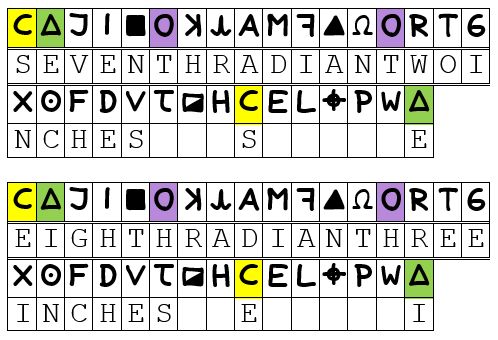
with the former taking us somewhere in or around the Castro Valley, the latter all the way over to Alameda.
Beyond these last two, then, there are no more viable potential candidates of this specific form.
“This isn’t right! It’s not even wrong!”—Wolfgang Pauli (1900–1958)
The appealing feature of both of these candidate forms is the weight each now gives to the author’s decision to give us the ciphertext pairing ‘O…O‘ specifically. In both instances, this pairing alone requires that, given the initial ordinal, we already have fixed for us:
- the associated distance (‘TWO’/’THREE’);
- the precise placement of the word ‘RADIAN’; and
- the precise placement of the word ‘INCHES’, also.
Then, on top of this, we also have two fixed plaintext letters in the remaining ‘location specifier’ to help us with the final test.
Whether a final search leads us to anything of relevance in either case is, then, the next question.
“This isn’t right! It’s not even wrong!”—Wolfgang Pauli (1900–1958)
Beyond these last two, then, there are no more viable potential candidates of this specific form.
Actually, we’ve missed one here. There are, in fact, three potential candidates of the form ‘[ordinal]RADIAN’. Going back to the original example, we do still have:
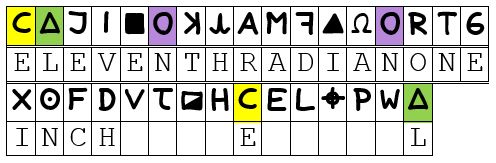
which takes us over to Concord within the bounds of the old US Naval Weapons Station.
“This isn’t right! It’s not even wrong!”—Wolfgang Pauli (1900–1958)