
If I apply all possible Caesar shifts to the triplets after converting them using an A=0 system, some interesting combinations begin to emerge and seem to recur across different years. In a few cases, similar sequences or structures appear despite starting from different triplets. I don’t know whether this has any real significance or whether it is simply a natural consequence of the transformations, but I think it is still worth keeping in mind.

Sorry about the odd formatting there, if you’re getting it also. Again, as an image:
“This isn’t right! It’s not even wrong!”—Wolfgang Pauli (1900–1958)
In a few cases, similar sequences or structures appear despite starting from different triplets. I don’t know whether this has any real significance or whether it is simply a natural consequence of the transformations, but I think it is still worth keeping in mind.
This recurrence is happening because in two of the cases—1968 and October 1981—the difference between the first and second numbers and that between the second and third, each taken modulo 26 where required, are the same, namely:
10 (–9) 01 (+3 + 26 + 26) 56
14 (–9) 05 (+3 + 26) 34.
There is nothing particularly special about this occurring. What it produces is the same repeating cycle, just out of step with each other by 14 – 10 = 4.
“This isn’t right! It’s not even wrong!”—Wolfgang Pauli (1900–1958)
There is nothing particularly special about this occurring. What it produces is the same repeating cycle, just out of step with each other by 14 – 10 = 4.
Another way of noting the same is to take the two RAs and reproduce them with each of their three components reduced modulo 26, where required. This brings them to:
10 01 04
14 05 08
after which we can see readily that the second row, per digit pair, is derived from the first by adding 04 three times.
“This isn’t right! It’s not even wrong!”—Wolfgang Pauli (1900–1958)
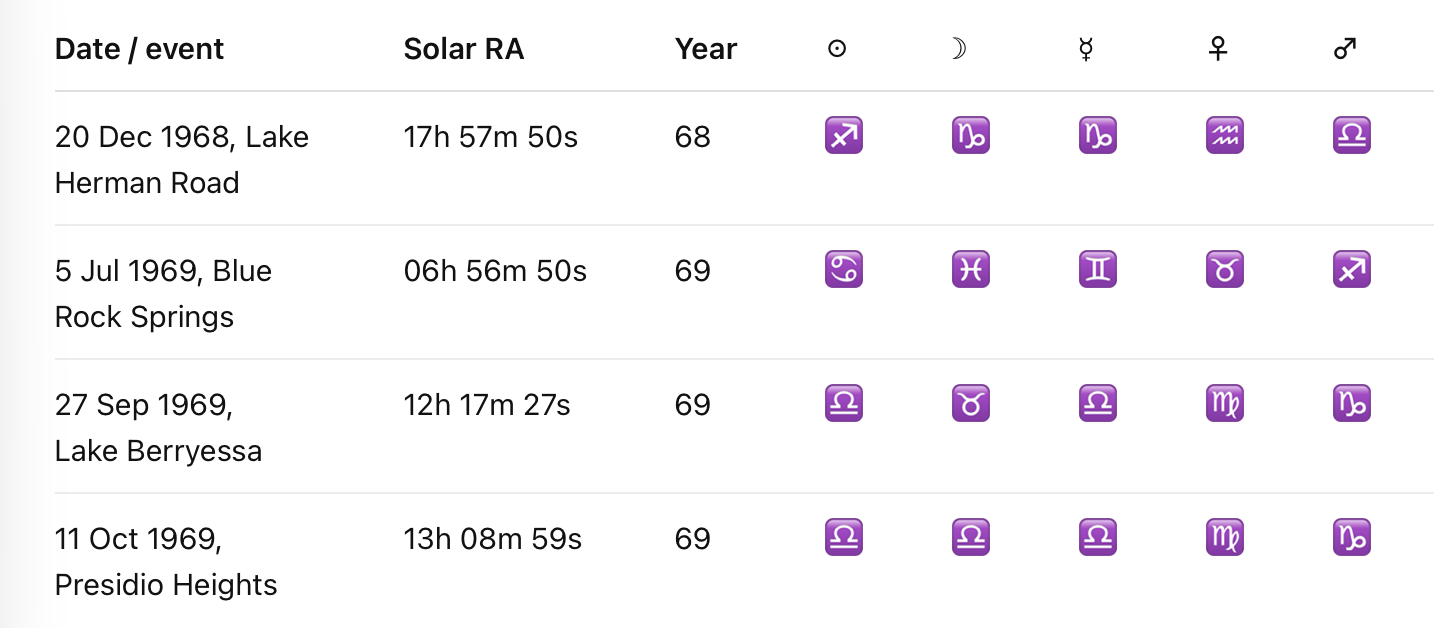
The value of the ‘Zodaic’ ephemeris, namely:
is that it illustrates immediately what the sender of the Vagheggi letter was attempting to emphasise in respect of Il Mostro’s attacks.
Unless we are applying pre-judgement and effectively begging the question, then the Zodiac ephemeris should function as a randomised control to what we have from Il Mostro. And we do, indeed, see this clearly. Even with only the four events, we effectively lose all of the tendency towards higher degrees of concentration of signs. That is, except in the last row, partly, but this is only brought about by the fact that the Moon happened to be close to new. And neither do we find our celestial bodies confined in the main to the domiciles of the Sun through Mars, as we now find all of Capricorn, Aquarius and Pisces occupied.
“This isn’t right! It’s not even wrong!”—Wolfgang Pauli (1900–1958)
If I apply all possible Caesar shifts to the triplets after converting them using an A=0 system, some interesting combinations begin to emerge …
So I’ve made several attempts to apply this, your favoured method, to the numbers given in the Vagheggi table—for example, summing the three numbers in each RA, applying a modulo 26 and then running through the corresponding Caesar shifts—and I’m not finding anything at all that stands out to me. Taking this along with my analysis of the general aim and purpose of what the table appears to be conveying, I do not get any sense that there is anything deeply cryptic that is hidden here. I have reached the point of feeling that I am caught in the proverbial act of “looking for a black cat in a dark room that isn’t there.” 🤣
I found this article at the end of my own researches and feel that I can broadly agree with what is there deduced as to what it is we actually have in the Vagheggi table: Il Mostro di Firenze Addendum 2: sulla lettera a Paolo Vagheggi. (Not so much the “motivation” part, though.)
All the same, I wish you happy hunting and better luck than I have had. 👍
“This isn’t right! It’s not even wrong!”—Wolfgang Pauli (1900–1958)
Maybe some of your thoughts, and this conversation in general, have helped me find something! I can’t say yet whether it’s really the solution to the problem, but at least it’s a solution that finally feels right to me and that I’m genuinely happy with. Hopefully I’ll manage to write it down today or tomorrow!
In the meanwhile, it seems worthwhile to offer a reconstruction as to how the sender of the Vagheggi letter may have easily gone about constructing the table of Right Ascensions and signs, requiring nothing more than access to contemporary ephemerides and astrological tables and the application of only some basic degree of skill in interpolation. The purpose, here, is to demonstrate that there is no requirement that he or she possessed overly specialised knowledge or was called upon to perform complex calculations involving spherical trigonometry or any other such horrors.
The calculation I shall reconstruct shall be the one that is most readily demonstrated, although this is not with the intention to hide that there are real problems in accounting for evident errors in the compiler’s handling of data for the most part. We shall also be making use of contemporarily available data sources without any claim that these were the precise ones originally accessed. However, as the data themselves are not such as should show variation across alternative presentations, we can be largely confident that the same results would be attained whatever the specific sources used.
The line in the table for 1984 reads:
8 34 59 84 LEO LEO VIR LEO SCO
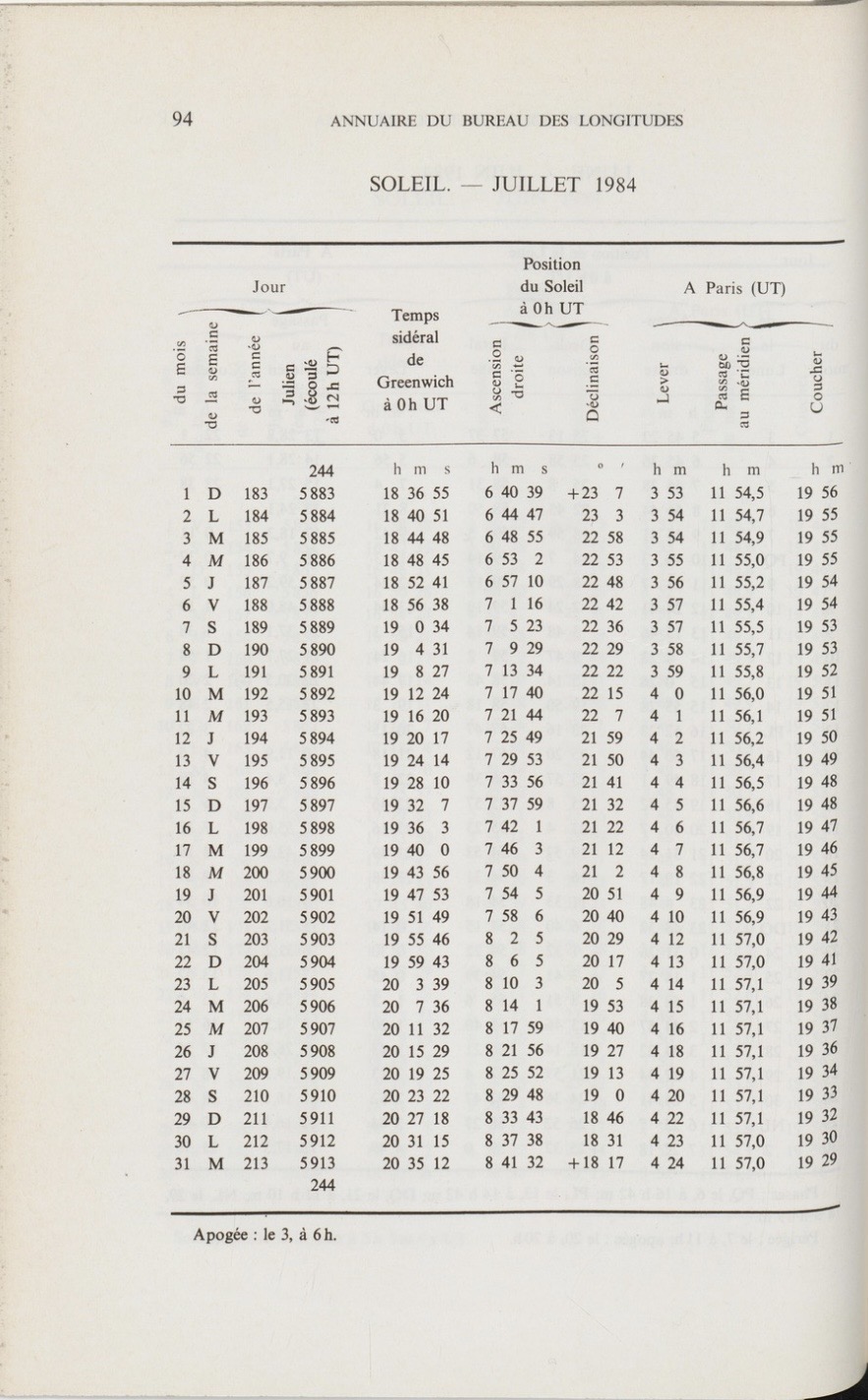
The interpretation of the table as a whole, as discussed already, informs us that the context for this entry is the 1984 double killing of Claudio Stefanacci and Pia Rontini on July 29 near Vicchio, in the Metropolitan City of Florence, Tuscany. We would then be looking for the first three numbers on the left to correspond to the Right Ascension of the Sun on, or around, the time of the killing. For this, we have the reports of witnesses placing the sound of gunshots around 21:45 hrs CEST. We will then, first of all, see how an ephemeris may have been consulted and used to determine the Sun’s RA in the first instance and, for this, we will turn to the Bureau des Longitudes, Éphémérides astronomiques 1984 (Paris: Gauthier-Villars, 1983) and the specific Sun tables for July, which are as here:
“This isn’t right! It’s not even wrong!”—Wolfgang Pauli (1900–1958)
Now, 29 July 1984 at 21:45 CEST equates to 19:45 UT on the same date. We therefore need to undertake a straightforward interpolation of the RAs given for the 29 and 30 July 1984 at 0h UT, over which period the Sun’s RA changes from 08h 33m 43s to 08h 37m 38s. This amounts to an increase of RA by 3m 55s, or 235s, per day. We next determine that 19:45 UT corresponds to 19.75h past 0h UT on the 29th, which is a duration of 19.75/24 = 0.8229167day. We then need merely to add 0.8229167 × 235 = 193.385s of RA to the RA for the 29th at 0h UT, which gives 8h 36m 56.4s.
But this, clearly, does not give us the 8h 34m 59s we had been expecting!
Now, here, we can diagnose the influence of an easy-to-make error. Let us suppose that the author had confused his morning and evening times in his calculations and, instead of 21:45 CEST had used instead 09:45 CEST, equating to 07:45 UT. That deduction of 12 hours then accounts for a reduction of the RA by 0.5 × 235 = 117.5s or 1m 57.5s and, deducting this from our initially determined 8h 36m 56.4s gives us 8h 34m 58.9s, which rounds up precisely to the value we see in table.
From this, it is thus evident how the Right Ascension for the Sun at the event time of the double killing on the evening of 29 July 1984 could have been readily obtained from conventional astronomical tables albeit, in this instance, involving a clearly deducible and understandable error.
“This isn’t right! It’s not even wrong!”—Wolfgang Pauli (1900–1958)
The path to which constellations the five celestial bodies were in at the time of the event in Vicchio (whether taken correctly, or including the 12h timing error), would have required access merely to the kind of astrological almanac that would have been readily available over newsagent counters across Europe. Such almanacs would have produced some such simple table as the following, which itself is taken from the 1983 edition of The American Ephemeris for the 20th Century (Michelsen, N. F., 1983):
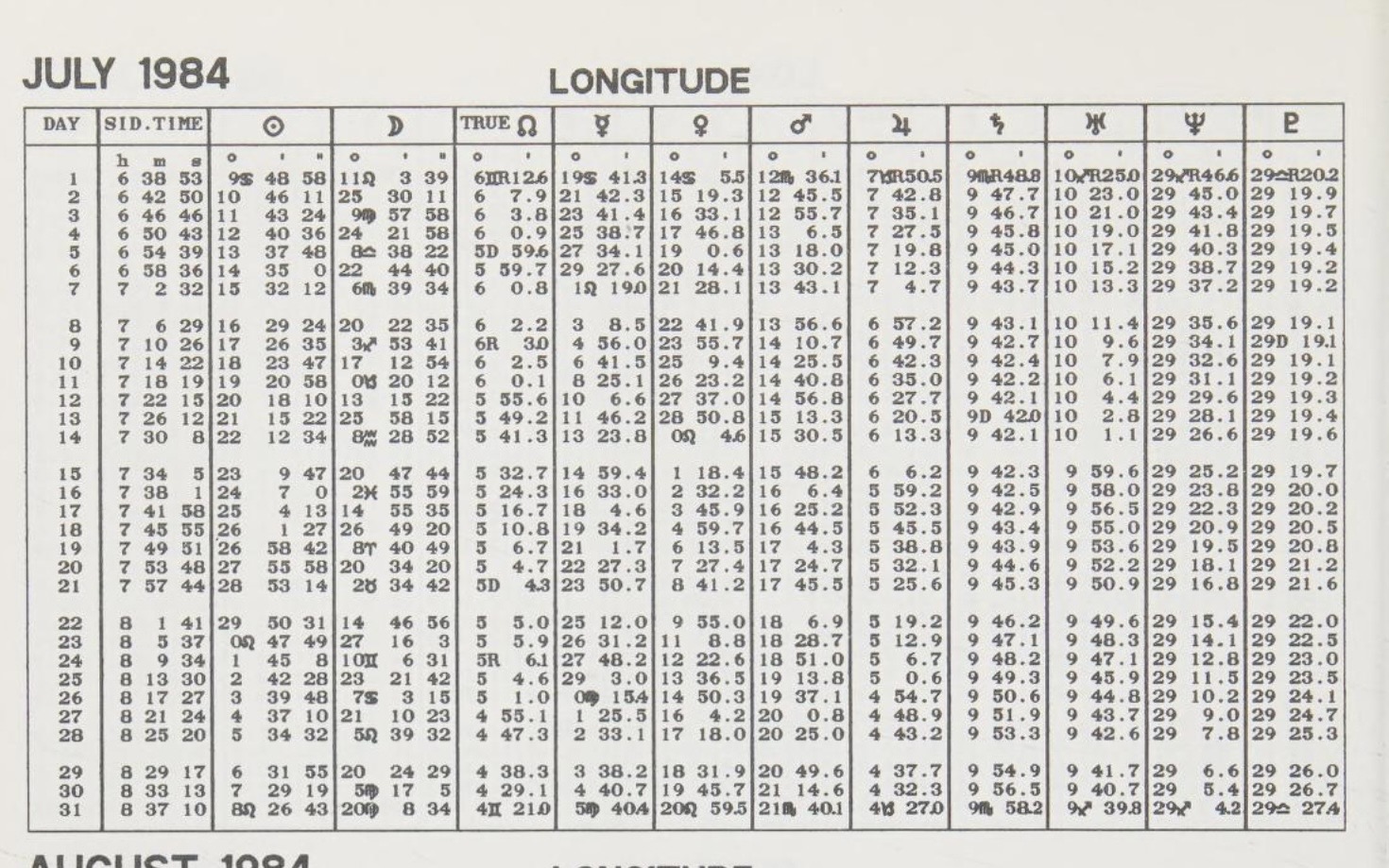
Simply tracing back up the columns from the row for the 29 July 1984, we can immediately see that the Sun was in Leo, the Moon in Leo, Mercury in Virgo, Venus in Leo and Mars in Scorpio.
Again, this is precisely what we find documented against the 1984 entry in original artefact, which one line, at least, we have now been able to readily and plausibly account for.
“This isn’t right! It’s not even wrong!”—Wolfgang Pauli (1900–1958)
From this, it is thus evident how the Right Ascension for the Sun at the event time of the double killing on the evening of 29 July 1984 could have been readily obtained from conventional astronomical tables albeit, in this instance, involving a clearly deducible and understandable error.
On further study it would appear that our identified 12h error here, although still very much present and demanding of explanation, may actually derive from a more plausible source. From the table of the Solar RAs that we had taken our start from, we can see the daily epoch clearly stated as being 0hUT. Prior to 1984, however, the same ephemerides were constructed using noon (12hUT) as the daily epoch. A person, therefore, ingrained in the old format would make just such a 12h error if it were simply the case that they had not registered the change. This feels like a much more plausible explanation than grounding the error in some unlikely mixup between times am and pm.
“This isn’t right! It’s not even wrong!”—Wolfgang Pauli (1900–1958)
As regards the sign matrix, if we were to replicate use of something like the American Ephemeris for the 20th Century, we would obtain the following from the event times directly:
|
Event |
Sun |
Moon |
Mercury |
Venus |
Mars |
Comparison with artefact |
|
22 Aug 1968 |
Leo |
Scorpio |
Virgo |
Virgo |
Leo |
5/5 match |
|
14 Sep 1974 |
Virgo |
Virgo |
Libra |
Virgo |
Libra |
5/5 match |
|
6/7 Jun 1981 |
Gemini |
Leo |
Cancer |
Cancer |
Gemini |
5/5 match |
|
22 Oct 1981 |
Libra |
Virgo |
Libra |
Sagittarius |
Virgo |
4/5 — artefact Moon = Leo |
|
19 Jun 1982 |
Gemini |
Gemini |
Gemini |
Taurus |
Libra |
5/5 match |
|
9 Sep 1983 |
Virgo |
Libra |
Virgo |
Virgo |
Leo |
4/5 — artefact Moon = Virgo |
|
29 Jul 1984 |
Leo |
Leo |
Virgo |
Leo |
Libra |
5/5 match |
|
8 Sep 1985 |
Virgo |
Cancer |
Virgo |
Leo |
Virgo |
5/5 match |
38 of 40 sign determinations match.
The only residual errors are:
- 22 October 1981: event-time Moon = Virgo; artefact = Leo. This is a close discrepancy, and the noon ephemeris offers a simple route to it because the 12h daily entry is still Leo and the Moon does not enter Virgo until 16:05 UT. If the ingress table was merely not consulted, as would need to be the case, then the user would erroneously record the Moon in Leo.
- 9 September 1983: event-time Moon = Libra; artefact = Virgo. This is a larger discrepancy, and the daily table does not explain it; Virgo requires moving back to before the Moon’s ingress into Libra on 8 September.
But then, it is in precisely the row for September 1983 that we find the RA underlined and the lunar sign highlighted with a square around it.
“This isn’t right! It’s not even wrong!”—Wolfgang Pauli (1900–1958)
Here I am! Before presenting the solution involving the numerical triplets, I will proceed step by step. I will first focus on the left-hand section of the table, related to the zodiac signs, and then move on to a comparison with a possible solution to the Z18.
As you also pointed out, Shaq, an error has been identified in the transcription of the value shown beneath the Moon symbol for the years 1981 (B) and 1983. However, as we will see later, I believe this discrepancy may not be accidental, but rather something deliberately introduced by the author.
To begin, it is useful to list the zodiac signs in their traditional order, starting with Aries. The choice to begin with this sign is not arbitrary: in classical astrology, Aries marks the beginning of the zodiacal cycle, as it symbolically corresponds to the point of the spring equinox.
- Aries — ARI
- Taurus — TAU
- Gemini — GEM
- Cancer — CAN
- Leo — LEO
- Virgo — VIR
- Libra — LIB
- Scorpio — SCO
- Sagittarius — SAG
- Capricorn — CAP
- Aquarius — AQU
- Pisces — PIS
Next, as shown in the table, I assigned a numerical value to each zodiac sign according to its position in the traditional sequence listed above. For example, Gemini (GEM) is assigned the value 3, since it is the third sign in the adopted order, and the same principle is applied to all the remaining zodiac signs.
Finally, for each row, I added together the numerical values corresponding to the zodiac signs. As an example, let us consider the row for 1968, which contains the following symbols:
LEO (5) + LEO (5) + VIR (6) + VIR (6) + LEO (5) = 5 + 5 + 6 + 6 + 5 = 27
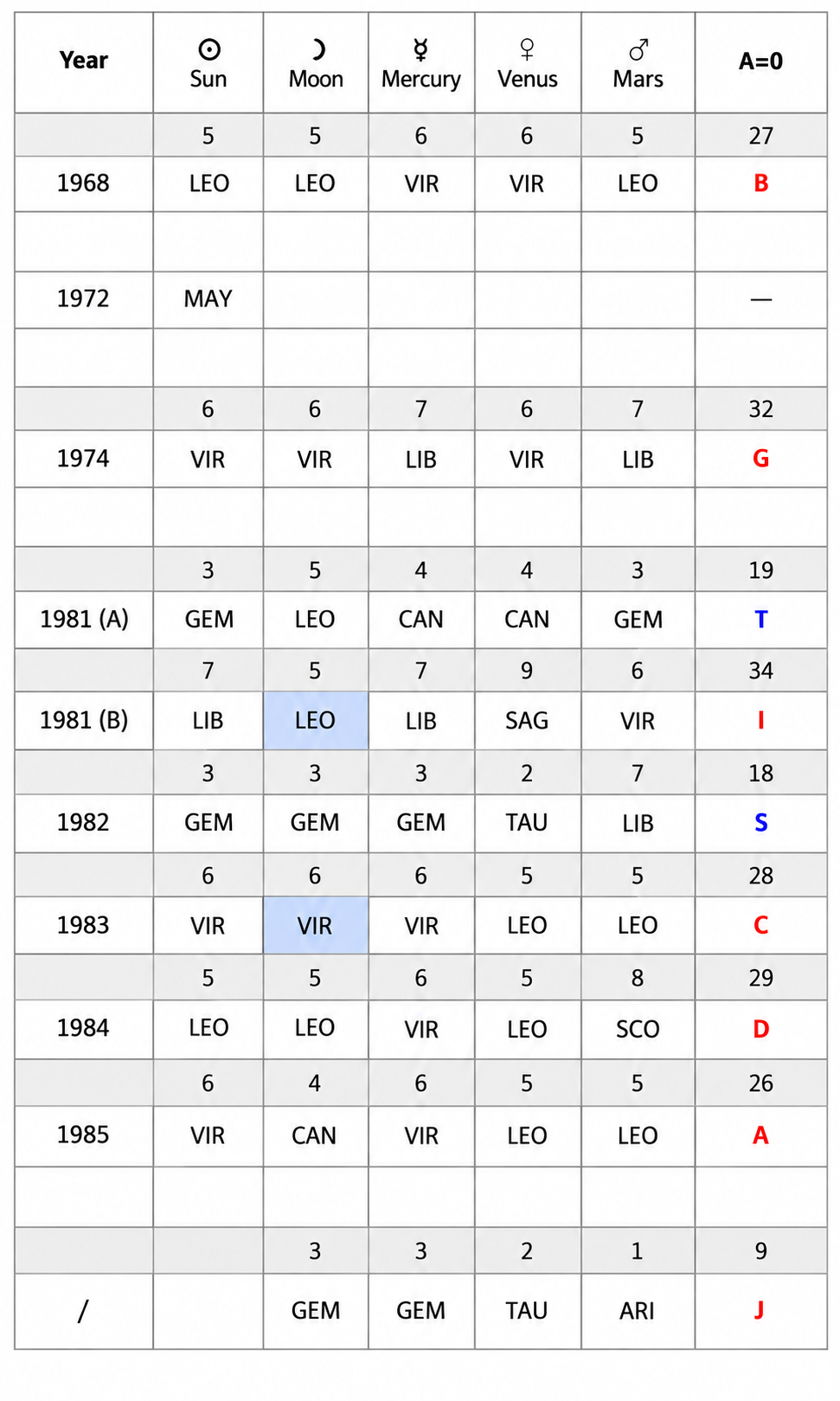
I therefore obtained the following values, broken down by year:
1968 = 27
1972 = 32
1981 (A)= 19
1981 (B) = 34
1982 = 18
1983 = 28
1984 = 29
1985 = 26
/ = 9
From this, the following numerical sequence is obtained:
27 – 32 – 19 – 34 – 18 – 28 – 29 – 26 – 9
Applying the A=0 cipher system, whenever a number exceeds 25, it is reduced modulo 26. This gives the following correspondences:
1968 → 27 − 26 = 1 → B
1972 → 32 − 26 = 6 → G
1981 (A) → 19 → T
1981 (B) → 34 − 26 = 8 → I
1982 → 18 → S
1983 → 28 − 26 = 2 → C
1984 → 29 − 26 = 3 → D
1985 → 26 − 26 = 0 → A
/ → 9 → J
At this point, we can identify two distinct groups: on the one hand the “isolated” years, namely 1968, 1972, and the row with no year indicated, and on the other, the group of murders committed between 1981 and 1985. The first group yields the following letters:
1968 → B
1972 → G
/ → J
This therefore gives the sequence BGJ, which at first glance appears rather “random”, perhaps the author’s signature? Let us now see what happens with the second group:
1981 (A) → T
1981 (B) → I
1982 → S
1983 → C
1984 → D
1985 → A
These letters bring us close to the word ZODIAC. The comparison below highlights the matching letters in red:
T S D I A C
Z O D I A C
Now let us focus on the letters that do not match, highlighted in blue, namely “TS” and “ZO”, because this is where the most interesting aspect emerges. The letter Z could be interpreted as another form of the author’s signature, while the remaining letters may have been intended to indicate the number of victims. In fact, the letters “TS”, when converted using the A=0 system, correspond to the following values:
T = 19
S = 18
Their sum is therefore:
19 + 18 = 37
This value corresponds to the number of victims claimed by Zodiac as of 1974, according to statements made in his letters. The letter O, on the other hand, has the following value in the A=0 system:
O = 14
This number can be related to the victims attributed to the Monster of Florence between 1974 and 1985. The sequence can therefore be read as:
Z O T S = Z + 14 + 19 + 18
that is:
Z + 51
where 51 would represent the overall total:
37 Zodiac victims + 14 Monster of Florence victims = 51
Following the reasoning outlined above, the author may have deliberately altered the Moon values for 1981 (B) and 1983. Without these modifications, the letters obtained from the conversion would not have been I and C, respectively, thereby disrupting the possible construction of the sequence associated with ZODIAC. The changes therefore appear not to be random, but rather intended to steer the final result toward a specific alphabetical sequence.
THE CONNECTION WITH Z18
Marclean pointed out that the Z18 sequence:
EBEORIETEMETHHPITI
has a rather unusual structure: it consists of 9 vowels and 9 consonants. Furthermore, if repeated letters are removed while preserving the order of their first occurrence, exactly 9 distinct letters remain:
EBORITMHP
This observation led me to two considerations.
The first may be somewhat marginal to the main subject of this thread, but it is still intriguing: the number 9 also recurs in some analyses of the dates associated with the Monster of Florence murders. I therefore brought this feature of Z18 to the attention of a researcher who is investigating the possible recurrence of this number.
The second consideration, which is more relevant to this thread, concerns the sequence EBORITMHP. Out of curiosity, I applied every possible Caesar shift to these nine letters and obtained the following results:
Shift 0: EBORITMHP
Shift 1: FCPSJUNIQ
Shift 2: GDQTKVOJR
Shift 3: HERULWPKS
Shift 4: IFSVMXQLT
Shift 5: JGTWNYRMU
Shift 6: KHUXOZSNV
Shift 7: LIVYPATOW
Shift 8: MJWZQBUPX
Shift 9: NKXARCVQY
Shift 10: OLYBSDWRZ
Shift 11: PMZCTEXSA
Shift 12: QNADUFYTB
Shift 13: ROBEVGZUC
Shift 14: SPCFWHAVD
Shift 15: TQDGXIBWE
Shift 16: UREHYJCXF
Shift 17: VSFIZKDYG
Shift 18: WTGJALEZH
Shift 19: XUHKBMFAI
Shift 20: YVILCNGBJ
Shift 21: ZWJMDOHCK
Shift 22: AXKNEPIDL
Shift 23: BYLOFQJEM
Shift 24: CZMPGRKFN
Shift 25: DANQHSLGO
It was precisely at this point that I noticed a curious feature connected to the solution I proposed for Z32.
If you read through this thread and follow how my analysis developed, you will see that I divided Z32 into 9 sequences. For each sequence, I added together the alphabetical values of its symbols using an A=0 system, obtaining the following nine-character sequence:

CREHƧXUYL
Let us now compare it with shift 16 derived from EBORITMHP:
Z32: CREHƧXUYL
Z18: UREHYJCXF
The two sequences share no fewer than 7 out of 9 characters:
C – R – E – H – X – U – Y
But this peculiarity is not limited to the number of characters they share. When the two sequences are divided as follows, a very interesting structure emerges:
Z32: C | REH | ƧX | U | YL
Z18: U | REH | YJ | C | XF
The sequence REH appears in exactly the same position in both cases, from the second to the fourth character. Furthermore, the letters C and U occupy the same two positions in reverse order: in Z32, C appears at the beginning and U in the seventh position, whereas in Z18 the opposite occurs, with U at the beginning and C in the seventh position. These two letters therefore seem to “mark out” both sequences according to the same structure:
Z32: C | REH | __ | U | __
Z18: U | REH | __ | C | __
Finally, two pairs of characters remain in each sequence:
Z32: ƧX | YL
Z18: YJ | XF
Here, too, another curious feature emerges: the letters X and Y appear in both sequences, but they are distributed across the two pairs in a crossed arrangement. In Z32, X belongs to the first pair and Y to the second; in Z18, the opposite occurs, with Y in the first pair and X in the second.
This creates a pattern somewhat similar to the interchange observed between C and U, although in this case the correspondence is not as immediate: to align X and Y in the same column within their respective pairs, the ƧX pair would need to be rearranged.
Z32: ƧX | YL
Z18: YJ | XF
We can therefore hypothesize reorganizing the short sequence ƧX in a mirrored form, applying the same principle I used in my solution to Z32. In this way, ƧX would become XS. Let us now observe what happens when the new sequence XS is inserted into the letter structure previously derived from Z32:
Z32: C | REH | XS | U | YL
Z18: U | REH | YJ | C | XF
At this point, a particularly interesting structural correspondence emerges. In addition to the previously identified association between C and U, we can also observe an alignment between the pairs beginning with X and Y. The two sequences therefore appear to follow a coherent mirrored pattern, in which certain elements occupy corresponding or complementary positions.
Let us now move on to the numerical comparison of the two sequences by converting each letter according to the A=0 system.
Before carrying out the subtraction, I exclude the common sequence REH, since it appears identically in both ciphers. I therefore do not treat it as part of the numerical operation itself, but rather as an alignment marker: a fixed element that allows the two structures to be placed in correspondence and the groups of letters on either side to be compared consistently.
Once this common element is removed, the two sequences become:
Z32: C | XS | U | YL
Z18: U | YJ | C | XF
Applying the A=0 conversion gives:
Z32: 2 | 23 18 | 20 | 24 11
Z18: 20 | 24 9 | 2 | 23 5
At this point, we can proceed with the subtraction of the corresponding values, performing the operation Z32 − Z18 position by position:
2 − 20 = −18
23 − 24 = −1
18 − 9 = 9
20 − 2 = 18
24 − 23 = 1
11 − 5 = 6
We therefore obtain the following numerical sequence:
−18 | −1 | 9 | 18 | 1 | 6
Since we are working with an A=0 alphabetic system consisting of 26 values, we can now bring every result into the 0–25 range by applying modulo 26. For the negative values, this simply means adding 26:
−18 ≡ 8 (mod 26)
−1 ≡ 25 (mod 26)
The remaining values already fall within the required range. The sequence therefore becomes:
8 | 25 | 9 | 18 | 1 | 6
Finally, converting these values back into letters using the A=0 system:
8 = I
25 = Z
9 = J
18 = S
1 = B
6 = G
We therefore obtain the sequence:
I | Z | J | S | B | G
At this point, I reorganize the resulting sequence and interpret it as follows:
Z IS JBG