
So I do see where you have taken this analysis, and it is very much in line with how thoroughly you are able to dive into the smallest details. The difficulty I would have with such a method, however, is again that it doesn’t allow sufficient scope for choice on the part of the author. If we are to propose that any compositor has hidden a specific secret message anywhere then we have to be able, first of all, to show that he/she had the freedoms required to do so.
Here, you add the signs from the June 1981 and the 1982 rows together in the way you have shown and you get separately T and S, equating each to 19 and 18 respectively and hence 37 in total. Yet the compiler had no freedom over any of this in these two rows, as the signs are correct for the murder events and thus fixed.
It must seem, then, that we are forced into noting the appearance of 37 in this way as an interesting coincidence, but not anything more than that.
“This isn’t right! It’s not even wrong!”—Wolfgang Pauli (1900–1958)
At this point, I reorganize the resulting sequence and interpret it as follows:
Z IS JBG
Not G”J”B?
“This isn’t right! It’s not even wrong!”—Wolfgang Pauli (1900–1958)
I think it might be useful, in testing your analysis of “The Connection with Z18,” to flip the proposed route to your result around to see how, in putting all this together, the author would have had to proceed to get to the last 18 of the Z408. The value in this, I would expect, would derive from us finding that certain of the apparently interesting cross-correspondences and the like that we shall encounter along the way will again arise spontaneously without our author having had any control over them.
Thus we start with the fixed message that it is his intention to encode:
ZISJBG
Starting here, as you propose, he applies a little anagramming then converts these letters to numbers using the ubiquitous A = 0 scheme, so:
8 | 25 | 9 | 18 | 1 | 6
Then, likely with the intention of mixing things up a little, he splashes in a couple of mod-26 adjustments to get:
−18 | −1 | 9 | 18 | 1 | 6
Next, he has to start shaping his shift-16 Caesar for the upcoming last 18 and, for this, he subtracts the above values from a subset of the likewise fixed solution to his Z32 which, reduced using A = 0 in the same way, produces:
Z32:  2 | 23 18 | 20 | 24 11
Z18: 20 | 24  9 |  2 | 23  5
which, when converted back into letters using the A = 0 convention, gives:
Z32: C | XS | U | YL
Z18: U | YJ | C | XF
So, as expected, here we see the very types of pattern that initially appear to suggest significance and intention but, as we have just witnessed, are arising from wholly fixed starting points, without any scope for our author to introduce them intentionally. We see the seemingly meaningful cross patterns on both the C, U and X, Y pairings and momentarily wonder, and yet we have followed through the precise steps and none afforded the author any direct opportunity for making these appear. They just did.
“This isn’t right! It’s not even wrong!”—Wolfgang Pauli (1900–1958)
The next step, then, is just to add in some filler using the three letters missed out from the Z32 solution and then apply a Caesar shift to get to the skeleton of the last 18 of the Z408:
EBORITMHP
Of course, all this requires that the Z32 was already in the bag before the Z408 was finished.
In all this, then, there was only one point at which any pseudo-control was possible, and this was the anagramming step. But even this didn’t offer true freedom as, when shifting fixed letters about, what you lose from here you gain over there.
None of this, however, negates the possibility of some such route from the starting phrase through to the last 18. All the same, it does highlight how remarkable and seemingly meaningful coincidences are prone to appear in abundance if we look hard enough for them, without any need, or even opportunity, for the hand of intention.
“This isn’t right! It’s not even wrong!”—Wolfgang Pauli (1900–1958)

So I do see where you have taken this analysis, and it is very much in line with how thoroughly you are able to dive into the smallest details. The difficulty I would have with such a method, however, is again that it doesn’t allow sufficient scope for choice on the part of the author. If we are to propose that any compositor has hidden a specific secret message anywhere then we have to be able, first of all, to show that he/she had the freedoms required to do so.
Here, you add the signs from the June 1981 and the 1982 rows together in the way you have shown and you get separately T and S, equating each to 19 and 18 respectively and hence 37 in total. Yet the compiler had no freedom over any of this in these two rows, as the signs are correct for the murder events and thus fixed.
It must seem, then, that we are forced into noting the appearance of 37 in this way as an interesting coincidence, but not anything more than that.
Let’s start from the assumption that the Monster did not deliberately choose the dates of the murders in order to obtain a specific zodiacal configuration or to create some kind of cryptographic game.
The dates were already constrained by several fairly obvious factors: the murders generally took place between June and October, often on holidays or the days before holidays, with little moonlight, and of course there also had to be an isolated couple in a suitable situation. It seems unlikely to me that, on top of all this, he would also choose the dates according to planetary positions. That would have imposed yet another unnecessary constraint.
So my idea is different: perhaps the author of the table studied the dates of the murders afterwards and realized that, using the five celestial bodies he had chosen, the actual zodiacal configurations already produced a sequence surprisingly close to what he needed.
In other words, he would not have adapted the murders to the code. He would have adapted the code to the murders.
And this is where, in my opinion, the two anomalies involving the Moon become interesting. Almost all the data in the table are correct, while in two cases the Moon’s position does not correspond to its actual position. In my hypothesis, these two values might not simply be mistakes, but deliberate changes made to push the result towards the letters he wanted.
Basically, the author would have kept the real data wherever they already worked for his purpose, and changed only the few points where he needed to adjust the result.
The row concerning the supposed future murder could fit into the same logic. In that case he was no longer constrained by an event that had actually happened, so he had much more freedom: he could choose a future date, and therefore a zodiacal configuration, that allowed him to add the letter he needed.
For this reason, I don’t necessarily see it as a problem that some of the letters arise automatically from the real astronomical configurations. That may actually have been what caught the author’s attention in the first place: he may have noticed that the real data were already unusually favourable for the game he wanted to construct and decided to take advantage of them.
So, in my opinion, the question is not really:
“Did the Monster choose the dates of the murders in order to obtain these letters?”
The question is rather:
“Could the author of the table, looking back at the dates of the murders, have realized that the real astronomical configurations already gave him almost everything he needed, requiring only two small alterations and then taking advantage of the freedom offered by the future row?”
And this is something that could actually be tested.
Keeping fixed the same five celestial bodies chosen by the author, we could take eight random dates compatible with the general period and conditions in which the murders normally occurred and see how often the same method produces a sequence of letters comparably close to the one needed.
More importantly, we could test how often, starting from eight random dates, only two changes out of the forty zodiacal values would be enough to obtain a comparable result.
If this turns out to be fairly common, then my hypothesis would lose much of its strength. But if it turns out to be very rare, then it would mean that the real murder dates happened to provide the author with an unusually favourable configuration, which he may then have noticed and exploited.
I think it might be useful, in testing your analysis of “The Connection with Z18,” to flip the proposed route to your result around to see how, in putting all this together, the author would have had to proceed to get to the last 18 of the Z408. The value in this, I would expect, would derive from us finding that certain of the apparently interesting cross-correspondences and the like that we shall encounter along the way will again arise spontaneously without our author having had any control over them.
Thus we start with the fixed message that it is his intention to encode:
ZISJBGStarting here, as you propose, he applies a little anagramming then converts these letters to numbers using the ubiquitous A = 0 scheme, so:
8 | 25 | 9 | 18 | 1 | 6Then, likely with the intention of mixing things up a little, he splashes in a couple of mod-26 adjustments to get:
−18 | −1 | 9 | 18 | 1 | 6Next, he has to start shaping his shift-16 Caesar for the upcoming last 18 and, for this, he subtracts the above values from a subset of the likewise fixed solution to his Z32 which, reduced using A = 0 in the same way, produces:
Z32:  2 | 23 18 | 20 | 24 11
Z18: 20 | 24  9 |  2 | 23  5
which, when converted back into letters using the A = 0 convention, gives:
Z32: C | XS | U | YL
Z18: U | YJ | C | XF
So, as expected, here we see the very types of pattern that initially appear to suggest significance and intention but, as we have just witnessed, are arising from wholly fixed starting points, without any scope for our author to introduce them intentionally. We see the seemingly meaningful cross patterns on both the C, U and X, Y pairings and momentarily wonder, and yet we have followed through the precise steps and none afforded the author any direct opportunity for making these appear. They just did.
I understand your reverse approach, and I think you may be right about some of the later symmetries. Once the two sequences are aligned and a certain final result is assumed, some of those correspondences can indeed arise almost automatically. So, for example, I would probably no longer consider the C/U or X/Y relationships as necessarily independent pieces of evidence.
What I am still wondering about, though, is what happens one step earlier.
Why does the nine-letter sequence independently derived from Z18, simply by trying its 26 Caesar shifts, end up so close to the nine-element sequence I had already obtained from Z32?
Before doing any subtraction, rearranging anything, or trying to interpret the result, we already have 7 out of 9 elements in common and, most importantly, the block REH in exactly the same three positions.
This is actually what I tried to quantify in the older Z32 thread. I ran a simulation asking how likely it would be for a random sequence of nine distinct letters, considering all 26 of its Caesar shifts, to produce at least 7 out of 9 letters in common with the Z32 sequence while also having at least 3 letters in the same positions.
The result I obtained was about 0.179%, or roughly 1 in 560.
Of course, that number depends on the model being used, and it does not mean there is a 559-in-560 chance that the connection is intentional. But I think it at least gives some idea that this initial level of correspondence does not seem to appear particularly easily by chance.
There is also another reason why I find the REH block especially interesting.
Read backwards, REH becomes HER.
And HER is not just any sequence to me. The first three ciphertext characters of Z340 are HER. Also, “Her” is the standard astronomical abbreviation for the constellation Hercules.
And Hercules is precisely the solution I had already reached independently through my analysis of Z32.
So the reason I focus on REH is not simply because three letters happen to match in the same positions. It is because, when reversed, they give HER, which creates two very specific connections at the same time: one with Z340 and one with Hercules.
In my hypothesis, the chain would therefore look something like this:
Z340 → HER
Z18/Z32 → REH in the same positions
REH reversed → HER
HER → astronomical abbreviation for Hercules
Hercules → the result already obtained independently from Z32
So I don’t think the main question is whether some of the later symmetries can be reconstructed backwards. On that point, I think your observation is valid.
What still seems interesting to me is the coincidence that comes before all of that: two independently derived sequences already sharing 7 out of 9 elements, with three consecutive letters in exactly the same positions, when in my earlier test I estimated a frequency of about 1 in 560 for a match of that level.
And on top of that, the very three-letter block that matches, when reversed, corresponds both to the beginning of Z340 and to the astronomical abbreviation for Hercules, which is the solution I had already obtained from Z32.
That is the part I still find difficult to explain entirely through the reverse procedure alone.
At this point, I reorganize the resulting sequence and interpret it as follows:
Z IS JBG
Not G”J”B?
Yes, G-J-B would work just as well.
I simply rearranged the six resulting letters on the spot to give them a possible meaning. The calculation itself does not force the order J-B-G.
For me, the main point was to separate the letters into Z / IS / three possible initials. So whether we write:
Z IS JBG
or
GJB IS Z
the basic meaning remains the same: Zodiac is [those three initials].
So yes, if G-J-B is the order I used in the previous solution, it makes more sense to keep that order for consistency. The exact order of the three initials is not really an important part of this particular result.
If this turns out to be fairly common, then my hypothesis would lose much of its strength. But if it turns out to be very rare, then it would mean that the real murder dates happened to provide the author with an unusually favourable configuration, which he may then have noticed and exploited.
But lendor, here is where we need to take a step back and consider the precise details of what you had just proposed. There is nothing in this that must single out ‘the author’ from ‘lendor’, and it is just as much of a conclusion to say that “the real murder dates happened to provide lendor with an unusually favourable configuration, which he may then have noticed and exploited.”
There is nothing of surprise in an outcome matching closely with another if the thought of any connection between the two was never in the author’s mind. You, on the other hand, have searched diligently until you have found such a match, and the point is that if you search hard enough you will find something, especially lendor who is clearly highly skilled in this area. But that doesn’t put it back to the author’s intention, rather it puts it back to you.
“This isn’t right! It’s not even wrong!”—Wolfgang Pauli (1900–1958)
I think I explained the purpose of the test poorly.
If a similar configuration turns out to be fairly common, that would actually make my idea more plausible from a practical point of view: it would mean that, by looking back at the real murder dates, the author would have had a reasonable chance of finding a structure that was already favourable enough to be exploited with only a few adjustments.
Of course, precisely because such a configuration would be relatively common, it would have less value as evidence of intentionality. I would then have to look for that intentionality in other steps of the process or in other independent features of the document.
If, on the other hand, such a configuration turns out to be very rare, then the problem changes. My hypothesis would require the author to have found himself with an unusually favourable combination of real dates. That could weaken the idea, or it could simply mean that he was very lucky to find a structure already so close to what he needed.
So the test alone could not demonstrate the author’s intention. Its purpose would be more limited: to understand how easy or difficult it would have been to construct this kind of game starting from the real murder dates.
And Hercules is precisely the solution I had already reached independently through my analysis of Z32.
Again, what you are singling out here is a correspondence that speaks to the tenacity of lendor in searching out ‘coincidences’. Both the solutions between which you find the correspondences you highlight are at this point lendor’s, not the authors’, and lendor has kept going until such a correspondence is found. In effect, it is you that has all the freedom to keep searching until such a point is reached, whereas under reconstruction we mostly see that the authors would have been faced with no such freedoms had the productions been theirs. Does that seem reasonable, or am I overstating it?
“This isn’t right! It’s not even wrong!”—Wolfgang Pauli (1900–1958)
My hypothesis would require the author to have found himself with an unusually favourable combination of real dates. That could weaken the idea, or it could simply mean that he was very lucky to find a structure already so close to what he needed.
So the test alone could not demonstrate the author’s intention.
Of crucial importance is the fact that there is no indication or suspicion even that what we are presented with contains any hidden message at all, so it’s not even simply a case of seeking out the author’s intention in this regard. That is what I was flippantly hinting at when I likened my own searching to “looking for a black cat in a dark room that isn’t there.” We are nonetheless still open, even primed, to misinterpreting shadows.
On the most likely assumption, that nothing whatsoever is encoded here, what your results would be showing is precisely that coincidences of high improbability will always be there if we are free and diligent in our searching and persist until we find, or even create, them.
“This isn’t right! It’s not even wrong!”—Wolfgang Pauli (1900–1958)
Yes, I understand your point, and I want to be fairly honest about how I got there.
Until about a month ago I was not even seriously working on Z18. In fact, I considered another person’s proposed solution fairly convincing, although with a few modifications.
It all started when I was reading Marclean’s topic, where some peculiar features of Z18 were pointed out: 18 characters, 9 vowels, 9 consonants, and 9 distinct letters after removing repetitions.
At that point I did something very simple that I often do when I come across a letter sequence: I tried all the Caesar shifts just to see whether anything interesting would appear. I was not looking for Hercules, and I was not looking for a connection with Z32.
When a sequence appeared with 7 out of 9 elements in common with the one I had already obtained from Z32, with REH in exactly the same positions, naturally it caught my attention.
There is also another reason why I tend to look carefully at letters that remain “out of place”. In another decryption of a letter attributed to the Monster of Florence, I think I found a similar mechanism. I do not know whether this type of construction has a specific name in cryptography, but the basic idea is this: the first level leads quite clearly to a word or solution, but some letters appear to be deliberately wrong. Those “wrong” letters, when compared with the letters that should have been there, seem to form a second layer of information.
To give a completely invented example: if the result were YELLOK, while the obvious word is YELLOW, I would not simply correct the K and forget about it. The difference K/W might itself be intentional and contain additional information, for example initials.
That is also why, when a solution looks almost complete but leaves a few anomalies behind, I tend to check whether those anomalies themselves might be meaningful.
Of course, I agree that there is a real risk of finding coincidences if you keep searching long enough, and I do not want to suggest that every correspondence I find must necessarily have been intended by the author.
In any case, yes: both of the solutions I am comparing are mine. There is not much I can do about that. 😄 All I can do is try to be as transparent as possible about how I arrived at them, and distinguish between what I was actually looking for and what I only noticed afterwards.
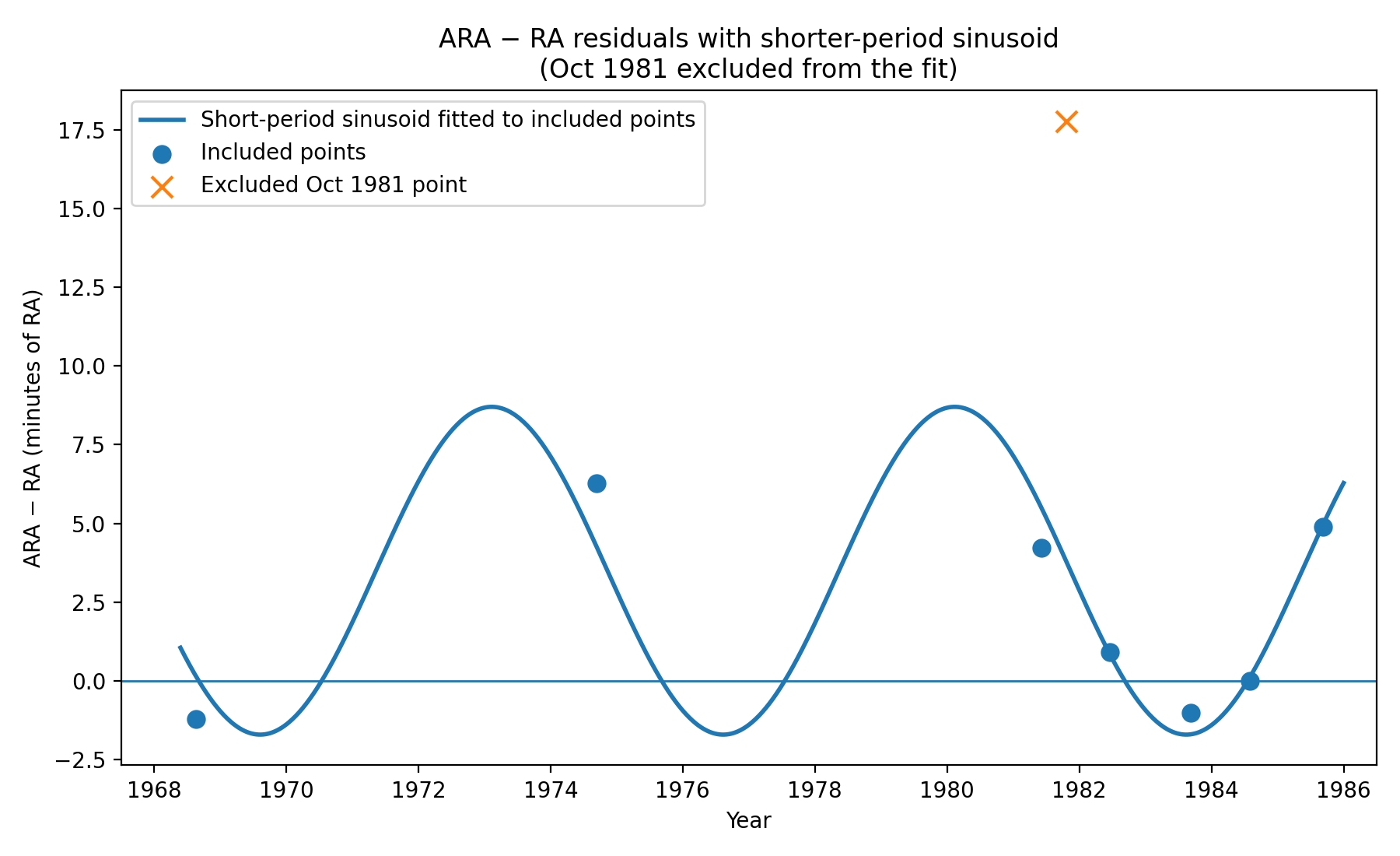
Returning to the anomalies, or ‘deltas’, in the Right Ascension column, these remain without any direct explanation following a concerted analysis. As shown previously, just the one entry, that for 1984, can be shown to have been capable of being derived precisely from simple table lookup, albeit with a 12hr error arising plausibly from the fact that, from 1984 onwards, the daily epoch for the Sun changed from 12h to 0h UT. No pattern for the remaining anomalies arising from any method that can be astronomically accounted for, nor from plausible errors in consulting tables, can be found. The closest I have been able to come is to note that the anomalies seem somewhat to trace out a sinusoidal progression over a roughly seven year period, but still the apparent fit is only approximate and doesn’t have any basis astronomically or astrologically.
“This isn’t right! It’s not even wrong!”—Wolfgang Pauli (1900–1958)
To give a completely invented example: if the result were YELLOK, while the obvious word is YELLOW, I would not simply correct the K and forget about it. The difference K/W might itself be intentional and contain additional information, for example initials.
Ciao, @lendor-77.
This is a useful example, as we can use it to make a comparison with a similar rationale that was applied in my case to demonstrate how the precise 1984 Right Ascension could have been derived from simple table lookup-up if we factor in a plausible and procedurally explicable error of application of the look-up method. The key points in such a comparison, then, are these.
Firstly, this one anomaly in the 1984 RA does not signal intention. Having noted that the actual RA and that of the artefact differed, what led to an attempt to pursue this further was not that it indicated it was somehow “intentional and contain[ed] additional information,” but simply that the time difference for the two RAs turned out to be precisely 12hr. Couple this with the observation that the ephemerides up to 1985 used noon (12h UT) as the daily epoch in the tabulation of RAs, whilst for 1984 onwards this was switched to midnight (0h UT), then we have an easy route towards explaining the anomaly as an error of oversight. But the key point here is that we are not just randomly seeking possible ‘meanings’ hidden in the anomaly. The interpretation is unique, plausible and derives directly from the method employed, not only without intention but without having been noticed.
In your example, we are doing something different. We are observing that what we have approximates to something else, but we have no foundational reason to suppose that there is any connection between the two at all. In turn, we are then applying wholly unconstrained methods of searching for some meaning, such as that the anomaly “might contain initials.” Only, initials could be anything at all, hence my use of the word “unconstrained” here.
Once we get into the realm of looking for possible meaning in senses that don’t have any boundaries to them—in contrast to merely testing anomalies consistent with errors of application of some known method—then we are essentially free to keep going in any direction, and to any extent, until we reach something that we are willing to assign interest to.
And the point is, it’s not that what you find in this way is not there. It is. It’s just that there will always be opportunities for stumbling upon nearly complete words, particularly once you add in full Caesar shifts and anagramming. Unless we have sound evidence to suspect otherwise in any such instance, we should not be expecting meaning in such occurrences.
I’m sure that can sound deflating, lendor, and apologies if it does as that is not my primary intention.
“This isn’t right! It’s not even wrong!”—Wolfgang Pauli (1900–1958)
Couple this with the observation that the ephemerides up to 1985 1983 used noon (12h UT) as the daily epoch in the tabulation of RAs, whilst for 1984 onwards this was switched to midnight (0h UT),…
“This isn’t right! It’s not even wrong!”—Wolfgang Pauli (1900–1958)