
Undoubtedly, given the evidence we have to this point, the compiler was clearly capable of making further errors and slips along the way, and thus we need not be surprised to find the three remaining ‘seconds’ values not precisely matching.
Although I am not in any way proposing that this is the source of the difference seen in the seconds column for 1982, it is worth noting that if we replace the event time of 21:45h UT with a rounded 20:00h UT, then application of our running model will again produce the artefact value, 5h 51m 21s, precisely. However, here we are clearly at risk of merely manipulating our data to produce the results we expect. The fact that the adjusted time falls precisely on 20:00 is, however, of interest.
“This isn’t right! It’s not even wrong!”—Wolfgang Pauli (1900–1958)
What would appear clear to me is that, in contrast to the method of construction deduced so far, the 1983 row requires its own error model. We have shown that the remaining rows can be reconstructed showing clear evidence of extrapolation back from a 1984 lookup result, but 1983 doesn’t fit this pattern.
To try and address this, I shall want to consider the following plausible assumption: that, as well as having access to (having owned) a copy of the ephemeris for 1984, he had also acquired the previous year’s, 1983, through the same route.
I will therefore be wanting to explore whether we can derive a plausible and reconstructable error model starting from a table lookup for 1983 as well. This would appear a worthy pursuit for a number of reasons.
Firstly if, as I have proposed, the author had joined an observatory or school astronomy club briefly in 1984, he would very likely have been able to pick up a surplus ephemeris for the previous year. Secondly, and certainly within the French ephemerides just shown, there was a key change between 1983 and 1984 in that the epoch for solar RAs did indeed switch from using 12h UT to 0h UT. Thus, if the author had consulted a 1983 ephemeris first, we have an identifiable explanation for the 12 hr error when using 1984 subsequently.
There is then, of course, no reason to suppose otherwise than that he chose one of his results only for extrapolation, this being his 1984 result, and so the remainder of the present reconstruction would stand as is.
“This isn’t right! It’s not even wrong!”—Wolfgang Pauli (1900–1958)
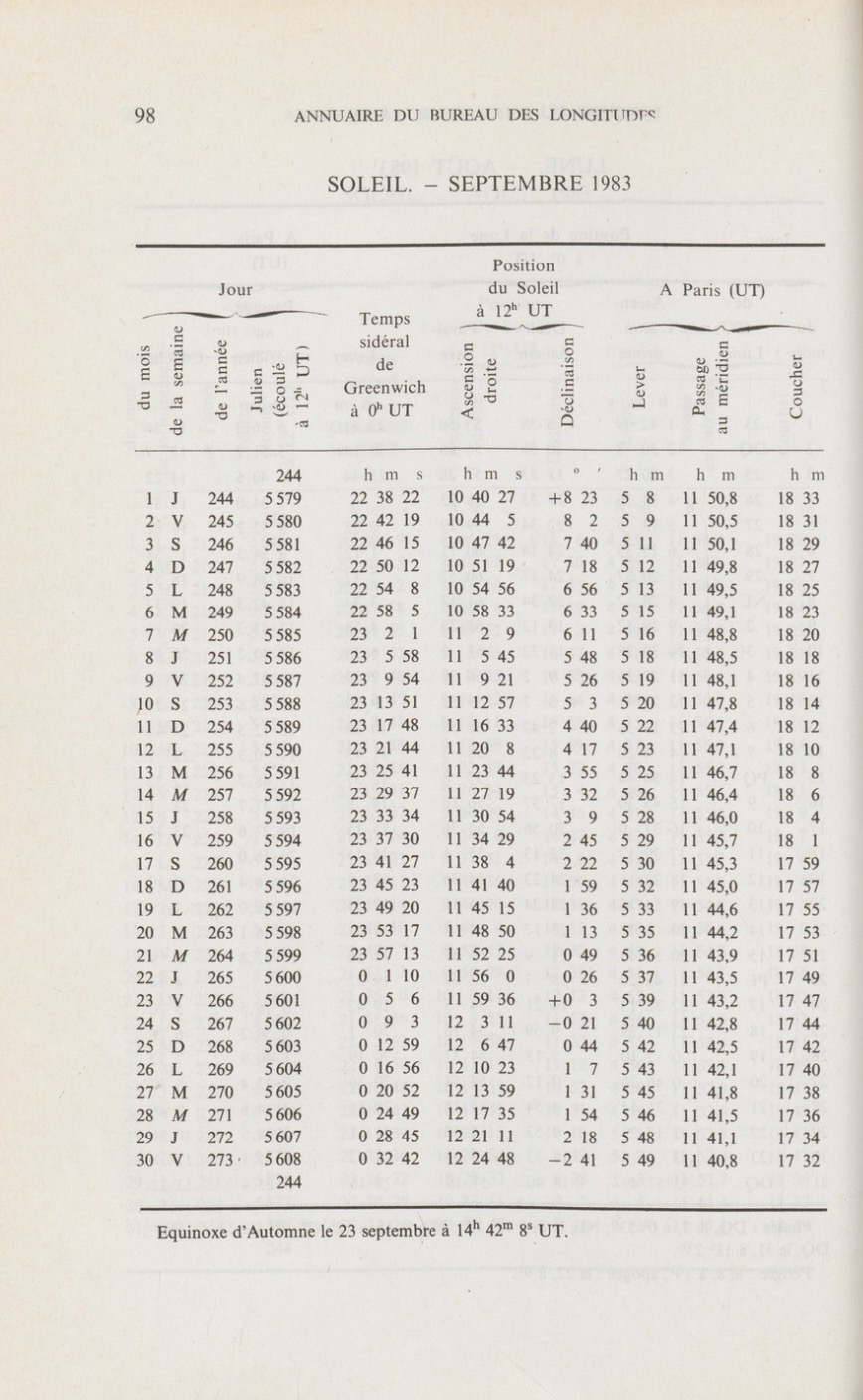
Here is an example ephemeris for 1983, showing solar Right Ascensions for the September.
“This isn’t right! It’s not even wrong!”—Wolfgang Pauli (1900–1958)
The following presents a highly plausible reconstruction of the prominent error occurring in the 1983 row of the artefact table. Although requiring nothing more than basic and comprehensible slips, the reconstruction nonetheless is of a different quality to that already given in that it stands in isolation and thus does not gain any internal support through propagation.
We suppose the author to have started from a simple list of event dates and times, as partially constructed below:
Date         Time (UT)

…

22 Oct  1981 22:45

19 June 1982 21:45

09 Sept 1983 21:30

29 July 1984 19:45

…
and have him misread the time for Sept 1983 from the Oct 1981 row, as 22:45 CEST which, on further conversion, would produce 20:45 UT. The table entries from the 1983 ephemeris would have 11h 09m 21s for 12h UT on 09 Sept and 11h 12m 57s on 10 Sept, the difference being 3m 36s or 216s of daily increase in RA. The difference between 12:00 and 20:45 is 8h 45m or 8.75h and so, for our interpolation, we need to add to the RA for the 9th a quantity equal to:
216s × 8.75 / 24 = 78.75s
or, 1m 19s. This would give us, as our deduced RA 11h 10m 40s. However, suppose our inexperienced compiler, rather than adding this term, subtracted it. This would then have given him:
11h 08m 02s
which, again, is precisely the value given for 1983 in the artefact table.
“This isn’t right! It’s not even wrong!”—Wolfgang Pauli (1900–1958)
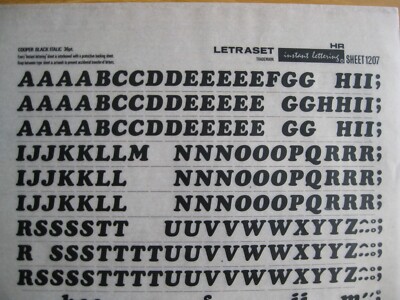
I was looking for transfer sets of the kind that would have been available in the late 1980s. This is a clipping of a used vintage Letraset Cooper Black Italic 36pt set, but I haven’t been able to pin down the precise year. The font appears to match that of the ‘ME’ on the artefact.
“This isn’t right! It’s not even wrong!”—Wolfgang Pauli (1900–1958)
Summary of analysis
It has been shown that, whilst we must of necessity account for a number of clear and explicable errors along the way, we are able to broadly reproduce the values in the left-hand half of the table as solar Right Ascensions corresponding to the event dates and times of the eight murders attributable to the Monster of Florence.
1. 1984 baseline
The method deduced for the construction of this half of the table starts from an ephemeris look-up for the 1984 event, the only one which is open to being derived directly in this way, and proceeds through extrapolation to the remaining rows using a naïve and, again, error prone model.
For the 1984 baseline a periodical ephemeris for this year was consulted. This would be required to be one which publishes the monthly tables of solar Right Ascension (RA) to a 0h UT epoch. It is evident from the result that this was then mistaken for a 12h UT epoch, as is equally commonly encountered, depending upon which precise ephemeris is at hand, thus effectively shifting the deduced RA by 12 hours civil time.
The process of table look-up requires interpolation through simple calculation, which we can express by the following formula which incorporates the 12h epoch error:

T is the time (UT) of the event on 29 July, 1984, taken as 19:45. The two RAs on the right-hand side are those to either side of this event time in the table for July 1984. The result on the left then comes out precisely as in the artefact table as 08h 34m 59s.
“This isn’t right! It’s not even wrong!”—Wolfgang Pauli (1900–1958)
2. Extrapolation to derive RAs for 1974, Oct. 1981 and 1985.
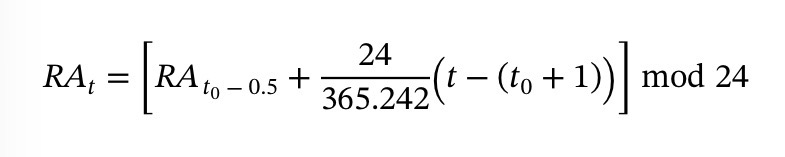
It has been shown that the following linear expression will produce the artefact RAs from the 1984 baseline by extrapolation using a naïve model of the Sun’s motion which assumes that its changes in Right Ascension occur at a constant rate.
I deem this ‘naïve’ precisely for the reason that it doesn’t correspond to any conventional astronomical modelling or approximation method. We can, of course, approximate the Sun’s motion as even along the ecliptic, and this is the origin of the familiar astronomical concept of the ‘mean Sun’. But even this does not result in even motion parallel to the celestial equator, owing to the fact that the two are mutually set at a containing angle equivalent to the tilt of the Earth’s axis.
In this expression, t is the time of the event expressed in days, t_0 that of the 1984 baseline, so that the difference in the outer round brackets corresponds to the interval between the two in units of days. But note that the reconstruction includes an additional +1-day error which we must assume arose from a slip in working out the year day for the baseline date. 365.242 is a reasonable rounding of the length of the Tropical Year, the first RA in the square brackets is that from our baseline lookup. Application of this formula to the event dates/times for the years 1974, Oct. 1981 and 1985 produces the corresponding tabulated artefact RAs to the second.
Note that the +1-day error results in an asymmetrical shift in the RAs deduced from this expression, dependent upon whether the event date/time is before or after the 1984 baseline. For events prior to 1984 (1974, Oct. 1981), the shift corresponds to an increase in time between the event and the baseline by one day, for those after 1984 (1985) the effect is a 1-day reduction of this interval. This is precisely what we see arising for the three corresponding artefact RAs.
“This isn’t right! It’s not even wrong!”—Wolfgang Pauli (1900–1958)
3. Discussion
Despite there being residuals of the order of seconds when this same formula is applied to the events of 1968, June 1981 and 1982, there are features of our reconstruction for the remaining dates (excepting 1983, which remains problematic under any accounting) that indicate that this is not merely a model capable of fitting the four RAs, but one which appears to recover the actual computational logic that generated them. The key points, in this regard, are:
- that the table lookup for 1984 gives the only artefact result that is attainable in this way, albeit with the incorporated error of having applied the wrong epoch (12h UT instead of 0h UT). This is a precise, explicable and common mistake committed in table look-ups;
- that this baseline RA for 1984, including the epoch error, is propagated through the model to give the precise RAs here to the second;
- that the 1-day counting error attributed to the determination of the 1984 year number likewise propagates through our results both precisely, and demonstrating the very asymmetry that we must find for dates pre/post our 1984 baseline;
- that the slope (gradient) of our linear expression is given by 24/365.242 where the numerator merely converts the time difference to hours, and the denominator corresponds precisely to the length of a tropical year.
“This isn’t right! It’s not even wrong!”—Wolfgang Pauli (1900–1958)
4. Residuals
If we were to attempt to extend the method which produces the precise artefact RAs for the 1974, Oct. 1981, 1984 and 1985 rows to the remaining four events then we find that we are left with residuals in the seconds column for 1968, Jun. 1981 and 1982. 1983 does not fit even in the minutes, but then it is in any case clear that there must be something unique (and possibly acknowledged by the compiler) going on here.
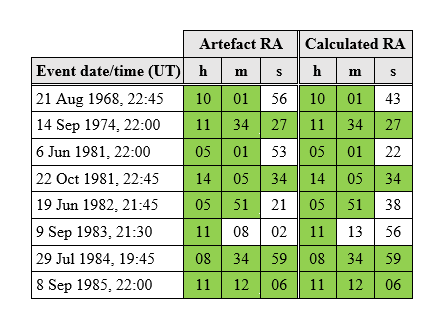
After concerted investigation it is concluded that these residuals cannot be fitted into any single error model applicable to all three at the same time. It can be shown that there is no single alternative baseline RA that would permit generation of these three values identically, nor will any further common day-counting error achieve the same. Likewise, no common erroneous value for the length of the Tropical Year is of help to us here, either. In fact, there remain only two possibilities if we were wanting to propose that the model was intended to be applied consistently to all rows whilst further errors were committed. These are:
- simple copying errors or errors of pressing an incorrect button on a calculator, none of which, even if present, can be incontrovertibly reconstructed;
- errors in deducing the event times for the years that cannot currently fit our model precisely.
The latter, certainly, are the only potentially reconstructible errors that are of the correct order to bring all the artefact rows into line.
“This isn’t right! It’s not even wrong!”—Wolfgang Pauli (1900–1958)
Shifting for a moment to attempting to think like @lendor-77, suppose we consider these three residuals to not be errors at all, but intentional shifts in some way. We could, for instance, propose that the precise match over our first four rows is there precisely to allow us to deduce the method, thus enabling us to produce the corresponding expected seconds values for 1968, Jun. 1981 and 1982 and spot that those in the table don’t match. Suppose further we next determine the actual residuals, as:
56 – 43 = 13
53 – 22 = 31
21 – 38 = –17
Modulo 26, these become:
13
5
9
or, using the familiar A=0 conversion:
M
F
J
with ‘MF’ potentially as ‘Mostro di Firenze’? 🤓🤔
“This isn’t right! It’s not even wrong!”—Wolfgang Pauli (1900–1958)
I deem this ‘naïve’ precisely for the reason that it doesn’t correspond to any conventional astronomical modelling or approximation method. We can, of course, approximate the Sun’s motion as even along the ecliptic, and this is the origin of the familiar astronomical concept of the ‘mean Sun’. But even this does not result in even motion parallel to the celestial equator, owing to the fact that the two are mutually set at a containing angle equivalent to the tilt of the Earth’s axis.
This is, of course, evidence of a gross error on my part!
Uniform motion of the Sun in Right Ascension over the span of a year is, in fact, the very definition of the ‘mean Sun’. Thus, the model as reconstructed here need not be considered as ‘naïve’ as I had suggested it was.
“This isn’t right! It’s not even wrong!”—Wolfgang Pauli (1900–1958)