
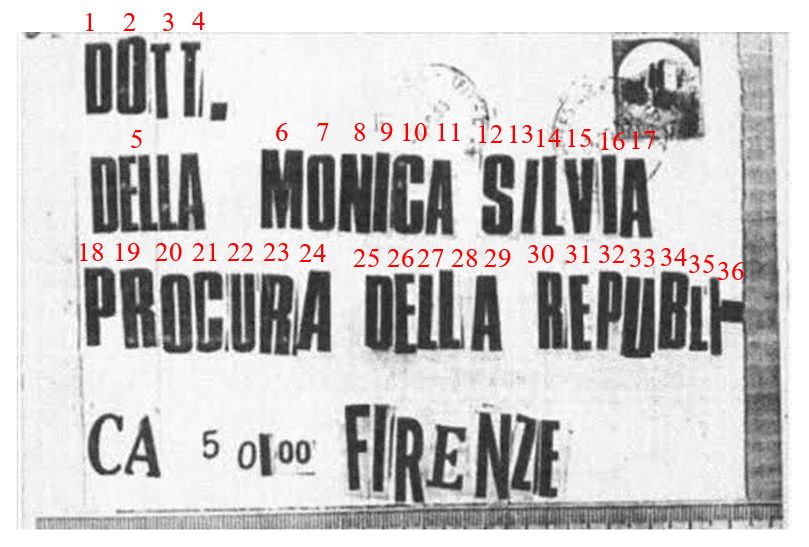
Another interesting detail concerns the word “DELLA”: in the first instance it appears as a single cut-out, while in the second it is composed of individual letters. According to researcher V. Vecchione, this difference may not be accidental.
I would want to go further than Vecchione here and argue that the difference certainly is not accidental.
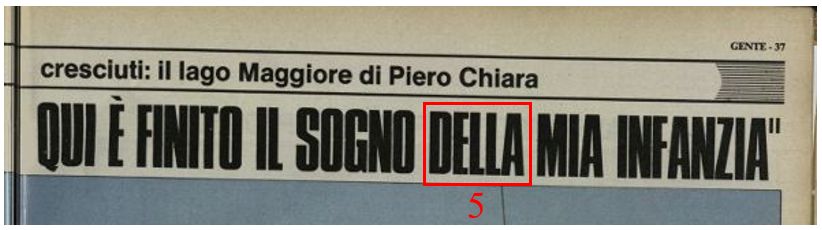
Of all the words required to make up the text on the envelope, only one is found whole in the texts of the various article headings the author had available to him from this edition of Gente. That single word is ‘DELLA’, and it likewise occurs only once there. Hence, what we may discern from this is simply that, where such a whole word was found to be available, the author was happy to use it en bloc.
Thus, he did exactly this for the first occurrence of ‘DELLA’ on the envelope whilst, of necessity, he was then required to separately construct the second instance.
From this simple observation, we have to assume that had one of the headings included, for example ‘PROCURA’, he would have used this as a single block word also.
We have to be careful not to go searching for complex explanations when the most simple and most obvious is totally satisfactory.
“This isn’t right! It’s not even wrong!”—Wolfgang Pauli (1900–1958)

I would need to check the magazine to be certain, but words such as “SILVIA”, “MONICA”, “PROCURA” or “REPUBBLICA” do not appear to be present in full within it, and therefore must have been constructed letter by letter.
As for “DELLA”, however, it appears multiple times as a complete word within the magazine. Yet on the envelope we find two occurrences, but only one has been used as a single cut-out, while the other has been constructed from individual letters.
In my view, this makes a purely availability-based explanation less straightforward. If it were simply a case of “word available → use it directly”, one might expect a more consistent pattern of behavior.
The hypothesis that the first “DELLA” was left intact in order to allow the source magazine to be identified is interesting and consistent with what we observe; however, I admit that it cannot be considered a certain conclusion.
Ciao!
For my point regarding ‘DELLA’ I was working from the understanding that, up until we reach the change of font for the last line, the author was selecting letters solely from the major headings, as those that I extracted in this post. Was I incorrect in this assumption perhaps?
“This isn’t right! It’s not even wrong!”—Wolfgang Pauli (1900–1958)
Per quanto riguarda la mia osservazione su “DELLA”, partivo dal presupposto che, fino al cambio di carattere dell’ultima riga, l’autore avesse selezionato le lettere esclusivamente dai titoli principali, come quelli che ho riportato in questo post. Forse mi sbagliavo in questa supposizione?
No, you’re not mistaken! I also remembered there might be another one, but in fact, within the article headings, it is the only one that appears in full. At most, on page 95, he could have taken “DEL” and “LA” separately and combined them for convenience.
Eccomi!
I tried using Codex to test the randomness of the hypothesis that the letters were cut from selected words, placed into a sort of “virtual container,” and then drawn one by one to compose the text on the envelope.
The reasoning was as follows: the word “DELLA” is likely intentional, since it appears as a complete cut-out and matches exactly the text on the envelope. However, to be cautious, I did not use it as part of the main statistical test and instead treated it as a fixed block.
I then looked at the graph of the letter sequence. In this graph, each letter of the envelope is placed in order along the X-axis, while the Y-axis represents the page from which that letter was taken.
A particular pattern emerges: letters from page 45 and page 57 tend to cluster toward the right-hand side of the text. Specifically, page 45 appears from the central/right portion onward, while page 57 appears even later, roughly from the last third of the sequence.
Based on this observation, we ran 20,000 random simulations of letter selection from the container, keeping “DELLA” fixed as a block. The test asked: how often does a pattern similar to the real one appear purely by chance, namely page 45 concentrated in the central/right portion and page 57 concentrated toward the end?
The result was: 0 occurrences out of 20,000 simulations.
So, the cautious conclusion is that this configuration is not impossible, but within the model used it appears to be very rare, less than 1 in 20,000 cases, i.e. less than 0.005%.
What do you think?
A fine and well-presented study, @lendor-77, and one that certainly deserves careful consideration. I shall take some time to re-read and understand fully the report you produced and then offer my thoughts, for what they may be worth, in a while.
“This isn’t right! It’s not even wrong!”—Wolfgang Pauli (1900–1958)
Grazie!
Firstly, I shall want to confirm whether or not I understand the details of this experiment correctly.
It appears clear, then, that we are only considering the first three lines of text on the envelope at this point. Then, from all the possible sources available, we are choosing only those specific words from which the letters as we have them were actually cut but having available all the letters from each of these words.
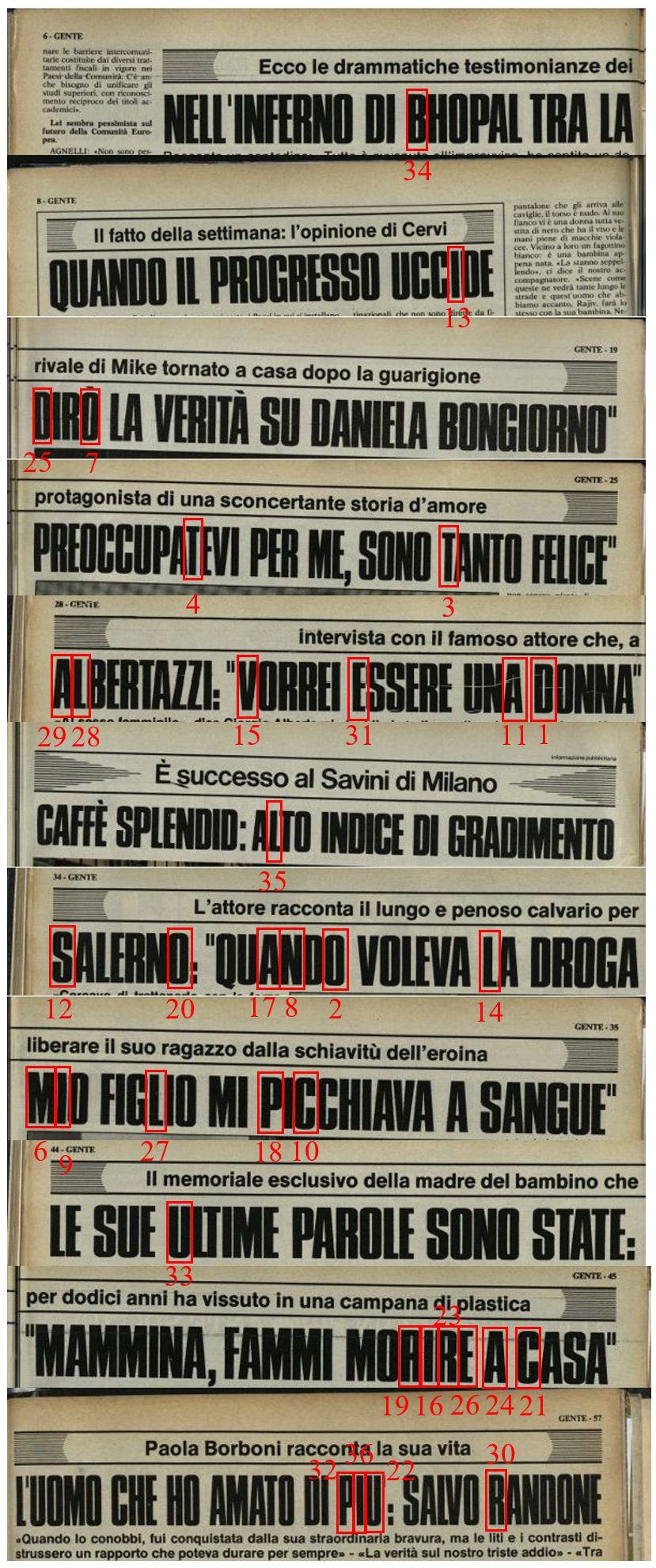
From your earlier post I take these words to be (in order of page number, for convenience only):
- ‘BHOPAL’ (p. 6)
- ‘UCCIDE’ (p. 8)
- ‘DIRO’ (p. 19)
- ‘TANTO’, ‘PREOCCUPATEVI’ (p. 25)
- ‘DONNA’, ‘UNA’, ‘VORREI’, ‘ALBERTAZZI’, ‘ESSERE’ (p. 28)
- ‘ALTO’ (p 31)
- ‘QUANDO’, ‘SALERNO’, ‘LA’ (p. 34)
- ‘MIO’, ‘PICCHIAVA’, ‘FIGLIO’ (p. 35)
- ‘ULTIME’ (p. 44)
- ‘MORIRE’, ‘A’ (p. 45)
- ‘RANDONE’, ‘PIU’ (p. 57)
with the first occurrence of ‘DELLA’ (from p. 37) having been excluded from the randomisation as forming a block.
In the simulation that follows, run 20,000 times, we have (for each run) the letters from only these words placed in a “virtual cylinder” and selected at random until we have completed the text “DOTT [DELLA] MONICA SILVIA PROCURA DELLA REPUBLI.”
After each run, the same letters go back into the cylinder and we try again.
Is this an accurate reading of the experiment, or have I maybe misunderstood any part of it?
“This isn’t right! It’s not even wrong!”—Wolfgang Pauli (1900–1958)
Yes, exactly. Since I needed to define a parameter to evaluate “randomness,” I focused on a visible feature in the graph: the fact that letters from page 45 and page 57 are concentrated on the right-hand side of the sequence, particularly those from page 57.
Starting from this observation, I used this distribution as a potential indicator of intentionality and tested, through simulation, how likely it would be for a similar configuration to emerge purely by chance.
And so, having made the 20,000 draws and collated the results, I imagine we are not surprised to find that a clustering of pages as in the actual selection does not occur, and thus we can fairly conclude that the degree of randomisation built into our experiment is not present in the text of the envelope.
“This isn’t right! It’s not even wrong!”—Wolfgang Pauli (1900–1958)
There is a sense, then, in which this can feel conclusive, as if confirming for us that the selection method used by Il Mostro was not random.
However, we do need to be a little careful here and think about such things as degrees of randomness, as well as randomness in some aspects co-existing alongside choice in others.
To be precise, what our conclusion actually gives us here—and how we should state it formally so as not to claim too much—is confirmation that:
The selection process used by the author in compositing the envelope cannot have exhibited the same (ultimate) degree of randomness as would have been produced had he actually placed his available letters in a rotating cylinder, spinning this after each selection to ensure the contents remained randomised.
“This isn’t right! It’s not even wrong!”—Wolfgang Pauli (1900–1958)
Suppose we try and think for a moment about what a ‘real-world’ randomised selection might actually look like.
As with the example from the study, let us suppose that the author had selected only those words that we have identified above. Sitting at his table, he has those in front of him, and now he is preparing to separate them out into individual letters.
We picture him picking up the words one at a time, cutting them into single letters, and then placing these letters down on the table ready for the construction of his text.
But, how does he place them down on the table?
I’m assuming that he wouldn’t just throw them down (randomly) on the table into one big pile, only then to have to separate them all out again. With considerably more plausibility, I would see him laying them out on the table so as not to overlap and thus, in this way, to retain some of the word-origin of each letter, having been thus laid down in little groups deriving from a common word.
Some of these groups, then, will be near to where he is preparing his envelope on the table, and some will be an arm-stretch away. Just maybe, then, the letters he had cut from page 57 have been set down near the vase of flowers right at the edge of his small table, whilst those from page 45 are more in the middle of them all.
Working away without any particular concern for specific selections, we can still imagine how a process of merely reaching for the nearest available letter could produce a clustering of page 45 around the middle of the text, and page 57 towards the end.
Effectively, even when trying to imagine any completely non-intentional selection process such as this on the author’s part, there is no possibility of removing the human (choice) element from the act entirely, and whatever pattern we find will never come close to ideal randomness, in my view.
“This isn’t right! It’s not even wrong!”—Wolfgang Pauli (1900–1958)
Solely because I personally can reason more easily using visualisations, the following is the envelope labelled according to the use of individual letters across the first three lines, as in your study:
“This isn’t right! It’s not even wrong!”—Wolfgang Pauli (1900–1958)
“This isn’t right! It’s not even wrong!”—Wolfgang Pauli (1900–1958)
“This isn’t right! It’s not even wrong!”—Wolfgang Pauli (1900–1958)