
It is possible to imagine a process in which the author proceeds progressively: while writing the text, he uses the already cut-out letters placed on the table, moving forward in parallel with the construction of the sentence and the selection of words.
However, under this scenario, a point of attention emerges. For example, having already available words such as “PREOCCUPATEVI” (page 25) and “PIU” (page 57), both containing potentially useful letters, one might wonder why, when constructing a word such as “PROCURA”, the author does not use the “U” already available in “PREOCCUPATEVI”, which would be more immediately accessible within the already selected material.
Instead, it seems that the word “PIU” is used, from which all available letters are taken, while from “PREOCCUPATEVI”, despite containing many potentially reusable letters, only a single “T” is actually extracted.
This type of selection raises a question: if the process were truly driven solely by the immediate availability of already cut-out letters, one would expect a more uniform reuse of the available sources. The presence of seemingly less efficient choices might suggest the intervention of additional constraints, or that the selection process was not purely sequential or optimised in real time.
One might hypothesise that the author was a distracted or imprecise individual. However, at the same time, it is evident that he must have been extremely careful, considering that no fingerprints or traces of DNA were left.
This would suggest an environment that was not necessarily sterile, but nonetheless highly controlled and calm. As also noted by researcher V. Vecchione, applying the letters (which are approximately 2–3 cm in height, if I am not mistaken) would have required the use of tweezers or a similar tool.
More generally, I find myself wondering (and I ask you): is it plausible that the author was attracted to words connected to his own inner imagery, such as “PICCHIAVA”, “UCCIDE”, “PREOCCUPATEVI”, or “MORIRE”? These are terms that are certainly striking and far more evocative than others such as “QUANDO”, “LA”, or “DIRO”.
If such an attraction had truly been a guiding criterion in the selection process, one might expect a more pronounced prevalence of evocative words compared to neutral ones. The fact that more common or functional terms also appear instead could suggest that the selection process was not guided exclusively by semantic criteria, or that such criteria were intertwined with practical constraints in the construction of the message.

‘PREOCCUPATEVI’ is indeed an interesting case. He has taken a letter ‘T’ from this already, which will ultimately form the fourth letter added to the envelope. I suppose that we have to assume that he has it clearly in his mind who he is going to send the letter to, and yet he apparently misses—or deliberately avoids noticing—the fact that the word ‘PROCURA’, which he will soon be requiring, can be had in its entirety already from ‘PREOCCUPATEVI PER‘. That said, I cannot help also noticing the following …
“This isn’t right! It’s not even wrong!”—Wolfgang Pauli (1900–1958)
If we ignore for a moment pages 6 and 8, from which only the single letters ‘B’ and ‘I’ are respectively taken and which should initially be considered as outlier pages, either intentionally or otherwise, then we may suppose that the initial process of letter selection started with the next pages in the whole sequence of use. That is, with pages 19 and 25, where we have in fact:
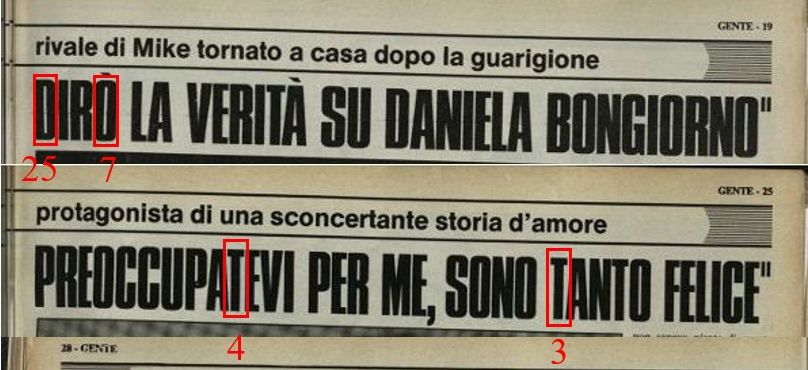
Now, although it is not precisely these cut-outs that the author uses to compose his ‘DOTT’ it does, to me, imply that he started out (at least) with the idea of cutting out just the letters he was going to need.
“This isn’t right! It’s not even wrong!”—Wolfgang Pauli (1900–1958)
Having achieved this small beginning, he then requires ‘DELLA’ and recalls seeing this whole on page 37, to which he now turns. Having set aside pages 19 and 25 to do so, and being distracted from having turned to page 37, he does not return to them and seeks ‘PROCURA’ elsewhere when he eventually comes to it.
“This isn’t right! It’s not even wrong!”—Wolfgang Pauli (1900–1958)
Sorry, but I have to go. What you found is very interesting, and I understand what you said. It is also possible that, later on, he flipped forward through the magazine and cut out “DELLA”.
I have started an analysis with Codex on Latin–English vocabularies regarding the “IUBILAE” discussion… let’s see what comes out of it. Tomorrow I will go further into what you said. Good night!
Buonanotte! 👍
“This isn’t right! It’s not even wrong!”—Wolfgang Pauli (1900–1958)
To my thinking also, from this small beginning—if we, indeed, find this idea continuing in some manner—we might be inclined to propose that he was not pasting the letters to the envelope immediately they were cut, as the first ‘D’ cut out did not become the actual first ‘D’ pasted. Until we find evidence to the contrary, it would therefore seem likely that he was clipping them into a small collection first and, at least initially within this first section, on a per-letter rather than a per-word basis.
“This isn’t right! It’s not even wrong!”—Wolfgang Pauli (1900–1958)
Turning next to pages 34 and 35, which open out side-by-side with each other, we can picture the author cutting out the next word, ‘MONICA’, from what he finds here alone and, again, setting them aside.
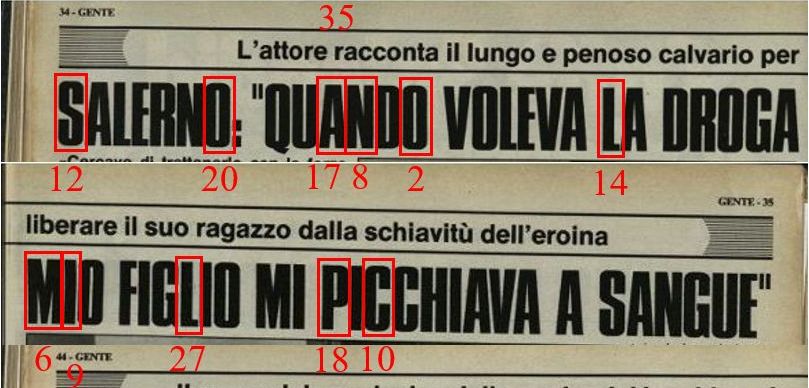
Again, the actual cut-outs used to form ‘MONICA’ on the envelope are not precisely these, whilst all the remainder not used here will be used elsewhere.
SALERNO: “QUANDO VOLEVA LA DROGA MIO FIGLIO MI PICCHIAVA A SANGUE”
“This isn’t right! It’s not even wrong!”—Wolfgang Pauli (1900–1958)
We could, then, continue this idea, if we felt inclined to, although we are likely to get ourselves further off track the further we go.
Being already on p. 34 the author takes the ‘S’ to start ‘SILVIA’ from here. However, there are no ‘I’s to follow this up on this page and, perhaps having the magazine folded over at this page, he does not think to seek such from p. 35 but looks elsewhere. We might suggest that he finds this on p. 45 but is again faced with not having and ‘L’ available here. We imagine him flipping back to notice that, from p. 28, he can cut the ‘L’, ‘V’ and ‘A’, but will still need one more ‘I’. In frustration, he starts flipping again from the beginning and picks up a lone ‘I’ from p. 8.
If even we have followed him closely this far, it may be at this point that he begins to rethink his strategy of cutting single letters in this manner. Perhaps he is feeling the need for greater efficiency at this stage and starts going back to pages he has already visited, perhaps having remembered untouched words that might now be of use to him.
We might suppose he goes back for the ‘P’ he recalls from the already clipped p. 35 but, again, doesn’t have an ‘R’ here. He will, in fact, need two for ‘PROCURA’ and, having the ‘P’ already, finds most of what he needs on p. 45. From here, he clips ‘R’, ‘R’, ‘A’ and ‘C’ and then goes in search of a ‘U’ and an ‘O’, on the possibility that he had carelessly defaced the ‘O’ in ‘MORIRE’ when taking the first ‘R’.
Taking the ‘O’ from ‘QUANDO’ back on p. 34 and, again finding the ‘U’ defaced by clipping the subsequent ‘A’, he is on the search again and pulls a lone ‘U’ from p. 44.
The compositor now needs ‘DELLA’ again, and must now construct it. Turning back to the already used pages 28 and 34, and grabbing an ‘L’ from p. 31 on the way, he completes his mission and turns now to ‘REPUBBLICA’.
We then picture him getting a start on this from p. 57 and 45, from where he gets ‘REPU’ and an ‘I’. But he hasn’t found a ‘B’ (actually two) and an ‘L’ here. So, once again, he flips back to the start and gets a ‘B’ from as early as p. 6, whilst noticing on the way back that he has left a stray ‘L’ back on p. 35.
If any of this mere storytelling is even remotely close to any actual method in practice, I would next propose that he continued finding letters we do not have and began pasting.
“This isn’t right! It’s not even wrong!”—Wolfgang Pauli (1900–1958)

“This isn’t right! It’s not even wrong!”—Wolfgang Pauli (1900–1958)
More generally, I find myself wondering (and I ask you): is it plausible that the author was attracted to words connected to his own inner imagery, such as “PICCHIAVA”, “UCCIDE”, “PREOCCUPATEVI”, or “MORIRE”? These are terms that are certainly striking and far more evocative than others such as “QUANDO”, “LA”, or “DIRO”.
To answer your direct question, I do think that it is plausible that the author may have been attracted in some sense towards words that associate closely with his “own inner imagery.” I think that we can all find ourselves doing this in some degree, in any choice we are faced with making. However, what I would doubt is whether we would be able to decide in a case like this between this “choice by inner association” having been a conscious or an unconscious event.
“This isn’t right! It’s not even wrong!”—Wolfgang Pauli (1900–1958)
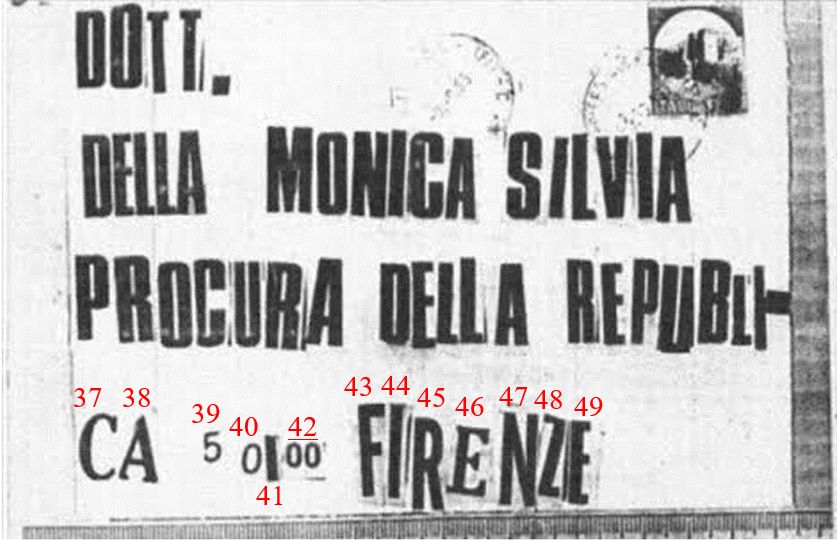
The sources for the last line on the envelope, of course, appear to show something different going on as to selection, with specific points of interest standing out immediately. Continuing the numbering of the image of the envelope as:
“This isn’t right! It’s not even wrong!”—Wolfgang Pauli (1900–1958)

“This isn’t right! It’s not even wrong!”—Wolfgang Pauli (1900–1958)
Perhaps of some note (although signifying what, I can’t be certain) is the fact that, between the first three lines together and the last, there are only two instances in which letters used for the latter are taken from pages of the magazine which had already been cut in forming the first three. And by ‘pages’ here, I am intentionally including the flip sides of any snipped sheets.
As to which letters from the last line, these are the very last two— ‘Z’ and ‘E’. The ‘Z’ comes from p. 37, from which the author had already cut ‘DELLA’ whole. The ‘E’, although coming from a previously unused part-heading, nonetheless is cut from the page facing this, p. 36 which, in turn, is the reverse side of p. 35 which had been raided heavily in constructing the first part of the text.
The sequence of (consecutive) pages involved in this sole overlap are, then, the following:
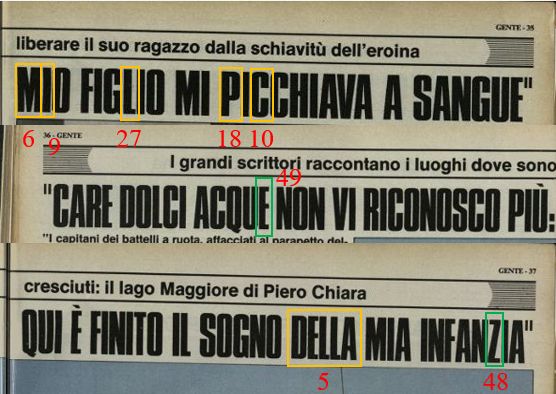
where the orange borders indicate letters used in the first 3 lines, green borders letters cut for the last line specifically.
“This isn’t right! It’s not even wrong!”—Wolfgang Pauli (1900–1958)
Hi! I’m reading what you wrote, this evening I’ll try to put together a few thoughts!