
Finally, the following shows the minimum pre-cuts that the author would have been faced with having found a ‘Z’ (‘INFANZIA’) on the right-hand facing page and requiring a final ‘E’ (taken from ‘ACQUE‘).

In all likelihood, however, the amount of damage to these pages was likely to have been greater. If I understand correctly, Il Mostro used a blade of some sort rather than a pair of scissors to make the final cuts on each letter. However, it does not seem very likely that he would have done so initially, as a blade cut would go through several pages at a time. It would appear more plausible, then, to propose that he cut larger sections firstly, which he later trimmed down with more precision.
“This isn’t right! It’s not even wrong!”—Wolfgang Pauli (1900–1958)
Apologies, I have marked the cuts showing through from p. 35 to 36 incorrectly in the previous figure. It should look like this:

I have also taken this opportunity to mark the locations where the final ‘Z’ and ‘E’ were taken from.
“This isn’t right! It’s not even wrong!”—Wolfgang Pauli (1900–1958)

Hi! Sorry, I can’t manage to finish tonight either. In short, I’m following your line of reasoning to check something—namely, the hypothesis that at the beginning the Monster intended not to mail the envelope, but to have it delivered directly to the prosecutor’s office. Some anonymous letters were delivered this way. In that case, he could have simply written “DR. SILVIA DELLA MONICA, PUBLIC PROSECUTOR’S OFFICE” without forcing that line break. Good night!
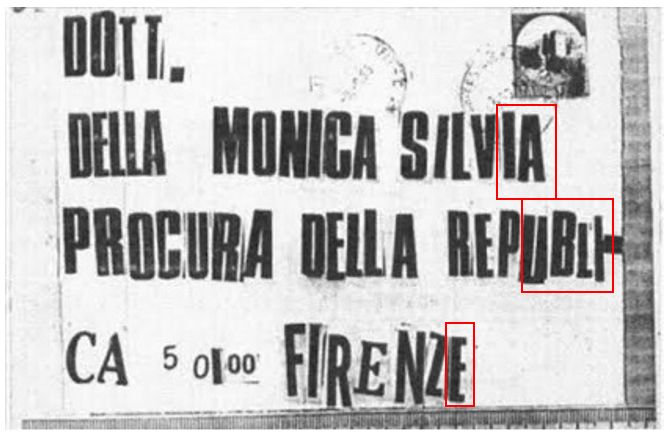
DOTT. DELLA MONICA SILVIA PROCURA DELLA REP.
“This isn’t right! It’s not even wrong!”—Wolfgang Pauli (1900–1958)
That wouldn’t have been possible, had he spelled ‘REPUBBLICA’ correctly!
“This isn’t right! It’s not even wrong!”—Wolfgang Pauli (1900–1958)
Hi! I’m not sure I fully understood what you were asking. I really hope that this evening I’ll be able to explain more clearly what I’m trying to do, starting from your intuition about “DOTT” in the first cut-outs.
In simple terms, I think he may have initially cut out all the letters needed to write “DOTT. DELLA MONICA SILVIA PROCURA DELLA REP.”, trying to use a single, consistent font; perhaps the original idea was to write “FIRENZE” in the same font as well.
He had acquired the magazine well in advance. He probably intended to do something significant, but was still figuring out exactly what. Perhaps he had already, unfortunately, decided what to send, although I’m not completely sure about that.
It is possible that he had cut out everything needed to compose “DOTT. DELLA MONICA SILVIA PROCURA DELLA REP.”, but then, while cutting or simply browsing through the magazine, he came up with the idea of inserting a small cryptographic message such as “IUBILAE”.
Forming “UBL” may have been relatively straightforward, since it appears within “REPUBBLICA”; to do this, he may have deliberately selected letters coming from individual pages that had not yet been used. He omitted the “B”, perhaps to avoid disrupting the structure too much, perhaps due to space constraints, or it could itself be part of a coded element, possibly related to word counting.
However, he needed to insert an “I” at the beginning in order to correctly obtain “IUBILAE” with minimal rearrangement; as a result, he may have taken one of the “I” letters from “SILVIA”, replacing it with one that better suited his purpose.
This is roughly the line of reasoning I’m following.
That wouldn’t have been possible, had he spelled ‘REPUBBLICA’ correctly!
Now I understand what you mean. It could indeed be a clue left to suggest the presence of “IUBILAE”, which would then emerge through the use of the pages.
I probably shouldn’t draw this kind of parallel, but it somewhat reminds me of the Z32 sequence with the Zodiac symbol, “HCEL”, where actual letters from “HERCULES” appear.
I really hope that this evening I’ll be able to explain more clearly what I’m trying to do
And I should stop distracting you by posting my own random observations until you have done that. 😆 🤐
“This isn’t right! It’s not even wrong!”—Wolfgang Pauli (1900–1958)
I really hope that this evening I’ll be able to explain more clearly what I’m trying to do
And I should stop distracting you by posting my own random observations until you have done that. 😆 🤐
No, don’t worry. It’s just that there are so many variables that I risk making a mess of it if I don’t lay things out properly! 😄
For example, now that I think about it, some have noted a peculiarity in the wording “DELLA MONICA SILVIA,” since it would be more natural to write the first name first, i.e. “SILVIA DELLA MONICA.”
Moreover, in other letters (not officially attributed to the Monster, unfortunately) sent to other prosecutors, the first name appears before the surname.
If the Monster intended to suggest the word “IUBILAE,” this inversion of name and surname could find a possible justification.
For example, now that I think about it, some have noted a peculiarity in the wording “DELLA MONICA SILVIA,” since it would be more natural to write the first name first, i.e. “SILVIA DELLA MONICA.”
I was wondering about this also, so thank you for clarifying this point.
Also, I have seen something posted questioning the use of ‘DOTT.’ in addressing a female, and perhaps that the correct form should be something like ‘DOTT.SSA’, if I remember correctly?
“This isn’t right! It’s not even wrong!”—Wolfgang Pauli (1900–1958)
Inoltre, ho visto un post che metteva in dubbio l’uso di “DOTT.” per rivolgersi a una donna, e forse la forma corretta dovrebbe essere qualcosa come “DOTT.SSA”, se non ricordo male?
I don’t remember exactly where I saw it, but Silvia Della Monica herself used to sign simply as “DOTT.”, so I’m not sure what the most correct form would be. I should try to find the source where one of her letters appears with the title “DOTT.”.
For future reference, here is an image taken as a screenshot from the Youtube video Mostro di Firenze – I macabri ritagli, uploaded by Valeria Vecchioni around four years ago. It shows the reverse sides of the letters composing Il Mostro’s letter to Dr. Silvia della Monica, in order:
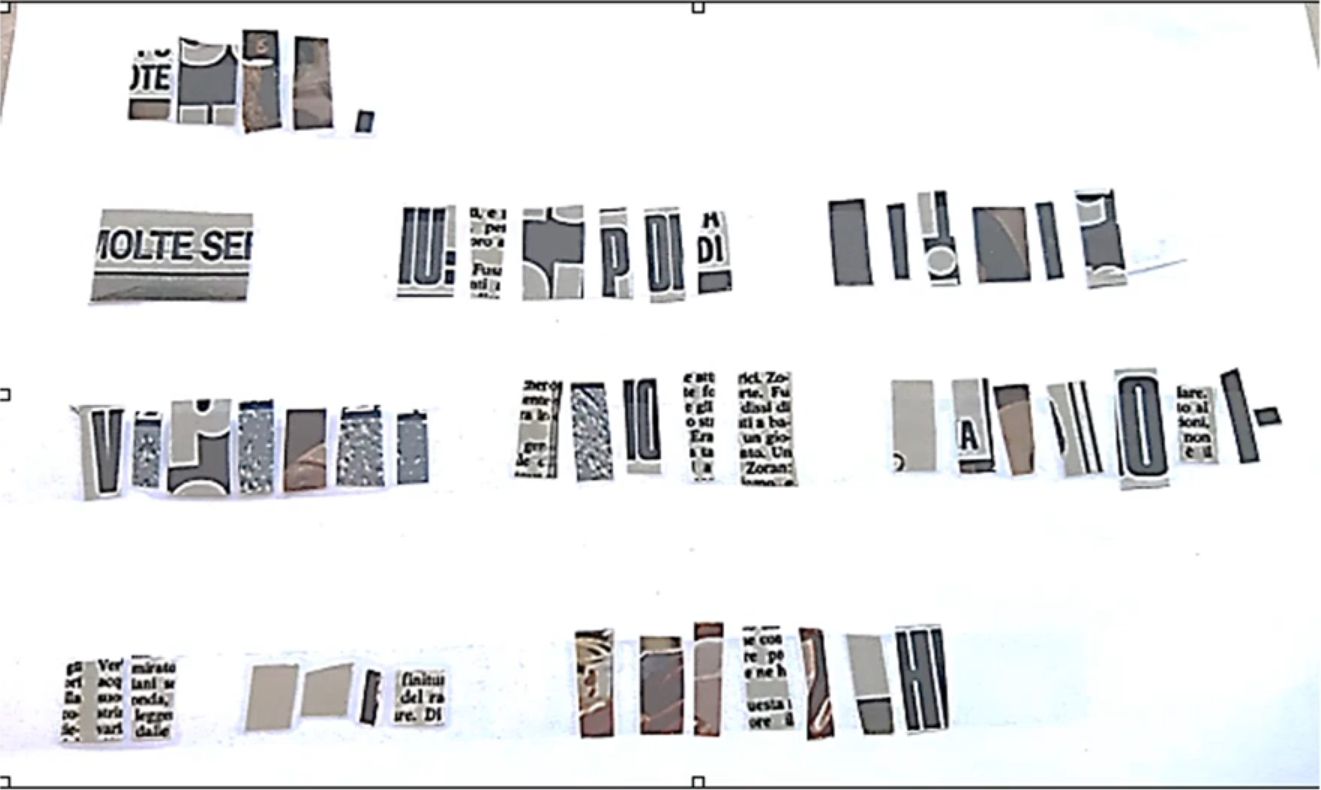
(Please post, anyone, if you have have a clearer version of this image as, perhaps, the actual one that Vecchione is using in her presentation.)
“This isn’t right! It’s not even wrong!”—Wolfgang Pauli (1900–1958)
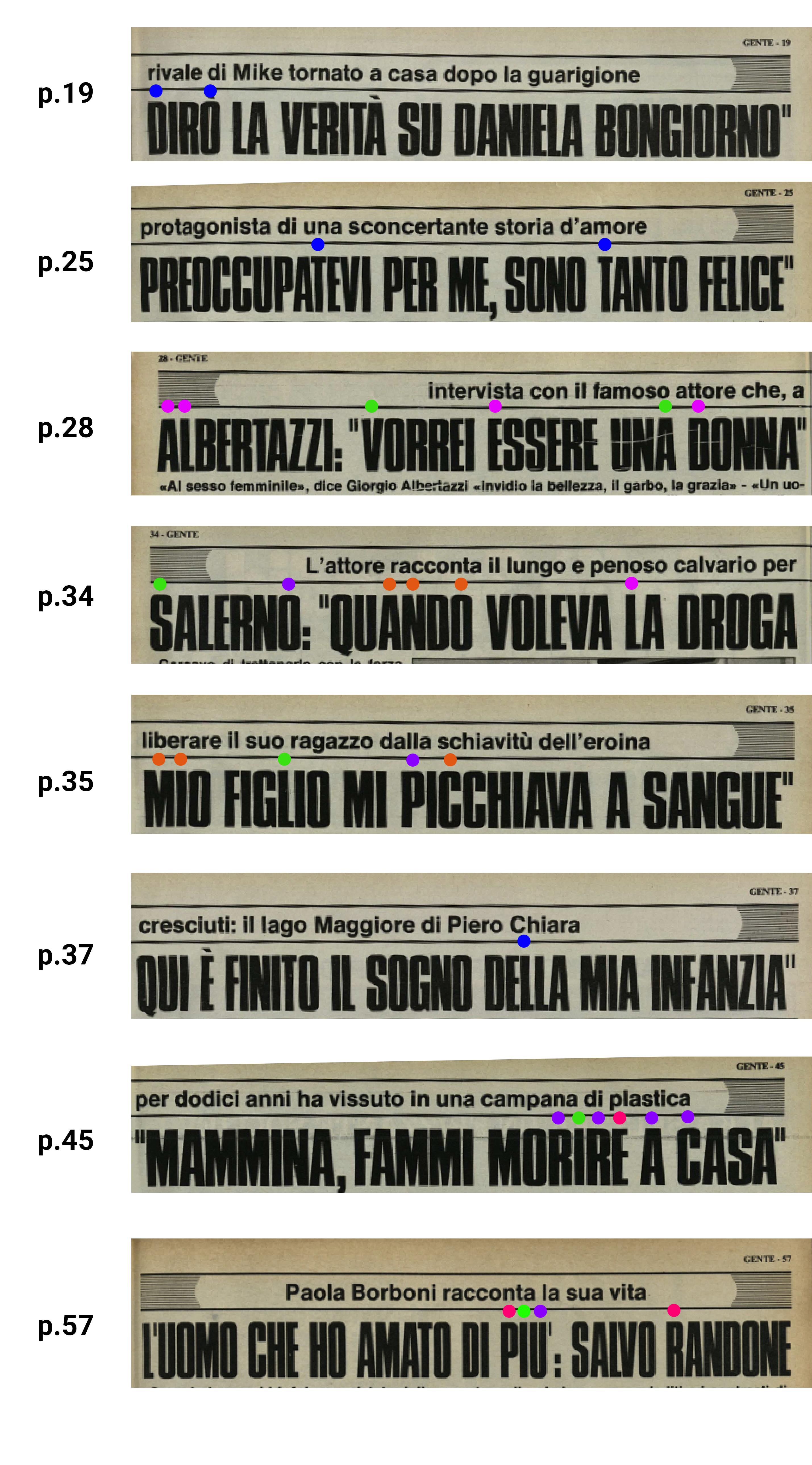
Ciao! I’m sharing this summary with you; as you can see, it’s not that different from yours. However, I tried to approach it from a slightly different starting point, namely that the author may have initially used the letters primarily to construct “DOTT. DELLA MONICA SILVIA PROCURA DELLA REP.”
The idea is that, as mentioned earlier, he may not have had a fully clear objective at the beginning: whether to simply send the letter or to deliver it directly to the prosecutor’s office. He most likely intended to write “FIRENZE” as well, using the same font as the rest of the phrase (“DOTT. DELLA MONICA…” etc.). However, the letters taken from the heading on page 120 appear different from the others, particularly larger, which suggests a later stage or a different choice.
If we also consider the hypothesis of a connection with Zodiac, it is possible that he was drawn to pages such as 36 and 37 because of the references to water and the so-called “water theory.” In this scenario, he may initially have intended to write “FIRENZE” using those pages, but later, while reorganizing the envelope, he discarded part of the letters, leaving only the “Z” and the “E,” even though he could theoretically have formed the entire word.
If we instead limit the analysis to words taken from headings with uniform size, it is still possible to construct “DOTT. DELLA MONICA SILVIA DELLA REP.” I refer to “uniform” headings because, for example, the “L” from “ALTO” appears slightly smaller than the others, something that can also be observed on the envelope.
Another interesting point concerns the working method: the fact that “DOTT” appears arranged differently compared to the final version on the envelope suggests that the author first cut out the letters and only later glued them. This approach would have allowed him to have an overall view before finalizing the composition. In contrast, cutting and pasting one letter at a time would have required many more steps and increased the risk of mistakes.
It is therefore plausible that, during the cutting process, or even just while browsing through the magazine, he began to notice interesting details or patterns, gradually developing the reasoning that led to the envelope as we see it today. In this context, the idea of inserting a small cryptographic message such as “IUBILAE” may also have emerged.