
Turning to the alternative format ‘[numeral]RADIANS’, we find ourselves even more out of luck. Taking any one of the first ten spelled-out numerals in this form, we find that we have for the ciphertext character ‘O‘ one of either ‘R’, ‘A’ or ‘D’, not one of which permits us to follow this format with a further numeral from the same set in our plaintext.
Finally, we do have the option of ‘ELEVENRADIANSNINEINCHES…”, but this again takes us way off the map to the North.
So, basically, if we want to:
- heed the indicated ordering of specifying a Radian (or number of Radians) followed by a distance in inches; and
- have the actual word ‘RADIAN[S]’ appear in the corresponding place in our plaintext,
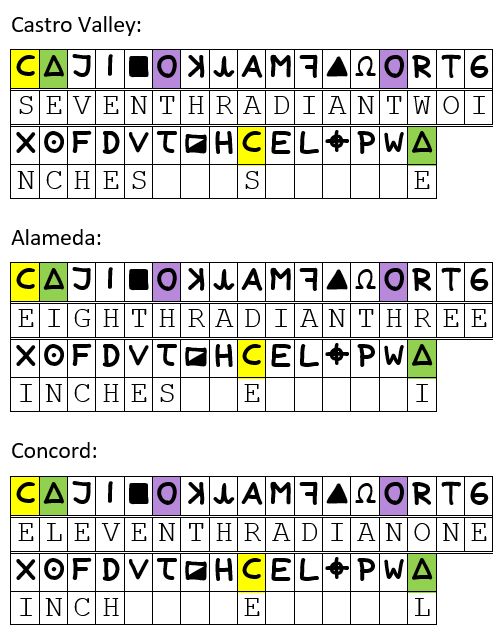
then we are formally limited to one of the following three partial candidates, and no others.
“This isn’t right! It’s not even wrong!”—Wolfgang Pauli (1900–1958)
And for completeness, finally, we should probably also give some passing consideration to:
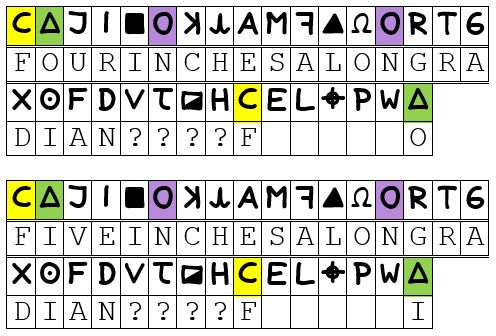
where the missing numeral in the first example is one of ‘FIVE’ or ‘SIX’, in the second, ‘FIVE’, ‘SIX’ or ‘NINE’.
“This isn’t right! It’s not even wrong!”—Wolfgang Pauli (1900–1958)
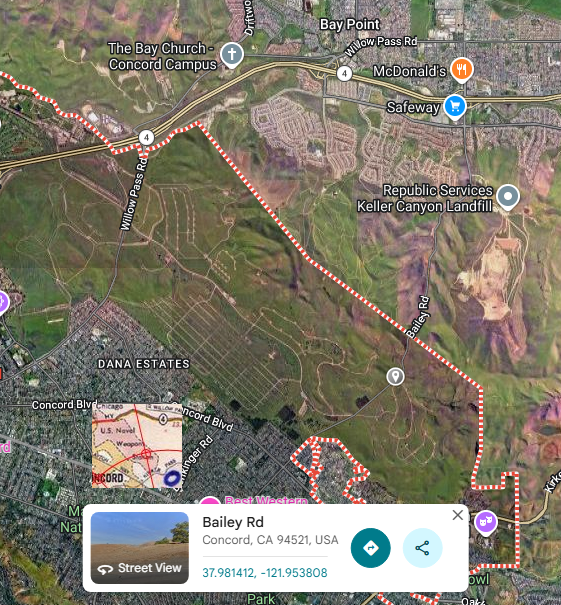
Returning to the third of the remainder candidates having the form ‘[ordinal]RADIAN’, we find that its coordinates bring us within the old US Naval Weapons Station (Inland) upon the middle road of only three roads cutting through the station, namely Bailey Road, the others being Willow Pass Road some way to the North and Kirker Pass Road to the South.
“This isn’t right! It’s not even wrong!”—Wolfgang Pauli (1900–1958)
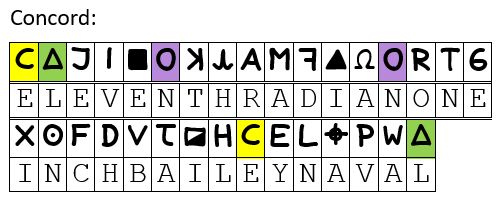
Might we not then at least propose that both the identified road, as well as the specific section, could together be plausibly identified from:
“This isn’t right! It’s not even wrong!”—Wolfgang Pauli (1900–1958)
The second of these three candidates, sighting somewhere in the Castro Valley, can likely be dismissed without further search, as the area identified falls close to the West side of Chabot Lake in unincorporated parkland.
This leaves Alamada, which is perhaps not so easy a task to survey.
Being the furthest from Mount Diablo and being constrained to only the loosest of coordinate specifications, it would have to be imagined that, if intended, these coordinates could be functioning only to identify Alameda Island as a whole, and not any specific location on it. We would further be faced with the task of having to project the island back in time to the 1970s before beginning our survey. In our favour, however, the final ‘I’ is, of itself, quite constraining, if it truly does identify something.
In any event, this is the actual candidate set reduction we have been able to achieve on the supposition that the plaintext starts with either of ‘#THRADIAN’ or, indeed, ‘#RADIANS’. Basically, it comes down to just Concord, and possibly Alameda.
“This isn’t right! It’s not even wrong!”—Wolfgang Pauli (1900–1958)
There is one further possible candidate of the form beginning with an ordinal which was initially missed. This is:
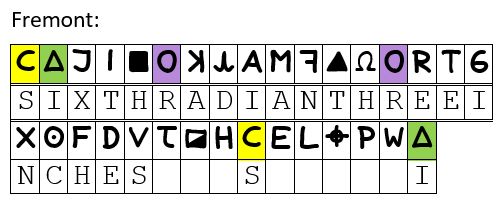
which directs our search over towards Fremont.
“This isn’t right! It’s not even wrong!”—Wolfgang Pauli (1900–1958)
Of the ordinal forms, we are therefore left with three candidates, in or around Concord, Alameda and Fremont.
As to the first, we have been able to readily complete the cipher out to a final location specifier—or simply ‘coda’, as we shall call it going forward—although there is something a little unsatisfactory about adding ‘NAVAL’ at the end. (In contrast to this, ‘BAILEY’ is a good fit and fits the pattern of the ciphertext content getting more precise the more information it adds.) The remaining two, however, both end in an ‘I’ which, in one sense, is certainly going to be more constraining as to what we might be able to propose for our coda.
(Note: the musical symbol for a coda, or “tail” section, is none other than our now familiar ‘𝄌‘ [zodiac symbol] which, it is not implausible to suggest, may have been a fact the author was familiar with. Indeed we have one such symbol placed fourth from the end of the Z32.)
“This isn’t right! It’s not even wrong!”—Wolfgang Pauli (1900–1958)
The following, then, is something I feel is worthy of suggestion, although it is far from being subject to substantiation to any elevated degree.
Suppose that a secondary purpose of having chosen the specific pairing between the second and the final cipher symbols was precisely to give us some help in decoding the final coda section. If we were to think so, then we might look for something that might help us pin down this final character substitution foremost. From the proposed numeral/ordinal beginnings of the plaintext, we can see at the outset that, all else considered, there is a high chance that the letter falling right at the end would be an ‘I’.
And, of course, “I” was a key part of what led the Harden’s to the solution of the Z408, being one of the first symbols decoded according to what they saw as the author’s likely arrogance. This “I” came right at the start of the plaintext of the Z408 and was encoded with ‘Δ’, which is precisely the symbol that we have again here.
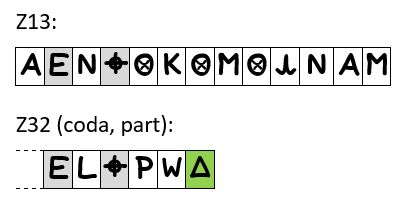
Further, if we take a glance back at the previous (unsolved) Z13, we can notice what might appear to be the occurrence of a part encoding that is mirrored marginally in the Z32 coda and which, in both places, incorporates the zodiac (coda) symbol.
“This isn’t right! It’s not even wrong!”—Wolfgang Pauli (1900–1958)
Not wanting to make too much of this, if there is indeed anything here at all, we might perhaps read into the comparison the suggestion that the 32th plaintext letter of the Z32 and the 30th are to be the same letter, hence ‘I’ in both cases if we are following this idea through.
And when we turn back, again, to the key for the Z408, we do indeed find that ‘P‘ encoded ‘I’ also.
“This isn’t right! It’s not even wrong!”—Wolfgang Pauli (1900–1958)