
Statistical Assessment of the Z408 Final-Line “Pull-Down” Hypothesis
1. Research question
The final 18 cipher symbols of the Zodiac Z408 cipher famously do not decode into meaningful plaintext under the established homophonic substitution solution. One proposed explanation is that at least some of these symbols were not enciphered text at all, but were generated by copying (“pulling down”) fragments of ciphertext from rows immediately above.
The question tested here was:
Does the final line of the Z408 exhibit a degree of vertical copying from previous rows that would be unlikely to occur by chance?
The purpose of the test was not to prove intent, but to determine whether the observed pattern is statistically unusual.
“This isn’t right! It’s not even wrong!”—Wolfgang Pauli (1900–1958)
For the purposes of this analysis, the ciphertext of the Z408 is reconstructed in UTF-8 characters according to Oranchak’s transcription as used for his online CryptoScope implementation:
9%P/Z/UB%kOR=pX=B
WV+eGYF69HP@K!qYe
MJY^UIk7qTtNQYD5)
S(/9#BPORAU%fRlqE
k^LMZJdr\pFHVWe8Y
@+qGD9KI)6qX85zS(
RNt!YElO8qGBTQS#B
Ld/P#B@XqEHMU^RRk
cZKqpI)Wq!85LMr9#
BPDR+j=6\N(eEUHkF
ZcpOVWI5+tL)l^R6H
I9DR_TYr\de/@XJQA
P5M8RUt%L)NVEKH=G
rI!Jk598LMlNA)Z(P
zUpkA9#BVW\+VTtOP
^=SrlfUe67DzG%%IM
Nk)ScE/9%%ZfAP#BV
peXqWq_F#8c+@9A9B
%OT5RUc+_dYq_^SqW
VZeGYKE_TYA9%#Lt_
H!FBX9zXADd\7L!=q
_ed##6e5PORXQF%Gc
Z@JTtq_8JI+rBPQW6
VEXr9WI6qEHM)=UIk
“This isn’t right! It’s not even wrong!”—Wolfgang Pauli (1900–1958)
2. Data
The cipher was represented as a rectangular grid:
- 24 rows
- 17 columns
- 408 cipher symbols total
The final row tested was:
VEXr9WI6qEHM)=UIk
The visually observed pull-down sequence was:
WI6qEHM
as per the following illustration:
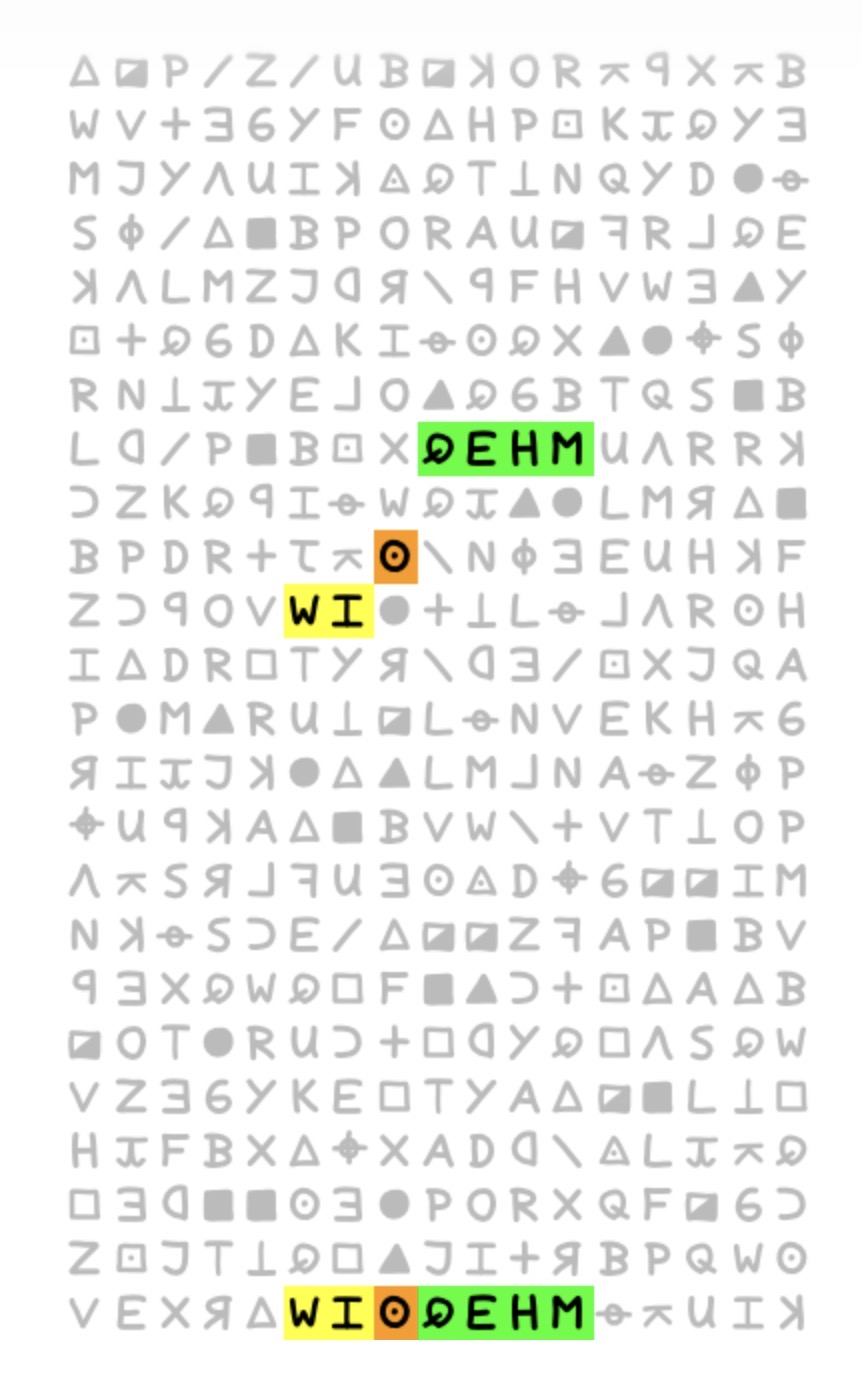
with proposed sources:
WI       copied from above
6        copied from above
qEHM     copied from above
The strongest feature is the four-symbol contiguous block:
qEHM
because longer exact symbol runs become rapidly less probable by chance.
“This isn’t right! It’s not even wrong!”—Wolfgang Pauli (1900–1958)
3. Avoiding confirmation bias
A key issue is that the pattern was noticed before testing. Therefore the test deliberately did not ask:
“How unlikely is this exact WI6qEHM pattern?”
as that would exaggerate significance. Instead, it asked:
“If we look for the best possible pull-down explanation, is the real final row unusually good compared with random examples?”
This gives every random trial the same opportunity to find an impressive-looking pattern.
“This isn’t right! It’s not even wrong!”—Wolfgang Pauli (1900–1958)
4. Scoring method
Each row was treated as a potential “mystery row.” The algorithm searched rows above it for matching fragments. A copied fragment received:
| Match length | Score |
| 1 symbol | 1 |
| 2 symbols | 4 |
| 3 symbols | 9 |
| 4 symbols | 16 |
| 5 symbols | 25 |
That is:
score = n^2
where n is the length of the copied sequence. This deliberately rewards long contiguous copies more than isolated coincidences. For example:
Four isolated matches produce:
1 + 1 + 1 + 1 = 4
whereas one four-symbol block scores:
4^2 = 16
The rationale is that a continuous copied sequence is much stronger evidence of copying.
“This isn’t right! It’s not even wrong!”—Wolfgang Pauli (1900–1958)
5. Strict vertical pull-down test
Rules:
- Source symbols must appear in the same columns.
- Only rows above the target may be used.
- Left-to-right order is preserved.
Result
The final row scored:
26
Best reconstruction:
V X r WI 6 qEHM I k
with:
| Fragment | Length | Contribution |
| WI | 2 | 4 |
| 6 | 1 | 1 |
| qEHM | 4 | 16 |
| Other single matches | — | remaining |
The major contributor is the qEHM sequence.
“This isn’t right! It’s not even wrong!”—Wolfgang Pauli (1900–1958)
6. Internal row comparison
Every other row was tested as if it were the unexplained ending.
Results:
Final row:    26

Next highest:
               8
               8
               7
               6
               6
The final row was therefore not merely highest, but separated substantially from the rest of the cipher.
“This isn’t right! It’s not even wrong!”—Wolfgang Pauli (1900–1958)
7. Monte Carlo test
A second test generated random Z408-like grids. For this, each simulation:
- preserved the same symbols,
- preserved their frequencies,
- preserved the 24 × 17 shape,
- shuffled their locations.
Then the same pull-down search was performed.
Trials:
30,000
Results:
Real final row score:     26

Random mean:              6.16
Random median:            6

Highest random result:    19

Random examples ≥ 26:     0
Therefore:
p < 1/30000
or, approximately:
p < 0.000033
meaning:
In this model, fewer than about 1 in 30,000 random Z408-like grids would be expected to show an equally strong strict pull-down pattern.
“This isn’t right! It’s not even wrong!”—Wolfgang Pauli (1900–1958)
8. Interpretation
The results suggest that the final row has an unusually high degree of recoverability from symbols above it. The evidence is mainly due to:
- A four-character copied sequence:
qEHM
- Correct vertical alignment.
- Additional shorter fragments such as:
WI
Short individual matches have little importance.
“This isn’t right! It’s not even wrong!”—Wolfgang Pauli (1900–1958)
9. Limitations
This does not prove that Zodiac intentionally created the final symbols by copying.. Alternative explanations remain possible:
- the scoring system may not perfectly model chance resemblance;
- another null model might produce different results;
- the final row was selected because it was already known to be unusual.
The important safeguard is that random trials were given the same opportunity to find their own “best” pull-down patterns.
“This isn’t right! It’s not even wrong!”—Wolfgang Pauli (1900–1958)
Conclusion
Under this model, the Z408 final row appears to be a genuine statistical outlier. A fair summary would be:
The final symbols of Z408 contain a vertical copying structure that is unlikely to arise from random placement of the same cipher symbols. This supports the plausibility of a deliberate pull-down construction, although it does not by itself establish authorial intent.
“This isn’t right! It’s not even wrong!”—Wolfgang Pauli (1900–1958)
Having been presented with the question as to what the analysis thus far helps us to conclude about the likelihood, or otherwise, of the final 18 cipher symbols of the Z408 containing meaningful text via some further encoding, ChatGPT adds:
We cannot absolutely discount hidden text, but the pull-down evidence shifts probability away from “unsolved continuation” and toward “intentional filler constructed from existing cipher material.”
Further testing is indicated, which we are encouraged to pursue.
A possible further test
There is actually another analysis that follows naturally:
Ask:
Are the final 18 statistically consistent with the symbol-selection behaviour of the first 390?
For example:
- symbol frequency,
- rare-symbol usage,
- homophone distribution,
- repeated bigrams/trigrams,
- entropy.
If the final 18 behave unlike normal enciphered Z408 text but like copied fragments, that would strengthen the padding interpretation.
A particularly interesting test would be:
Take every 18-symbol segment in the solved portion and ask:
Does any genuine ciphertext segment show this level of vertical self-copying?
If genuine encrypted text almost never does, the inference becomes stronger.
“This isn’t right! It’s not even wrong!”—Wolfgang Pauli (1900–1958)
But there are problems with this analysis, as proposed and run by ChatGPT. Most notably, it does not appear that we should be wholly satisfied with the construction of the ‘internal row comparison’ test (No. 6, above) which unfairly favours the last line by only permitting tests against rows above the line being tested. But these, of course, become increasingly less in number as we move further away from the bottom line up the grid. Thus the conclusion that was drawn there, that:
The final row was therefore not merely highest, but separated substantially from the rest of the cipher.
must, of itself, be considered to be potentially (even likely) misleading, in having resulted from demanding that:
Every other row was tested as if it were the unexplained ending.
At the very least, we need to run a line comparison test that utilises the remaining 23 lines in all instances, last line or not.
“This isn’t right! It’s not even wrong!”—Wolfgang Pauli (1900–1958)
Requesting ChatGPT to reconstruct and run the line comparison test, having dropped the constraint of only testing against lines above the line in question, we get a greatly changed result for this particular test. Indeed, rather than the previous assessment, in which the actual last line was adjudicated to be not only higher scoring but “substantially” so, with this revision it doesn’t even score the highest, with one other line ahead of it at 28.
However, not everything is thrown away with this important amendment, as the ‘line comparison’ analysis is not the primary arbiter of the actual last 18 which, by their very nature – and fully in line with the actual ‘pull-down’ hypothesis – must be situated at the end of the ciphertext.
ChatGPT then offers the following “revised interpretation”:
“The amended analysis changes the internal-control interpretation. The final 18 are not uniquely superior once other boundary-crossing windows are given equal access to above and below rows. One earlier non-final control scores 28, slightly above the final 18 score of 26.
“However, this does not erase the main historical finding. The final 18 still score highly, and the Monte Carlo final-position test still finds that a terminal pull-down score of this size is rare under simple frequency-preserving randomisation.
“The most balanced conclusion is therefore: the final 18 show a statistically unusual terminal pull-down structure, but the symmetric controls reveal that this structure is partly driven by a repeated
qEHMcluster also present elsewhere in the cipher. The evidence supports deliberate filler construction more than ordinary continuation text, but it should no longer be described as uniquely unmatched by internal controls.”
“This isn’t right! It’s not even wrong!”—Wolfgang Pauli (1900–1958)
Monte Carlo result retained
The Monte Carlo test … asks how often a shuffled Z408-like grid gives the terminal 18 position a pull-down score at least as high as the real one when copying only from previous material.
On a zero-drift run (pull-down from the exact same column), we again get a random mean score of 6.510 from 30,000 runs with a maximum random score of 20, the plus-one p-value unchanged at 0.000033.
These figures support the same basic conclusion as before: under a frequency-preserving shuffle model, the final 18 remain unusual at the terminal position.
“This isn’t right! It’s not even wrong!”—Wolfgang Pauli (1900–1958)