
Returning, then, to the original research question, which we posed as:
Does the final line of the Z408 exhibit a degree of vertical copying from previous rows that would be unlikely to occur by chance?
we find, ultimately, that we are required to pull somewhat back from seeking to answer this question positively, having been reduced to determining merely that:
“The final 18 contain a pattern consistent with having been generated by copying previous cipher material.”
or, as it may be alternatively stated:
“Given that the final 18 are already known not to behave like normal ciphertext, their internal copying structure provides a plausible explanation for how they were generated.”
Whether or not we can rest satisfied this result, even if only mildly so, is then the next question.
“This isn’t right! It’s not even wrong!”—Wolfgang Pauli (1900–1958)
“This isn’t right! It’s not even wrong!”—Wolfgang Pauli (1900–1958)
Whether or not we can rest satisfied [with] this result, even if only mildly so, is then the next question.
But, hold on. Have we not just taken our control analysis too far in the reverse direction? Is it really as damning to our original control analysis as stated here?
The problem now is that we have actually introduced an unwarranted ‘circularity’ into the equation.
If the final 18 scores highly because it contains
qEHM, andqEHMis copied from another line, then a symmetric control that allows copying in either direction will naturally tend to give the source line credit for the same relationship. In other words, the symmetric control is partly counting the same pairwise resemblance twice.
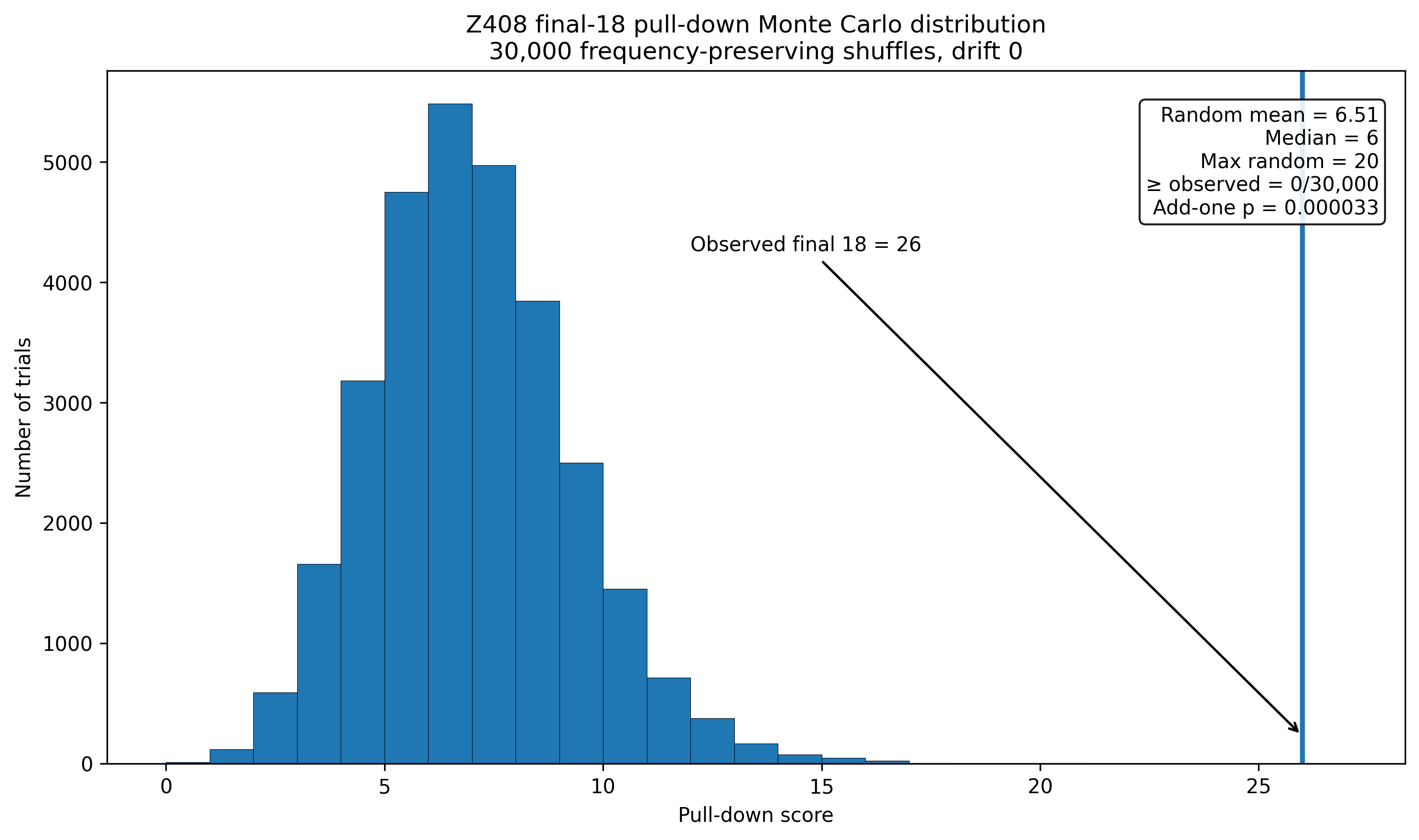
So now we have to eliminate this latter issue, and we can do so by formulating a ‘pairwise analysis’, with the intention of excluding from the results any that are merely mirror-copies of the proposed last 18 clustering anomalies. Running this revised analysis we discover, as we have suspected, that:
The previous “higher” symmetric control was indeed the mirror-image of the final-18 relationship.
Specifically:
Final 18 contains:      qEHM
Source in earlier grid: row 8, col 9

Symmetric control then allowed:
row 8 to copy qEHM back from row 24
So that control was not an independent rival anomaly.
When I excluded the final rows from acting as sources for non-final control windows, the results became:
Final 18 score:       26
Next highest control: 12
Next:                 10
Next:                  9
Next:                  8
So the final 18 returns to being the strongest boundary-crossing window once the circular mirror-copy is removed.
“This isn’t right! It’s not even wrong!”—Wolfgang Pauli (1900–1958)
As a final analytic exercise, we ask ChatGPT to shift away from basic significance testing into the specifics of model comparison, forming a series of ‘likelihood ratios’ against selected explicit generative continuation models.
The report is attached below, from which the conclusion reached is that:
Under explicit same-column filler models, the observed final-18 pull-down structure is substantially more likely than under the tested ordinary continuation models. Depending on the continuation baseline, the estimated likelihood ratio ranges from roughly tens-to-one to thousands-to-one. This supports deliberate or semi-deliberate filler construction over ordinary continuation text, while remaining dependent on the assumptions of the generative models and without proving authorial intent.
“This isn’t right! It’s not even wrong!”—Wolfgang Pauli (1900–1958)