Shift 0: EBORITMHP
…
Shift 3: HERULWPKS
You will have noticed this one, I am sure. Here we have six out of nine letters corresponding to your Z32 solution and, this time, in precisely the expected order and starting with the ‘HER’ from the Z340. But again, the question is “what of it?” When the interpretation of significance is not bound to any foundational criteria, we are free to say we have found it in what ever place we like. Shift 3. and 16. are intimately bound to each other and can’t have significance independently. Yet they both appear to, only on different accounts. The great likelihood is that both are irrelevant, but one of them clearly is, with certainty.
“This isn’t right! It’s not even wrong!”—Wolfgang Pauli (1900–1958)

Shaq, I’m a bit overloaded with work these days, so sorry if I can’t reply straight away. I’ll get back to you soon, actually very soon, because I want to properly address the points you raised, as well as the solution involving the numerical triplets, which I still have to post.
And anyway, you really don’t need to apologize. Quite the opposite, I’m the one who should thank you for putting what I find “under stress.” That’s exactly how it should be.
Unfortunately, almost nobody really does that: either because they’re not very familiar with cryptography, or because as soon as they see formulas, transformations, or several steps, everything starts to look much more complicated than it actually is. In reality, most of the time the calculations themselves are pretty basic.
Thanks!
I’ve got a busy work schedule coming up after a bit of a break, so I know how that is.
Thinking more generally, I would say that the important first step when faced with ‘errors’ is always to investigate whether and how it is possible to account for them plausibly as errors. And there are quite a number of them. In simple terms, all of the eight Right Ascensions are in error by some amount. However, the error in the 1984 row is explicable with a simple and likely misreading of the relevant ephemeris. This we can directly trace to the fact that there was a change of epoch for the Sun tables precisely from 1983 into 1984, and so we can fairly accept that this is what is going on here.
As noted, it is clear that the matrix of signs was constructed independently of the RAs. Nonetheless, we have two errors here also, the ones you have focussed on. However, they are not of the same nature and the first, again, can be readily accounted for through a slip during table lookup. The second is real and, again, I cannot place how it occurred. Importantly, though, this is the very one that the author himself singled out through drawing a box around the erroneous lunar sign and underlining the associated RA. Thus this must clearly show that, as to the author’s awareness, there is only one outstanding anomaly, with something of relevance going on with only this one line, that for 1983.
Of course, even then it would be possible to suggest that the highlight is just the author’s way of saying “I can see I made a mistake here,” whilst avoiding messing the whole thing up or starting again.
However it might be, I would argue we have a duty to ensure that we have made every effort to first see if we can explain apparent anomalies as errors, and to undertake this comprehensively before we get anywhere near suggesting that such anomalies are intentional and somehow conveying hidden meaning.
This last point is especially important when working with an isolated communication from an unknown author in respect of whom we have no indication that they are inclined towards cryptic communication.
“This isn’t right! It’s not even wrong!”—Wolfgang Pauli (1900–1958)
The Sun’s motion in Right Ascension over the course of a year is not regular, and this is for two primary reasons. The first is that the Sun moves along the ecliptic in the heavens, while RA is measured along the celestial equator, the projection of the Earth’s equator into the sky. The second is that the Sun’s motion is not a real motion of the Sun, but arises from the fact of the Earth revolving around the Sun and giving us different lines of sight to it through any given year. However, the Earth neither moves on a simple circle around the Sun, rather on an ellipse, and does so at changing speeds.
To continue testing potential sources of the errors seen in the tabulated RAs, it is worth considering whether the author, in fact, understood anything of the points just made about the Sun’s apparent motion.
There are two ways to determine the RA for the Sun at any given time. On the one hand you can perform a relatively straightforward table look-up using published and readily-available ephemerides. We have seen that this method is strongly evidenced as having been used by the author for the 1984 entry, albeit with one clumsy error of 12 hours precisely through assumption of the wrong daily epoch. None of the remaining erroneous RAs appear to have been produced in the same way.
The second method of determining RAs is through direct calculation, which is readily achievable for an expert astronomer but is somewhat over-complex for someone without the specialist knowledge.
So, what if we try the supposition that the author did try to calculate the remaining RAs, deriving them from the one looked-up result for 1984 as an available baseline, whilst not understanding the fundamentals of the Sun’s motion as we have just described?
We can test this idea first with the 1985 entry, which is the one that comes just after the 1984 line in the table.
“This isn’t right! It’s not even wrong!”—Wolfgang Pauli (1900–1958)
Let us start from the 1984 RA of 8h 34m 59s, which was determined for an event time around 29 July 1984 at 19:45 UT. The 1985 murder occurred somewhat over a year later on 07 September around 22:00 UT. This difference in time amounts to 405.09375 days.
Now, if we naively ignore the irregularities in the Sun’s apparent motion we would assume it moved regularly in increasing RA through 24 hours in one tropical year of 365.2422 days, or 3m 56.555s of RA per day. Doing the math, we then get for the increase in RA from our 1984 event to the later one in 1985 a value of 2h 37m 07.098s, having deducted the one full 24hr cycle.
If, then, we add this to the RA determined for 1984, we get:
11h 12m 06s
which is precisely the RA given in the table for 1985.
“This isn’t right! It’s not even wrong!”—Wolfgang Pauli (1900–1958)
At this point, without feeling any need to push on and provide a complete analysis of every single error and indication of misunderstanding on the part of the compiler of the Vagheggi astrological table, I am content to offer the following summary from my investigation as to what it is we have here and how it was constructed.
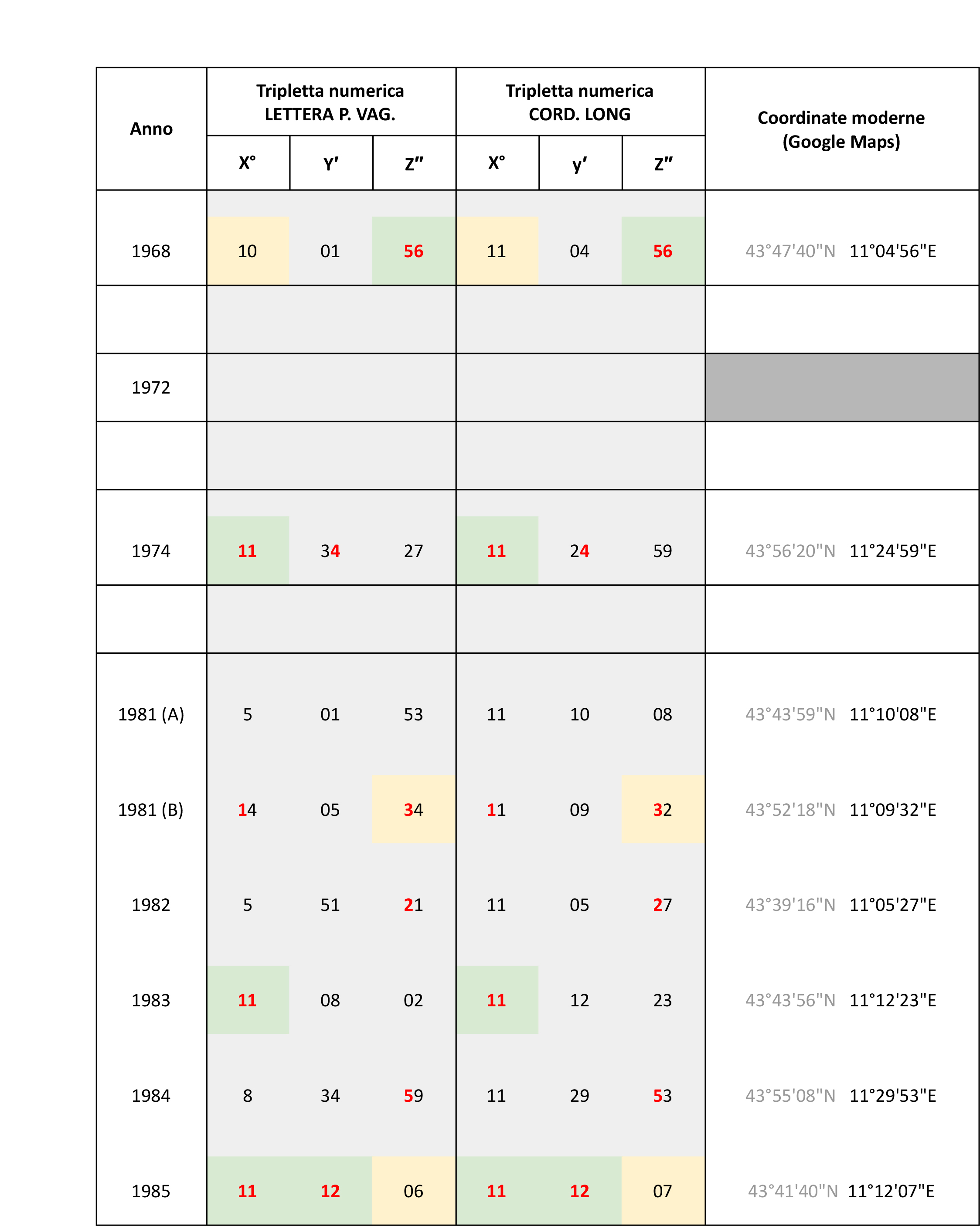
Its purpose is quite clear in that it is intended to present certain astronomical arrangements corresponding to the times of the eight canonical murders attributed to the Monster of Florence—these are the Right Ascensions of the Sun, together with the zodiac signs occupied by the first five ‘planets’ at the time—and add a single future prediction. As to its production, close inspection identifies that, whilst the zodiac signs were added in a very neat hand, the years and the right ascensions having been added using a stencil, the ‘ME’ that we see appended appears to be by transfer or stickers.
The table is rife with errors, but these are of a nature that we can, with time and effort, reconstruct back to the realisation that the compiler, although someone with an astrological interest, has effectively no understanding of the intricacies of the celestial sphere nor of the motions of the Sun. Where we see accuracy (or near accuracy) in the table entries, these can be found to have been obtained by table lookup using readily available ephemerides, but even here identifiable slips creep in. We have one lookup for the 1984 RA, whilst the remainder are produced through application on the basis of some wholly naive and erroneous model of the Sun’s motion.
The calculations required are straightforward, and common personal calculators of the period were available which would handle sexagesimal (base 60) conversions directly.
Taking all this one step beyond the evidence, I would have no problem proposing the table as having been produced by someone of late school age, educated but having only an interest in astrology and astronomy but no understanding yet of the latter specialism, born in May of 1972, the third row being their horoscope.
“This isn’t right! It’s not even wrong!”—Wolfgang Pauli (1900–1958)
“This isn’t right! It’s not even wrong!”—Wolfgang Pauli (1900–1958)
Ciao @lendor-77.
I will apologise once more, as I am producing more for you to read at a time when you are already busy with other things.
I do feel that it is important, at this point, to address one key difference of opinion head on, and this is precisely the following question:
Does the left-hand column of the Vagheggi table record ‘solar Right Ascensions’ or ‘sidereal times’?
Under my analysis, I have identified the column values as being RAs. This is not, however, the common interpretation, and many (if not most) proposals put forward take them to be sidereal times.
But how can this be? It would seem logical that they must be the one or the other, and yet both camps can seem to find some or other mode of analysis that fits their preferred interpretation.
In reality, although RA and Sidereal Time are not at all the same thing they are, however, intimately related. At any given place, the current sidereal time is given as the RA of any point on the celestial sphere just then crossing the meridian. The Sun, of course, crosses the meridian at precisely local apparent noon so, at local apparent noon, the RA of the Sun and the current sidereal time are the same. However, as the day progresses the Sun’s RA advances only marginally, through an amount that is just less than 4 arcminutes per day—a relatively small fraction of 1°—whereas sidereal time increases at a rate of nearly a full 24 hours (~360°) per day.
Now, since the RAs and sidereal times of the Sun at local noon are broadly coming together, it is immediately evident that if we take the Sun all the way back to midnight then we will get a discrepancy between the RA and the sidereal time corresponding to the midnight of very close to 12 hours. And it is precisely this that accounts for the fact that those who are inclined to interpret the first column as sidereal times find that they have to introduce a 12 hour adjustment to the values as given, even to get close, proposing a wholly non-standard use of English a.m./p.m. time formats for sidereal times. This never is done.
On top of this, because the event times of the murders fall somewhere into the late evening approaching midnight, it is solely for this reason that the midnight sidereal times, such as may be read directly from astrological ephemerides, fall somewhere in the region of the solar Right Ascension at the precise event times when artificially reduced by the said 12 hours. It is thus in this way, and for this reason alone, that the sidereal time interpretation is even remotely coherent.
And we have to acknowledge that the sidereal times that are shown to be given in a leading column of the various ephemerides available at the time the table was constructed are giving the sidereal time of solar transit on the Greenwich Meridian specifically. Florence, however, is 1 hour off of this meridian, so we would have to then question, at the very least, why the times of solar transit for a different longitude are being considered as relevant to events happening in Florence.
We have seen above that, given the inclusion of an identified error, we can reconstruct the RA of the Sun for 1984 precisely, to the second. Likewise from this, but now in a manner demonstrating a genuine lack of understanding of the celestial sphere, we can then reconstruct the RA for 1985, again precisely to the second. There is no need to explain away approximate correspondences with sidereal time, such as we can expect to be there (see above), by introducing “intention changes.”
We cannot reconstruct the same precision using sidereal time.
“This isn’t right! It’s not even wrong!”—Wolfgang Pauli (1900–1958)
However, as the day progresses the Sun’s RA advances only marginally, through an amount that is just less than 4 arcminutes per day—a relatively small fraction of 1°—whereas sidereal time increases at a rate of nearly a full 24 hours (~360°) per day.
This needs correcting, of course. The advance in RA corresponds to just short of “4 minutes” per day, not “arcminutes,” an equivalent physical change in the Sun’s position of just a little less that 1 degree.
“This isn’t right! It’s not even wrong!”—Wolfgang Pauli (1900–1958)
We can run a couple more quick calculations to confirm that, albeit accompanied by yet further errors, the author of the Vagheggi table was indeed forming Right Ascensions in the first column, using the looked-up RA for 1984 as a baseline and then extrapolating from here by applying an erroneous model of the Sun’s motion as increasing uniformly in Right Ascension. For these, we will be taking the attack on 14 September 1974 as having occurred at “around midnight” CEST, or 22:00 hrs UT and that on 22 October 1981 as “between 23:00 and midnight,” choosing 23:45 CEST as simplifying the calculation of the time difference from 21:45 CEST for the baseline event on 29 July 1984.
Calculating the time interval between the 1974 event and the baseline event in 1984, we get 3605.90625 days, or 3605.9 days close enough. This equates to a difference in RA between this and the 1984 event of:
3605.9 × 86400 / 365.242 = 852995.439s of RA
which, modulo 86400s (24h), is 75,395.439s or 20h 56m 35.439s.
Subtracting this from the fixed 1984 anchor RA of 08h 34m 59s then gives 11h 38m 23.561s.
So, this is not equal to the 11h 34m 27s given for the RA of the Sun for the 1974 event. It is out by an amount of 3m 56.561s of RA.
Now, this difference is almost precisely one mean day’s RA increment under our uniform increment model. Therefore it is worth proposing, and testing, that the author here made an error of 1 day in counting back the time interval from the 1984 event to (likely) the beginning of that year, carrying the error through his calculation.
If, then, we go back and recalculate as:
3606.9 × 86400 / 365.242 = 853231.994s of RA
or 75,631.994s from modulo 86400. That is, 21h 00m 32s.
If, now, we subtract this from our fixed 1984 anchor RA, we get:
11h 34m 27s
precisely.
“This isn’t right! It’s not even wrong!”—Wolfgang Pauli (1900–1958)
We can next perform the same calculation for October 1981 and, here, we shall assume at the outset that the same counting error of one whole extra day in 1984 is perpetuated through this calculation also, just so that we don’t have to do things twice.
For 22:45 UT on 22 October 1981 we get, as the time difference between this and 19:45 UT on 29 July 1984, 1010.875 days which, on adding the extra day as previously, gives 1011.875 days. This corresponds to a change in RA of 239364.586s which, modulo 86400 is 66564.586s or 18h 29m 24.586s. Subtracting this from the RA derived by table lookup for 1984, we then get (rounded):
14h 05m 34s
precisely.
“This isn’t right! It’s not even wrong!”—Wolfgang Pauli (1900–1958)
Of the remaining four table rows (1968, June 1981, 1982 and 1983), on direct application of the same erroneous method of taking Right Ascension as exhibiting a constant rate of change, coupled with the consistent addition of a one-day slip in counting back to the beginning of 1984, the first three of these again fall within around 30s or less of the artefact RA. All differences from what the model would predict are occurring in the seconds column.
1983, however, does not fit this model at all, and the difference in RA between what it would produce and the actual artefact RA remains a significant –5m 53.7s out. So, even in the context of the author’s erroneous method, they would themselves have been able to identify, and mark, this one row as “in error.”
“This isn’t right! It’s not even wrong!”—Wolfgang Pauli (1900–1958)
I find the reconstruction based on the Sun’s Right Ascension very interesting, especially because the proposed model reproduces several of the table values remarkably well and leaves 1983 as the only major anomaly, precisely the row that the compiler himself highlighted.
That said, I have one logical and practical objection. If the compiler knew what Right Ascension was, knew how to consult an ephemeris, and was able to derive the 1984 value from a table, why would he then choose not to do the same for the other years? In other words, why read a precise tabulated value for 1984 and then reconstruct 1968, 1974, 1981, 1982 and 1983 through an approximate model which is, moreover, astronomically incorrect?
This seems even more relevant because, in order to construct the matrix of zodiac signs, the compiler must in any case have consulted ephemerides covering the other years and dates. If he already had the relevant tables in front of him, it is not immediately intuitive why he would ignore values that could simply be read directly and instead calculate thousands of days backwards from 1984.
Of course, this does not make the proposed reconstruction impossible. It may be that the compiler was using two different sources, for example, a multi-decade astrological ephemeris for the zodiac signs, and a separate astronomical table, perhaps limited to 1984, from which he obtained the Right Ascension for that year. In that case, extrapolating the remaining RAs by calculation would make considerably more sense.
For this reason, I think the decisive check is to identify exactly which ephemeris or publication is supposed to yield the value 08h 34m 59s for 1984. If that same publication also contains the corresponding data for 1968 to 1983, then the objection becomes much stronger: it would be difficult to explain why the compiler chose to calculate approximate values when he could simply have read them directly. If, on the other hand, the identified source really is limited to 1984, or otherwise does not provide the earlier years, then the extrapolation hypothesis becomes substantially more plausible.
I would add one further point. The reconstruction seems to require a compiler who was knowledgeable enough to understand what Right Ascension is, work in hours, minutes and seconds, use a tropical year, perform sexagesimal calculations and reduce values modulo 24 hours, yet at the same time inexperienced enough to assume that the Sun’s RA increases uniformly. That is certainly possible, but I think the profile should perhaps be described more carefully: rather than someone with virtually no understanding of astronomy, it would seem more like someone with partial knowledge and a conceptually incorrect, but by no means trivial, model of solar motion.